Photo credit: AI-generated image created using ChatGPT. Illustrative only
Out on the Texas City Dike, the kind of place where honest folks go to soak a line and catch a few for the table, Texas Game Wardens ran into something a whole lot different. A concerned citizen called in suspicious activity during the early morning hours, and wardens decided this one was worth doing the hard way.
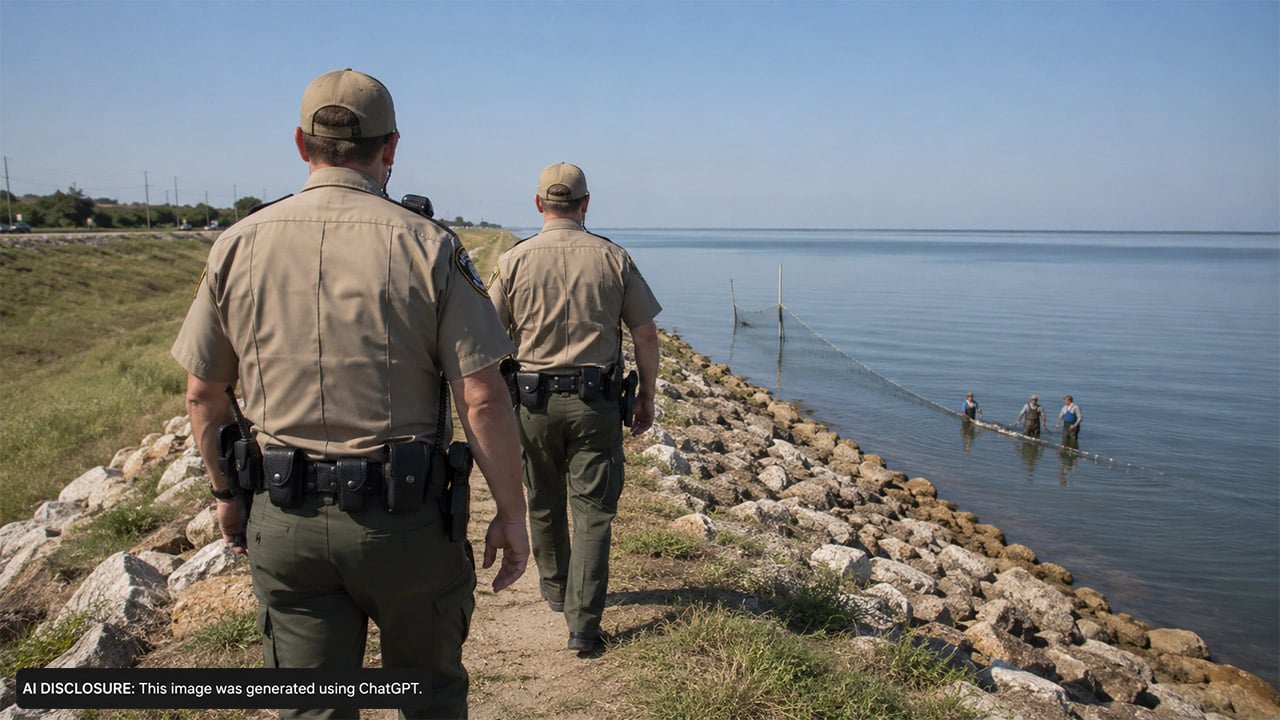
Instead of rolling up and blowing the scene, they hiked more than a mile and tucked into a concealed position to watch. What they documented next, detailed in the source post, ended with multiple citations and warnings and roughly 160 violations tied to illegal nets, unlicensed anglers, and a pile of fish and crabs that never should’ve been taken that way.
The call came in before daylight, and the wardens treated it like a real lead
This started the way a lot of resource cases start: somebody saw something that didn’t feel right and made the call. Texas Game Wardens say the report involved suspicious fishing activity at the dike during early morning hours sometime earlier this month.
That matters, because illegal netting doesn’t usually look like a guy missing a measurement by half an inch. It looks organized. It looks repetitive. And it’s often done when most law-abiding anglers are still sleeping or just pulling into the lot with a cup of gas-station coffee.
They hiked in, hid out, and watched the pattern before making contact
Instead of rushing straight to the action, the wardens hiked over a mile and set up surveillance from a concealed position. That’s a deliberate move, and it tells you they were thinking about proof, not just a quick contact.
From that hidden spot, they saw three people actively deploying and tending multiple nets. They also watched the group repeatedly fill a cooler with aquatic resources. In other words, it wasn’t a one-off toss of a cast net for bait—it was ongoing harvest, over and over, with gear that’s designed to keep catching while you stand there or walk away.
The gear they found wasn’t a gray area—gill nets and an oversized cast net
When the group pulled several large nets from the water and returned to their vehicle, that’s when wardens made contact. The inspection turned up four gill nets totaling over 700 feet in length, along with an oversized cast net.
Texas Game Wardens noted that gill nets are illegal in Texas public waters because they indiscriminately kill marine life. That’s the heart of why nets like that are such a big deal: they don’t “select” the way hook-and-line fishing does, and they don’t stop fishing when you’re done for the night.
Cast nets have their own rules, too. Wardens stated cast nets are only legal for taking nongame fish, must not be greater than 14 feet in diameter, and in saltwater those nongame fish may only be used for bait purposes. If you’re a coastal angler, that’s worth remembering—because plenty of folks own cast nets, and the line between “legal bait gathering” and “illegal harvest” can get crossed fast when the net is oversized or the catch isn’t bait.
More than 130 fish and several crabs were taken illegally
Along with the net gear, wardens found a large illegal take: 137 saltwater fish of various species, plus three stone crabs and one sponge crab. That’s not “we kept a couple extra.” That’s a serious amount of pressure on the resource, pulled in a way that doesn’t give much of anything a fair chance to escape.
On top of that, two of the three individuals didn’t have valid fishing licenses. Licenses aren’t just paperwork—they’re part of how management and enforcement are funded, and they help keep the playing field level for the folks who do things the right way.
After documenting roughly 160 different violations, wardens issued multiple citations and warnings. They also seized the nets and the edible aquatic resources.
Why this kind of netting hits a nerve with everyday anglers
Most saltwater anglers I know don’t mind somebody catching fish for the table. That’s the whole point of fishing: time outside, good meals, and a little tradition. What burns people up is watching someone use illegal commercial-style methods in public water while everybody else is measuring fish, checking seasons, and buying licenses.
Gill nets are a special kind of problem because they don’t care what swims into them. A fish you would’ve released? A fish that’s out of season? Something you didn’t intend to catch at all? A net doesn’t make those calls. And once a net’s in the water, it can keep killing while the people who set it are doing something else—especially if they’re moving between multiple nets like wardens observed here.
The other piece is fairness. There’s a big difference between a family catching supper with rods and reels and a group quietly stacking a cooler by tending multiple nets. When somebody shortcuts the rules that hard, it’s not just “their business.” It affects the fishery that everybody shares.
Cases like this are also a reminder that the simplest tool the public has is still the most effective one: making the call when something feels off. This bust started because a concerned citizen reported suspicious activity. Wardens did the walking, the waiting, and the documenting, but it began with someone paying attention.
Outdoorsmen don’t have to be confrontational to protect what they care about. Let the wardens handle it. Give them good information. And if you’re the one fishing, keep your license current, know what gear is legal, and don’t assume “everybody does it” means it’s allowed—especially when nets are involved.
Like The Avid Outdoorsman’s content? Subscribe to our newsletter so you never miss an article.
Here’s more from us: