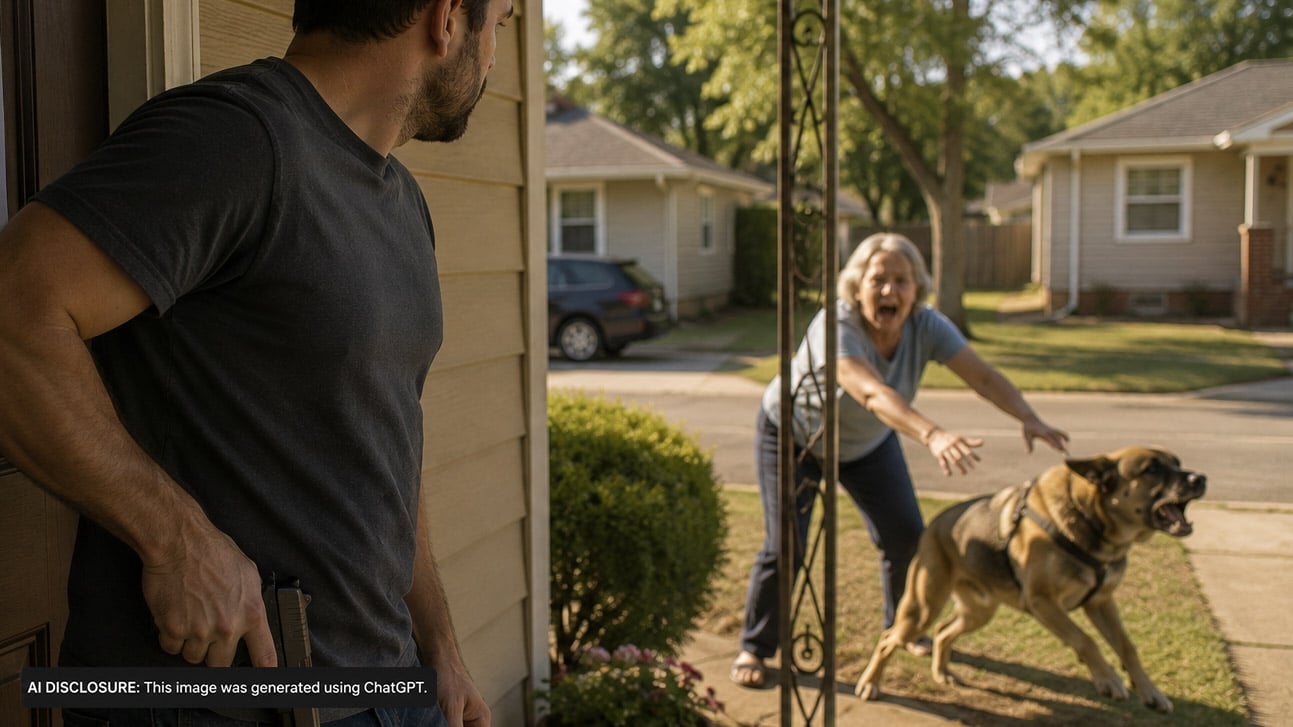
Photo credit: AI-generated image created using ChatGPT. Illustrative only
A loud scream will flip a switch in any household, especially when it’s your mom outside and you don’t know what’s happening. In Tennessee, one man says he heard that scream from the kitchen, grabbed his legally owned handgun, and ran out the door thinking he was walking into an assault.
What he says he found instead was an off-leash pit bull going after his mother and their small dog. The incident didn’t leave anyone injured, but it set off a chain reaction that ended with a three-day notice taped to their apartment door. The full account was laid out in the original post, along with the renter’s claim that management accused him of pointing a firearm at other residents during an “altercation.”
The scream, the dog, and the split-second decision
The resident says he was inside when he heard his mother screaming outside. Like a lot of gun owners, his first thought wasn’t “loose dog”—it was “someone is hurting my family.” He retrieved his handgun and went out, expecting the worst.
Once outside, he says it became clear the problem was the neighbor’s off-leash pit bull, which had been going after his mom and their small dog. Even with no injuries, anybody who has seen a dog fight kick off knows how fast that can turn into a tragedy—especially with a smaller pet and an older family member in the mix.
Why “displaying” a gun can become the whole story
According to the account, the pit bull’s owner eventually got the dog back home. The resident says he then brought the handgun back inside, unloaded it, and set it on the kitchen table in case law enforcement needed to see it.
That detail matters, because the eviction notice later alleged he “pointed a firearm at other residents.” Whether or not a gun was aimed, the moment a firearm comes out in a neighborhood dispute, it tends to become the headline. Apartment staff, neighbors, and even responding agencies often focus on the gun first and the dog second, especially if someone complained.
When police say “animal control,” and animal control says “we didn’t get it”
The resident says he and the neighbor agreed they needed to call police and file a report. But he claims police refused to come out, telling him it was an animal control issue and that they’d report it so animal control could come out the next day.
Then came the kind of bureaucratic ping-pong a lot of folks have run into: after follow-up calls, animal control allegedly said they never received anything. Eventually, someone did respond, but the resident says the report only included the other party’s side of the story—not his.
That’s a tough spot. When you’re trying to protect your family and also protect your rights, you need the official paperwork to reflect what actually happened. Without it, the person who calls first—or complains loudest—can end up setting the narrative.
The three-day notice that changed everything
A week later, the resident says a notice was taped to their door giving them three days to vacate or face eviction. The stated reason: violating the safety of the complex due to him “pointing a firearm at other residents during an altercation.”
He says he has video and audio evidence from that night that strongly supports his account and “almost completely disproves” the claim that he pointed the gun at anyone. Even so, the notice reportedly instructed them not to contact the landlord directly and to route everything through the landlord’s attorney.
That’s where reality hits. In an apartment setting, management can move fast, and a short notice window forces renters to act before they’ve even had time to gather documents, request reports, or calmly line up witnesses.
Lawyer consultations, money pressure, and why evidence still matters
The resident says he consulted with a few attorneys, including one paid consult. He described one attorney as confident that, if the videos show what the resident says they show, they’d have a strong fight. The attorney also noted the landlord’s law firm may be on retainer, meaning the landlord may have less financial incentive to back down quickly—even if the tenant has good evidence.
The resident’s goal, though, wasn’t to “win in court” after the fact. It was to avoid the eviction stage entirely if possible. That’s an important distinction for anyone who’s rented: an eviction filing can follow you around, even if you ultimately prevail, and it can make finding future housing harder.
He also noted a common problem for working folks: they make too much money to qualify for most low-income legal aid, but hiring a private attorney still hurts. In his case, he said the attorney offered a flat fee covering the matter even if it goes to court, but it would still be “a few thousand dollars.”
The outdoorsman takeaway: document, de-escalate, and don’t assume common sense will win
This is one of those situations that makes gun owners grind their teeth. A person believes he’s responding to a family member in danger, a loose dog is the actual threat, and nobody is hurt—yet the biggest consequence ends up being housing instability because of how the firearm portion gets framed.
There are a few practical lessons here that apply whether you live on 40 acres or in a second-floor apartment. First, documentation is gold. The resident says he has video and audio, which is exactly the kind of thing that can keep “he said, she said” from becoming “tenant is out in three days.” Second, once tempers flare, do what you can to slow the situation down. If the dog is secured and everyone is separated, that’s the time to breathe and start thinking about how your actions will look to a third party reading a report later.
Finally, don’t assume the system will automatically sort it out. The resident says police pushed it to animal control, animal control didn’t initially receive the handoff, and when a report did get made, he believes it only reflected the other side. If you ever end up in something similar, push for proper reports, keep your own records, and take deadlines seriously—especially when an attorney letter shows up telling you to route communication through counsel.
In the end, this Tennessee renter is trying to thread a needle: protect his family, protect his rights, and keep a roof overhead—all while being accused of something he says his recordings can disprove. Whether the landlord’s side chooses to reconsider may come down to how that evidence is presented and how quickly the tenant responds inside that tight three-day window.
Like The Avid Outdoorsman’s content? Be sure to follow us.
Here’s more from us: