Photo credit: AI-generated image created using ChatGPT. Illustrative only
Buying a rifle as a birthday surprise sounds simple: find a good deal, swipe a card, start the waiting period, wrap it up when the paperwork clears. But for one California gun owner and his wife, that plan ran straight into the hard edge of how gun shops are trained to spot “straw purchases,” even when a family gift is the intent.
In the original post, the husband explained they’d jumped on a “crazy deal” at a big-box sporting goods store on a Ruger AR-15. He’d already bought one for himself, and he figured his brother would like one too. So he and his wife decided to buy a second rifle as a birthday present—putting it on her credit card—and went in to start the 10-day waiting period.
A routine “gift” plan turned into a phone call and a refund
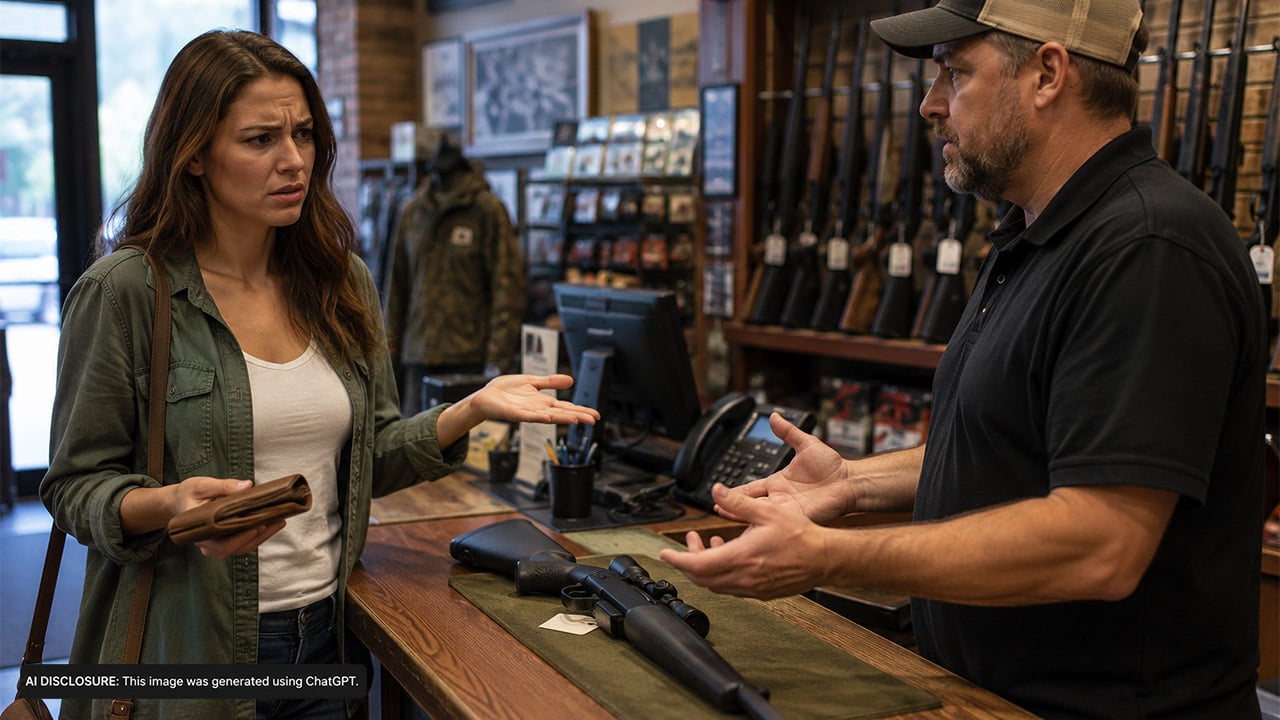
The next day, the wife got a call from the store telling her there was “an issue with the gift purchase for your brother-in-law and the purchase will have to be refunded.” She pushed back and told them she didn’t want a refund, and that she’d like to purchase it herself. The store’s answer didn’t change: they said they couldn’t sell it to her because it would be a straw purchase.
They didn’t drop it there. The husband went into the store with her after work and asked if she could gift the rifle to him instead. Same answer—straw purchase. He even asked whether they could gift it to a friend, and the employee said he wasn’t sure and would have to ask a manager who had already left for the day.
Why a store hears “straw purchase” when you say “birthday present”
Gun owners hear “straw purchase” and think of criminals using a clean buyer to get a gun they can’t legally buy. Stores hear it too—and they hear it in any situation where the person paying and the person intending to receive the gun don’t line up cleanly on the paperwork.
In this case, the husband described it as a gift for his brother, paid for on his wife’s credit card, and the purchase was being started with the recipient in mind. Even if nobody’s trying to “skirt the law,” the store employee is looking at a transaction that can look like a textbook red flag from across the counter.
And that’s the practical part a lot of folks miss: a gun counter isn’t a courtroom. It’s a risk-management desk. If the employees smell something that could be interpreted as “someone is buying this for someone else,” they’re trained to stop it before it becomes their problem.
The couple felt accused—and that’s a common reaction
The husband said it felt like the store was basically accusing them of a federal crime. That reaction makes sense, because the words “straw purchase” land heavy, especially when you’re just trying to do something nice for family.
He also pointed out that he’d just picked up his own rifle the week before through the same store, and he was already in the middle of another 10-day wait for a 10/22. From his perspective, they weren’t shady buyers. They were regular customers, doing normal gun-owner stuff, and suddenly they were being treated like a liability.
But the store isn’t judging character; it’s judging the shape of the transaction. When a purchase is openly framed as “this is for my brother-in-law,” many stores will shut it down immediately, because the safest move for their license is to refuse anything that resembles buying a gun “for” someone else.
What the buyer worried about: DOJ attention and the FFL’s license
The post also shows the kind of pressure California adds to all of this. The buyer said he understood it may “look bad” to the DOJ and asked if this was standard practice. He also wondered if the store was essentially saying, “I’m not risking my license for this transaction.”
That’s the heart of it. Even when a gift can be lawful in many situations, the store is the one with everything to lose if a transaction later gets questioned. Big retailers, in particular, often apply a strict, one-size-fits-all policy because it’s easier to train across hundreds of employees: if it even smells like a straw purchase, stop the sale and refund it.
From the customer side, that feels unfair. From the store side, it’s a simple math problem—one questionable sale isn’t worth risking the business.
How gun folks tend to handle gifts without setting off alarms
The couple’s plan—buying a rifle as a present and putting it on the wife’s credit card—sounds harmless, but it’s the kind of detail that can make a clerk’s ears perk up. In most gun shops, the cleanest way to avoid that whole mess is to keep the “buyer” and the “receiver” clearly separated in a way the store is comfortable with.
Many shooters handle this by giving a non-firearm gift (like a safe, a case, a sling, ammo where legal, or training) and letting the recipient do their own purchase. Others use store gift cards or simply hand the person money and make a range day out of it. The point isn’t to play games—it’s to avoid putting the retailer in a situation where they think you’re asking them to help transfer a gun to somebody you picked.
In the post, the husband also clarified something important: they weren’t trying to skirt anything, and they didn’t know his brother would be denied. That kind of surprise denial is exactly why many experienced gun owners prefer the “you pick it, you buy it” method for gifts, especially with modern background-check systems and state-specific rules.
When plans change, don’t try to “work around” the counter guy
After the store refused to sell it as a gift for the brother-in-law, the couple tried a couple other angles—could she gift it to the husband, could they gift it to a friend. That’s an understandable scramble when you’re staring at a refund and a ruined birthday surprise.
But it’s also the point where a store gets even more nervous. From the outside, it can look like the buyer is trying to find any person who can complete the transaction so the gun ends up with someone else. Even if the intent is innocent, that’s exactly the pattern retailers are trained to shut down.
The husband said that if the store allowed his wife to gift it to him, it would stay in his possession and be “a backup to my backup.” That might be a reasonable personal plan, but once the straw-purchase concern is raised, the shop’s trust usually doesn’t come back during that same visit.
If you get stopped like this, the smartest move is usually to pause, get clarity on the store’s policy, and—if needed—choose a different, straightforward route that doesn’t put the employees on edge. Pushing for alternate recipients in real time can turn a misunderstanding into a hard “no” that follows you right out the door.
At the end of the day, this is what gun buying looks like in the real world, not the ideal world. A customer sees a family gift. The store sees a liability question. If you want to give a firearm as a present, the best results usually come from keeping it clean, simple, and clearly within the shop’s comfort zone—because once “straw purchase” gets said out loud at the counter, the sale is often over no matter how honest you are.
Like The Avid Outdoorsman’s content? Be sure to follow us.
Here’s more from us: