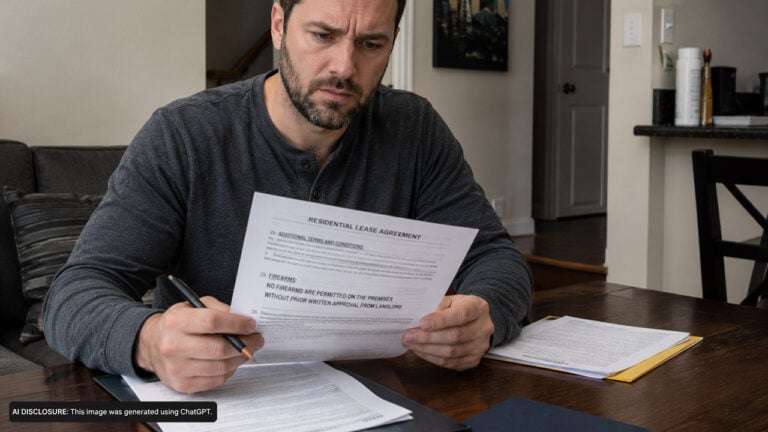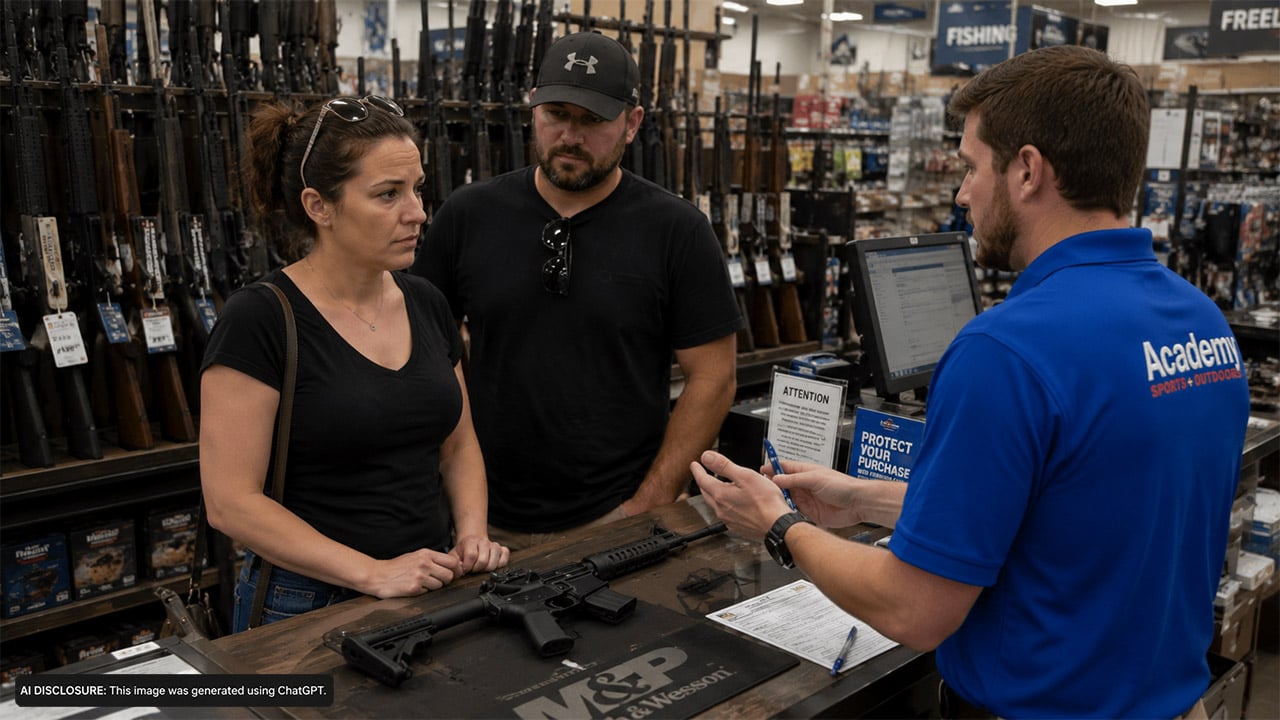
Photo credit: AI-generated image created using ChatGPT. Illustrative only
Walking up to a big-box gun counter should be the easy part. You show your ID, fill out the paperwork, and go home with the firearm you picked out. But one couple’s routine stop at Academy turned into a 30-day headache after a store employee decided the purchase didn’t look right.
In the original post, a husband explained that his wife—already a gun owner—went in intending to buy an AR-15 for herself while he stood beside her with their small child. Instead of a straightforward sale, they say the store treated it like a possible straw purchase and flagged her in the system.
It started with one simple sentence: “I would like to buy an AR-15.”
According to the account, the couple approached the gun counter and were asked if they needed help. The wife told the employee she wanted to buy an AR-15. That’s where the interaction took a turn: the employee reportedly asked for the husband’s ID first.
The wife corrected him, telling the employee the purchase would be under her name. Rather than moving forward, the employee questioned why the rifle wasn’t being bought under the husband’s name, which set the tone for the rest of the encounter.
The employee kept circling back to the husband buying the rifle
The husband says he clarified multiple times that the rifle was for his wife, therefore she would be the purchaser. The employee then quizzed the wife about the rifle—company, caliber, and other basic details—before again asking why the husband couldn’t just buy it himself.
At one point, the employee reportedly stated it was “uncommon for a women to buy an AR-15.” Then came another confirmation question directed at the wife: was the gun for her? She answered yes, and the employee followed with, “Are you sure?”
Anyone who spends time around gun folks knows how that kind of questioning can feel. It’s one thing to make sure the person filling out the form is the actual buyer. It’s another thing to repeatedly push the sale toward a different person—especially when the would-be buyer is standing right there, speaking clearly, and hasn’t asked anyone else to purchase the firearm for them.
They couldn’t get the rifle they wanted, but were told to drive across town
The wife knew which AR-15 she wanted and pointed it out. The problem was color: they only had it in brown, not black. The couple asked which nearby store might have the black one in stock.
The employee suggested another Academy across town and told them that location should have it. That advice made the situation feel normal again—like it was just a matter of inventory and a short drive.
The second store said she’d been flagged and had to wait 30 days
At the second Academy, the wife provided her ID. That’s when they were reportedly told they couldn’t sell her any gun because she had been flagged at the previous store. Not just for that specific rifle—any gun purchase—along with a required wait of at least 30 days.
For most folks, that’s where frustration really kicks in. You didn’t argue, you didn’t try to do anything shady, you didn’t even buy the gun at the first location. You simply asked for the item, got directed to another store, and then found out you’re now blocked from buying anything for a month.
Whether you’re shopping for a hunting rifle before season, a shotgun for the farm, or an AR-15 for home defense, getting hit with a 30-day delay can turn into a real problem fast. Sales come and go, inventory changes, and sometimes you’re buying with a time-sensitive purpose in mind.
They went back to the first store looking for answers
After being turned away at the second location, the couple returned to the first Academy and asked to speak with a store manager. The husband says he explained what happened and asked why the employee would flag his wife if he was also going to tell them to drive across town to buy the same rifle.
He stated the manager offered no answer and no apology. He asked for a store number and said he would follow up with a complaint. Later, he added a small update that both he and his wife made separate phone calls, were given a case number, and were told they would hear back soon.
Why “straw purchase” suspicion can get messy at the counter
Straw purchases are a legitimate concern. Dealers and employees are trained to watch for obvious red flags—one person picks the gun, another person pays, someone coaching answers, or a buyer who seems unfamiliar while another person calls the shots. Stores also don’t want trouble with compliance, and they’ll err on the side of caution.
But the hard part is that real couples shop together all the time. Husbands and wives buy each other hunting rifles as gifts. Parents help an adult child pick a first firearm. Sometimes the more experienced shooter is there to answer questions, compare models, or keep the purchase on budget. None of that automatically equals a straw purchase.
In this case, the husband’s account describes the opposite of what you’d expect in a straw-buy setup: the wife stated she wanted to buy the AR-15, provided her ID at the second store, and repeatedly affirmed the gun was for her. If the employee still felt uncertain, the most practical move would have been to pause the sale at that counter and explain the store’s policy clearly—without pushing the purchase onto the husband, and without sending the family on a wasted trip.
The other complication is the “flagging” itself. Once a buyer is flagged in a chain’s system—fairly or unfairly—it can follow them from store to store. That turns one awkward interaction into a bigger lockout that can’t be fixed by simply finding a different clerk.
For gun owners, the best lesson here is simple: if you’re buying, you do the talking. Use your own money. Handle your own paperwork. And if a clerk starts steering the purchase toward someone else, stop and ask, calmly, what exactly they believe they’re seeing. If they won’t explain it, ask for a manager before you leave the counter—because once a note goes into a system, it may not be easy to undo.
Big-box stores move a lot of firearms, but they also move a lot of employees through those counters. When the person behind the glass decides to play detective instead of just following the process, it can put regular folks in a bind. All this couple wanted was a black AR-15 that fit the wife’s needs, and they walked away with a 30-day wait instead.
Like The Avid Outdoorsman’s content? Be sure to follow us.
Here’s more from us: