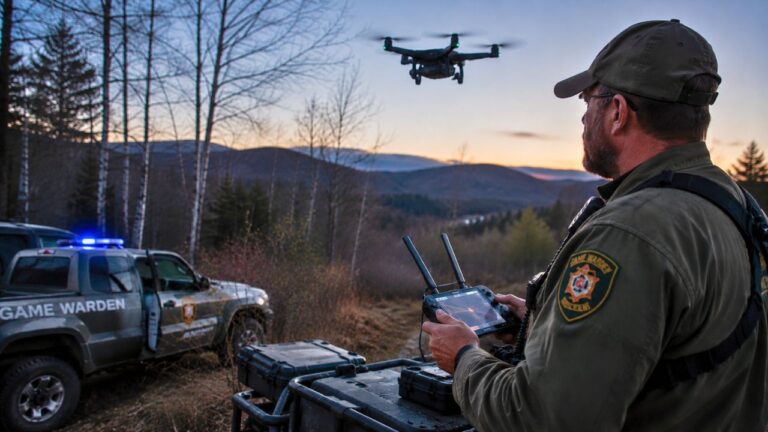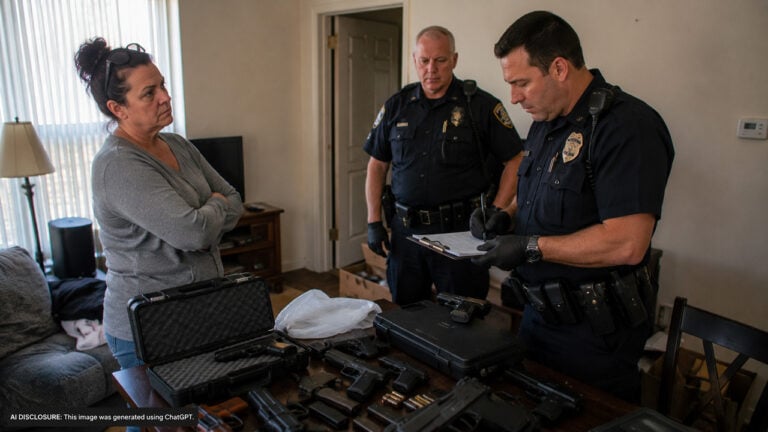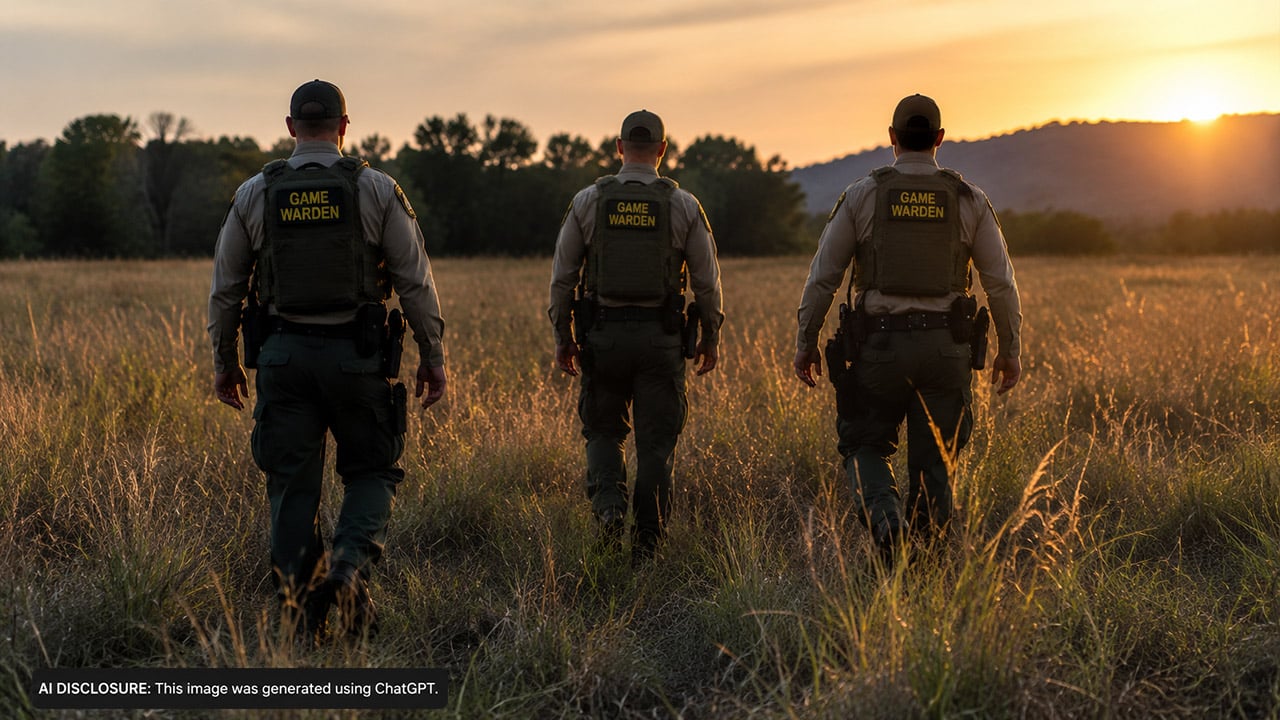
Photo credit: AI-generated image created using ChatGPT. Illustrative only
If you’ve ever caught an unfamiliar boot track crossing a food plot or found a gate chain hanging different than you left it, you know the feeling: it’s your dirt, but somebody’s walking it. In north Alabama, three landowners say that “somebody” has been state game wardens—showing up on their property without a warrant—and they took that fight to court.
But the first big round didn’t go their way. An Alabama Circuit Court judge dismissed their lawsuit challenging the state’s ability to enter private land under the “open fields” doctrine, as laid out in the original post. The Institute of Justice, the nonprofit law firm backing the case, says it’s appealing.
Three landowners say wardens searched their property without warrants
The case was filed in May 2025 by Killen residents Dalton Boley and Regina Williams, along with Muscle Shoals resident Dale Liles. All three said they were subjected to warrantless searches of their land by Alabama Department of Conservation and Natural Resources (DCNR) wardens.
Boley put it in plain language: “Until I know wardens aren’t secretly snooping around on the land, it’s hard for me and my sons to feel comfortable out there.” That’s a statement most rural landowners understand, whether it’s about trespassers, thieves, or anyone you didn’t invite onto a place where guns and hunting are part of daily life.
The “open fields” doctrine is the legal tool behind it
This dispute centers on what’s known as the “open fields” doctrine. It traces back to a 1924 U.S. Supreme Court case and has long been used to justify government entry onto private land—other than a home—for enforcement of game and fish laws.
In other words, it draws a hard line between your house and what’s outside it. Pastures, timber, cutovers, creek bottoms, and the back 40 might be private, but under this doctrine they’re treated very differently than the home itself.
Alabama leaned on that doctrine in its motion to dismiss, arguing that constitutional protection “never extends to ‘open fields or pasture land beyond the curtilage of the home or business establishment.’” And because of that, the state argued the wardens had a right to enter under Alabama law.
Why Tennessee matters—and why Alabama landowners are watching closely
If you hunt anywhere near the state line, you’ve probably heard about what happened in Tennessee. A similar challenge there ended with the Tennessee Wildlife Resources Agency losing, and the agency declined to appeal to the state Supreme Court in 2024.
The practical result was simple and easy to understand: in Tennessee, game wardens can no longer enter private property without explicit landowner permission or a court-ordered search warrant.
That’s why this Alabama dismissal matters. Right now, Alabama wardens retain the ability to enter private land under this open-fields framework, and the plaintiffs are trying to change that through the courts.
A safety angle that hits home for hunters
Legal arguments are one thing, but the way this plays out on the ground is another. Liles, who owns an 86-acre property in Muscle Shoals he primarily uses for hunting and fishing, said he has seen DCNR wardens on his land at least three times.
He also raised a point that every deer hunter who’s ever sat a stand in low light will understand: “Not to mention, it’s dangerous for them to be on a hunting property without wearing colors that make them easy to see.” If someone is moving through thick cover during archery season or slipping around a field edge during rifle season, visibility matters—no matter what patch is on their shoulder.
There’s also the landowner’s side of that same safety coin. If a landowner, a kid, or a lease buddy runs into an unexpected person on the property—especially one who isn’t clearly visible—it can turn a normal day outdoors into a tense situation fast. Nobody wants that, and nobody should be surprised that folks are pushing back.
The judge dismissed the case, but the appeal is already in motion
The Institute of Justice (IJ) is defending the three plaintiffs. IJ describes itself as a nonprofit, public interest law firm whose mission is to “end widespread abuses of government power.” After the Circuit Court dismissal, IJ attorneys said they will appeal to the Alabama Court of Appeals.
IJ attorney Suranjan Sen said the decision conflicts with what he called “the strong protections Alabama’s Constitution promises landowners from warrantless searches,” adding that the team looks forward to making that argument at the appellate level.
For hunters and anglers reading this, the key takeaway is that nothing has changed yet on the ground in Alabama. The case didn’t produce a new rule like Tennessee did—at least not at this stage.
What this means for regular landowners in the meantime
If you own or lease hunting ground in Alabama, this is one of those issues that affects real decisions: how you post property, how you manage gates, and how you talk to family members about what to do if they see someone they don’t recognize. It’s also a reminder that “private” can mean one thing to a landowner and something else in a courtroom.
None of this is a green light to get confrontational. The smartest play on any rural property—especially one where firearms are common—is to keep things calm, document what you can safely document, and handle disputes through proper channels. Liles’ comment about visibility is worth sitting with, too: whether it’s wardens, trespassers, or lost hikers, unexpected people on hunting land create risk.
IJ also noted it’s pursuing similar cases in other states, including Pennsylvania, Virginia, and Louisiana. So even if you’re not in Alabama, this is the kind of legal fight that can ripple outward, state by state, until the rules finally get clarified.
For now, Alabama landowners who want tighter limits on warrantless entry are still in a holding pattern—watching an appeal that could decide whether “open fields” stays the way it’s been for decades, or whether Alabama follows Tennessee’s lead and draws a firmer line at the property boundary.