Photo credit: AI-generated image created using ChatGPT. Illustrative only
Most hunters know the feeling: you finally lay hands on a once-in-a-lifetime buck, and the story is going to get told a hundred times. But in Ohio, one trophy tale didn’t just fall apart—it got rebuilt piece by piece using cell phone data, text messages, and a timeline that didn’t match the version shared with a hunting outlet. The case ended this week with jail time, steep restitution, and a long hunting ban, as outlined in the source post.
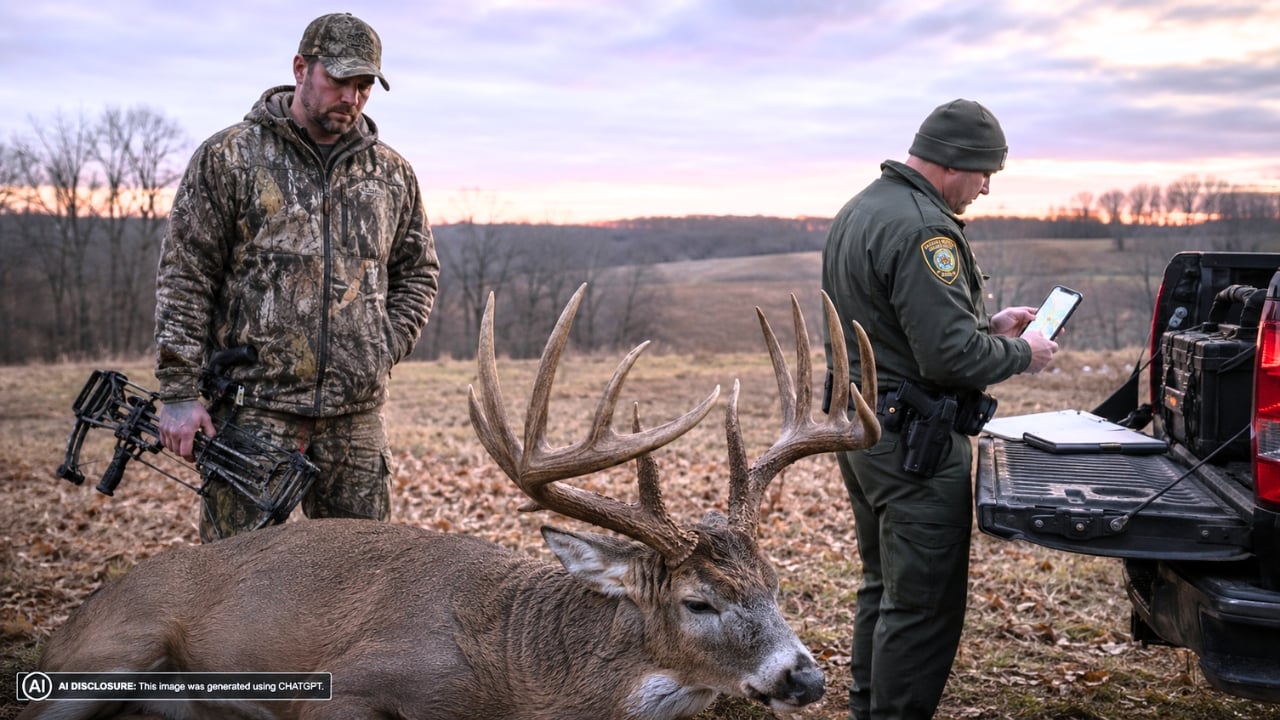
At the center of it is CJ Alexander of Wilmington, accused of illegally taking a giant 18-point buck and then trying to make it look like a lawful harvest on family ground. According to Ohio Attorney General Dave Yost’s office, Alexander will serve time, pay roughly $43,000, and lose his hunting privileges for at least a decade.
A trophy story that sounded clean on paper
The lies, according to the case summary, started with a polished narrative. Alexander told Outdoor Life that he killed a 200-plus-inch-class whitetail on Dec. 8, 2023, using a borrowed crossbow while hunting his sister’s 9-acre property in Clinton County.
That’s the kind of story that reads like a dream scenario: small parcel, family permission, and a monster buck stepping into range. Alexander stuck with that version for months—even after investigators got involved and seized the deer and other evidence.
What investigators say really happened
Public court records described in the source material lay out a different picture. Investigators used cell phone records—text messages and GPS location data—to map out where Alexander was, where the buck was killed, and how the recovery unfolded.
Those records, according to the reporting summarized in the material, showed Alexander sought out and killed the 18-point buck on private property where he knew he didn’t have permission to hunt. After the kill, authorities say he worked with others to recover the deer and then staged photos on his sister’s property to sell the “legal harvest” story and profit off the rack.
It’s a reminder that the modern deer woods have receipts. Phones track location. Messages don’t disappear just because somebody regrets typing them. And when a high-profile buck is involved, every detail gets attention—from access points to timestamps to who was where.
The cover-up pulled more people into the mess
Big poaching cases rarely stay “one guy, one mistake.” In this one, the source material says three other people helped Alexander: his sister, Kristina M. Alexander, and brothers Corey and Zachary Haunert. All pleaded guilty to charges in October and were sentenced separately.
That detail matters for regular hunters and rural landowners. When someone tries to launder a poached deer through a “safe” property—especially a family member’s place—everybody involved risks getting dragged into the legal and financial consequences. Even if the original shot happened somewhere else, the recovery, transport, staging, and falsification can turn into their own stack of charges.
Cell phone records and texts turned the lights on
There’s an old saying that “a liar needs a good memory.” In this case, prosecutors didn’t need anyone’s memory. They had a digital trail.
The source material mentions one text Alexander sent to his fiancée, Carissa Weisenberger, on Oct. 17—weeks before the buck was killed—suggesting he expected major money for the deer head: “I’m gonna get offered stupid money for this deer head babe … Like buying house type money … This deer is gonna make us money.”
That kind of message can change how a case gets viewed. It suggests motive beyond simply wanting a trophy for the wall. And when investigators can pair texts like that with GPS points and timelines, the “he said, she said” part of the story gets real small.
The penalties were built to hurt—and to last
Alexander pleaded guilty in October to 14 charges related to the poaching, including felony counts of theft by deception and tampering with evidence, plus misdemeanors tied to hunting violations, falsification, jacklighting, and the sale of wildlife parts, according to the material.
His sentence, as outlined, is a pileup of consequences: 180 days in jail with 90 days suspended (meaning 90 days to serve at the Star Community Justice Center before he’s eligible for work release), five years of community control, and a four- to six-month community-based program through that same facility.
Then there’s the money. The total ordered was about $43,000, including $39,696.73 paid to the Ohio Wildlife Fund, $2,000 restitution to KSE Sportsman Media (doing business as Outdoor Sportsman Group-IM), plus restitution to the poaching hotline, a wildlife fine, and court costs.
Finally—and this is the part that hits hunters where it hurts—his hunting privileges are revoked for a minimum of 10 years. The source material notes that if full restitution isn’t paid by the end of that period, the revocation stays in place until it is.
Ohio also calculates restitution on high-scoring deer based on total inches of antler when the gross score exceeds 125 inches. One widely reported gross score for the buck was 235 ⅞, while a Buckmasters score sheet posted on Alexander’s Instagram page listed 217 4/8, according to the source material. Either way, it’s the kind of deer that triggers serious restitution numbers.
Attorney General Yost summed up the state’s stance in a statement included in the material: “Hunting in Ohio is a time-honored tradition, and there is a proper way to be safe and successful… When bad actors like these guys try to cheat the system, it ruins the reputation of Ohio’s respected sportsmen and women — I can’t stand for that.”
Most of us don’t need a press conference to understand that. Poaching doesn’t just steal a deer—it steals trust between neighbors, it burns relationships between landowners and hunters, and it puts a spotlight on everybody doing things the right way.
If there’s a practical lesson here, it’s simple: permission and property lines matter, and “fixing it later” usually makes things worse. A big buck can scramble a person’s judgment in a hurry, but no antlers are worth jail time, a five-figure bill, and a decade (or more) off the landscape.
Like The Avid Outdoorsman’s content? Subscribe to our newsletter so you never miss an article.
Here’s more from us: