Photo credit: The Avid Outdoorsman
Prices verified September 16, 2026 against live retailer listings. The Avid Outdoorsman is an affiliate of Sportsman’s Guide, Optics Planet and Bass Pro Shops — if you buy through a link here we earn a small commission at no cost to you.
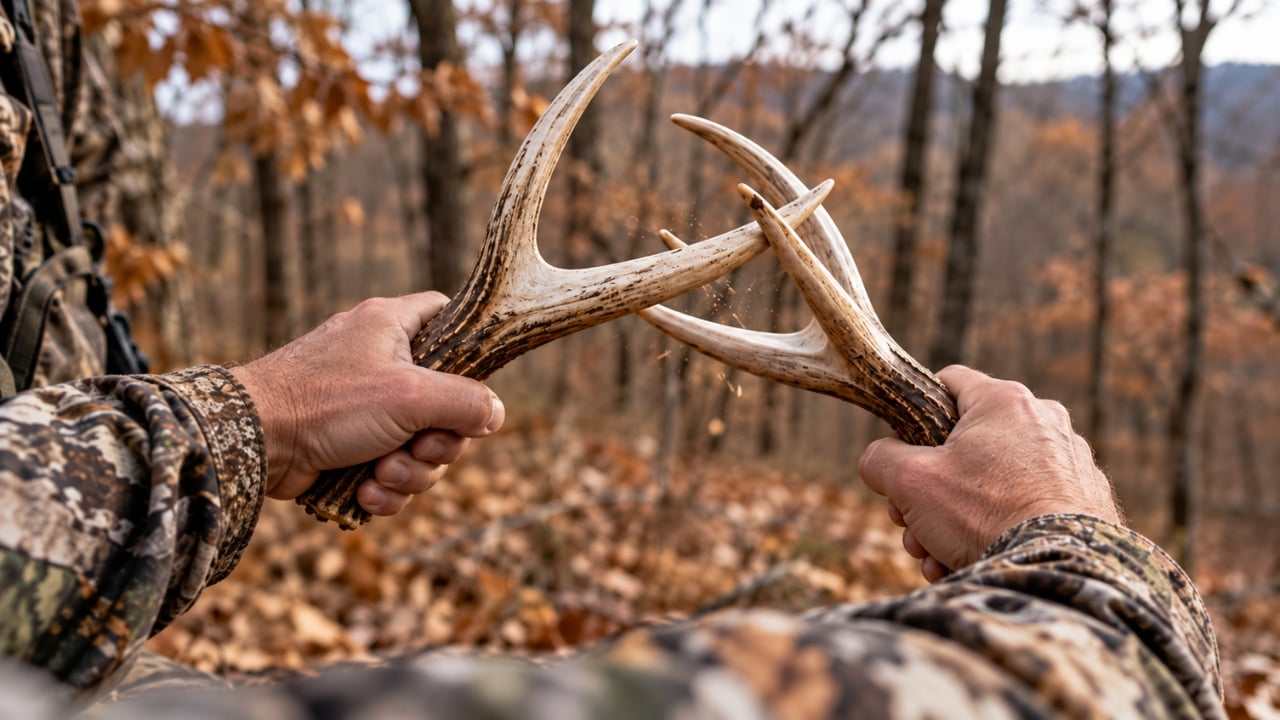
There’s no shortage of opinions on rattling. Ask five deer hunters how loud to rattle, how long to do it, or how often, and you’ll probably get five different answers.
But there’s actually been a pretty solid study on it — 204 rattling sequences, radio-collared bucks, and observers sitting in towers watching deer that the hunters on the ground never even knew were there.
And honestly, a few of the results surprised me.
1. Rattle loud.
The loud sequences brought in 81 bucks. The quieter sequences brought in 30. That means 73% of the bucks that responded came to the louder rattling.
So if you’re barely tickling the antlers together because you’re worried about overdoing it, you may be doing yourself a disservice. A real buck fight isn’t exactly subtle.
2. You don’t have to rattle forever.
One-minute sequences worked just as well as three-minute sequences.
That was interesting to me because guys spend a lot of time arguing about exactly how long a rattling sequence should last. According to this study, how hard you rattle matters a whole lot more than how long you keep doing it.
3. This is the big one: more than half the bucks that responded were never seen by the hunters.
The guys rattling from the ground missed 63 of the 111 bucks that came in — 57%. Think about that.
Those bucks heard the rattling. They came to investigate. A lot of them circled downwind, figured out something wasn’t right, and slipped back out without the hunter ever knowing they had called in a deer.
That changes the way I look at rattling more than anything else in the study. If you’ve rattled plenty of times and thought, Well, that didn’t work, there’s a decent chance it actually did.
The problem may not have been your rattling. It may have been your setup.
That’s what I kept in mind with everything below — along with the actual results from the study and what these calls and rattling antlers cost right now.
Study: Hellickson et al., SEAFWA Proceedings, 2009 — full PDF
When rattling actually works
Response rates by rut phase, from the same study, measured as bucks per rattling session:
| Rut phase | Bucks per session |
|---|---|
| Pre-rut | 0.30 |
| Peak rut | 1.07 |
| Post-rut | 0.57 |
Peak rut is about 3.5× better than pre-rut and roughly 2× post-rut. If you rattle on ten sessions during peak rut you should expect to pull about ten bucks — most of which you won’t see.
Time of day matters too: morning produced 0.92 bucks per session against 0.38 at midday. Of the 111 responders, 60 came between 7:30 and 10:30 a.m.
The finding that should change how you hunt
Here’s the part almost nobody reports, and it’s the most useful thing in this article.
Response rate by rut phase is different for every age class:
- Young bucks (1.5–2.5) responded most during pre-rut
- Middle-aged bucks (3.5–4.5) responded most during peak rut
- Mature bucks (5.5+) responded most during post-rut — and were at their lowest during peak rut
So, during the peak, the oldest bucks are already tending does. They have no reason to go investigate somebody else’s fight.
If you are specifically hunting the oldest age class, post-rut may be your better rattling window. That’s counterintuitive, it’s from the primary source, and you will not find it in most November magazine articles.
Loud or quiet?
Loud, and it isn’t close — 73% of responses.
But note what “loud” meant in the study. It wasn’t just banging antlers together. The loud sequences included rubbing bark, breaking branches, and raking the ground. You’re simulating two large animals fighting in the brush, not two antlers clicking.
This has a direct product implication. A rattle bag physically cannot produce peak-rut fight volume — as one experienced writer put it, “it’s simply not possible.” Bags are fine for September and early-October sparring. For peak rut, you want real antlers or a full synthetic set. That’s an evidence-backed recommendation rather than a preference, and it’s the clearest buying guidance on this page.
Do calls spook deer?
The data says no — and identifies a different problem.
“Males apparently did not learn to avoid rattling.” Bucks responded consistently to repeated sessions across the season. There’s no evidence in this dataset for “educating” deer by rattling.
The real risk is being busted by a deer you never saw. Combine the 57%-unseen figure with the widely reported finding that roughly 60% of responding bucks approach from downwind, and the mechanism is obvious: the deer wins on scent, not sound. He isn’t spooked by your call. He’s spooked by you, after your call brought him in downwind of you.
So the fix isn’t calling less. It’s setting up so a downwind circle doesn’t kill you — a stand with your scent cone over open ground or water, or a spot where the downwind approach is somewhere you can see.
⚠️ What the research does NOT say
We’d rather flag this than let you assume it.
There is no controlled study of grunt call effectiveness. We looked through university extension, state agency, and journal sources. The foundational work — Atkeson, Marchinton and Miller at the University of Georgia, 1988 — catalogued about 400 recorded vocalizations into roughly 12 call types. That’s descriptive: it tells you the sounds are real and what deer make them in what context. It does not measure how often a buck comes to a hunter blowing a tube. Every “grunt calls work X% of the time” claim traces to marketing or anecdote.
There’s no research on blind calling versus calling to a visible deer either. That’s expert opinion only.
And on the rattling study itself: it reports response rates but does not publish formal statistical tests or p-values for the treatment comparisons. We’re saying “substantially higher,” not “statistically significant,” on purpose. The fieldwork was also South Texas brush country in the early 1990s — high deer density, good buck age structure. Response rates in Midwest or Southeast timber are almost certainly lower, and nobody has replicated this at scale elsewhere.
Grunt tubes
| Model | Price | Where |
|---|---|---|
| Hunter’s Specialties True Talker OG | $19.99 | Bass Pro Shops |
| Flextone All-N-One Boned Up | $11.99 | Optics Planet |
| Primos Buck Roar 2 | $26.99 | Bass Pro Shops |
| Primos Little Big ROAR | $39.89 | Optics Planet |
| Illusion Extinguisher 2.0 | $32.99 | Amazon |
Hunter’s Specialties True Talker OG — $19.99 ⭐
A sliding rubber sleeve over the bellow varies volume, tone, and direction — five vocalizations including an aggressive growl. An earlier version of this guide flagged it as out of stock at the manufacturer; it’s in stock at Bass Pro at twenty dollars, which makes it the best grunt tube per dollar here. Check price at Bass Pro Shops
Flextone All-N-One Boned Up — $11.99
The honest budget answer. Under twelve dollars, multiple vocalizations. Check price at Optics Planet
Primos Buck Roar 2 — $26.99
A correction to our earlier version: we warned that this call looked discontinued because it had vanished from Primos’ own site. It hasn’t — Bass Pro stocks it at $26.99. Outdoor Life lists it as Will Primos’ personal pick. Check price at Optics Planet
Illusion Extinguisher 2.0. It’s the call we’d most like to recommend — adjustable multi-tone, buck, doe and fawn from one tube, a freeze-resistant reed, and 4.77/5 across 201 reviews. You can buy it from Amazon for about $33. Check price at Amazon.
Rattling
| Product | Price | Where | Type |
|---|---|---|---|
| Illusion Black Rack | $26.99 | Sportsman’s Guide | Synthetic antler set |
| Flextone Battle Bones | $29.99 | Sportsman’s Guide | Synthetic antler set |
| Primos Fightin’ Horns | $36.49 | Optics Planet | Synthetic antler set |
| Primos Big Bucks Rattling Bag | $28.79 | Optics Planet | Bag |
For peak rut, buy an antler set, not a bag. The volume finding makes this an easy call.
Illusion Black Rack — $26.99 ⭐ the one thing to buy
2.2 pounds, “Bone-Core” construction, two fully-racked buck halves with tines for leverage, matte black so it doesn’t flash, made in the USA. 5.0 stars — though on only 11 reviews, which is a thin sample worth knowing about. Check price at Sportsman’s Guide
Primos Fightin’ Horns — $36.49
The traditional synthetic set, and four dollars under what it was listing at earlier this season. Check price at Optics Planet
Flextone Battle Bones — $29.99
The other full synthetic set worth considering. Check price at Sportsman’s Guide
(Buying the Black Rack and a True Talker separately comes to $46.98 and gets you a better grunt tube.)
Real sheds are free if you find them, and they produce the best volume and depth — especially heavy beams. They’re also bulky and hard to source, and thin yearling antlers can’t generate much volume. Synthetics match a mid-sized rack well but can’t replicate a heavy 170-class set.
Rattle bags are compact and cheap and fine for early-season sparring. They also rattle around in your pack unless you band them. Just don’t expect one to do peak-rut work. ⚠️ Note that the Primos Big Bucks bag has jumped to $28.79 — it used to be a $20 call, and at that price the Black Rack antler set is only a couple of dollars more and does far more.
Bleat and estrus calls
| Model | Price | Where |
|---|---|---|
| Primos Original Can | $11.99 | Bass Pro Shops |
| Primos Original Can | $14.99 | Optics Planet |
Primos Original Can — $11.99 ⭐
Nearly foolproof, works one-handed, and it’s twelve dollars. The one real complaint: it bleats on its own if it’s loose in your pack. Store it upside down or banded. Check price at Bass Pro Shops
(Optics Planet lists the same call at $14.99. We’ve linked the cheaper one.)
How to actually use this
Rattle loud. Break branches, rake the ground, rub bark. You’re staging a fight, not clicking antlers.
Don’t rattle long. One minute is as effective as three. Then sit still and watch — for at least twenty or thirty minutes, because you’re going to miss most of what comes.
Rattle in the morning. More than twice the response rate of midday.
Set up so the downwind side is covered. Sixty percent circle downwind and 57% are never seen. This is the single highest-leverage change you can make, and it costs nothing.
Never grunt at a buck inside 75 yards that’s already looking for you. Every expert agrees on this one. Once he’s close and searching, another call gives him your exact position and he’ll pick that spot apart.
Grunt at every buck you see slipping past out of range. That’s the highest-value use of a tube — a targeted intervention with something to gain and little to lose.
Blind calling is defensible in thick cover in early-to-mid October — half a dozen moderately loud grunts every twenty to thirty minutes. In open country it mostly produces deer you never see.
Post-rut, dial it back. A tired buck won’t walk a hundred yards.
Frequently asked
Do I really need all three — grunt, rattle, and bleat?
No. Start with the Black Rack at $26.99 and the True Talker at $19.99 — $46.98 — and add the $11.99 Can if you want it. That’s the whole kit for about $59.
Does rattling work outside the rut?
Some — 0.30 bucks per session pre-rut against 1.07 at peak. It works; it just works about a third as well.
Real antlers or synthetic?
Real if you have heavy sheds. Synthetic if you don’t. The difference is smaller than the difference between rattling loud and rattling quietly.
Can I rattle too much and educate deer?
The evidence says no — bucks in the study didn’t learn to avoid it across a season. What you can do is get winded repeatedly by deer you never see, which teaches them about you rather than about rattling.
Bottom line: rattle loud, keep it short, do it in the morning during peak rut — and if you’re after a genuinely old deer, don’t write off post-rut. Then set up assuming that more than half of what you call in will circle downwind and that you’ll never see it. Fixing that is worth more than any call you can buy.
Primary source: Hellickson, Miller, Marchinton, DeYoung & Hall, “Behavioral Responses of Male White-tailed Deer to Antler Rattling,” SEAFWA Proceedings 63:7–10, 2009. Additional: National Deer Association · Outdoor Life rattling guide · Outdoor Life grunt tube guide · Grand View Outdoors, real vs. fake antlers. Prices checked against live Sportsman’s Guide, Optics Planet and Bass Pro Shops listings on September 16, 2026.