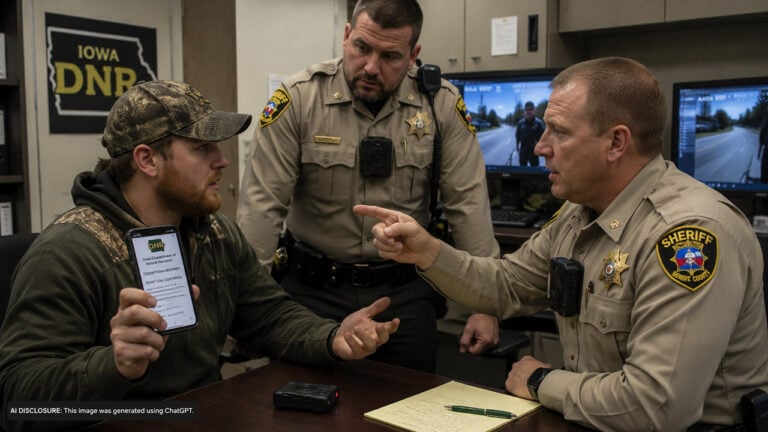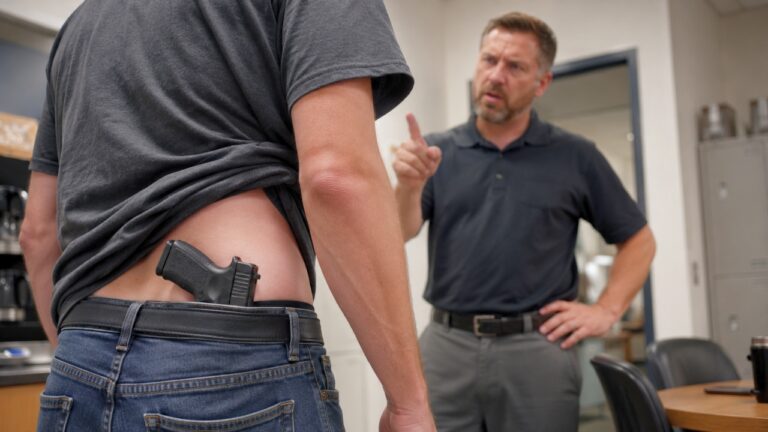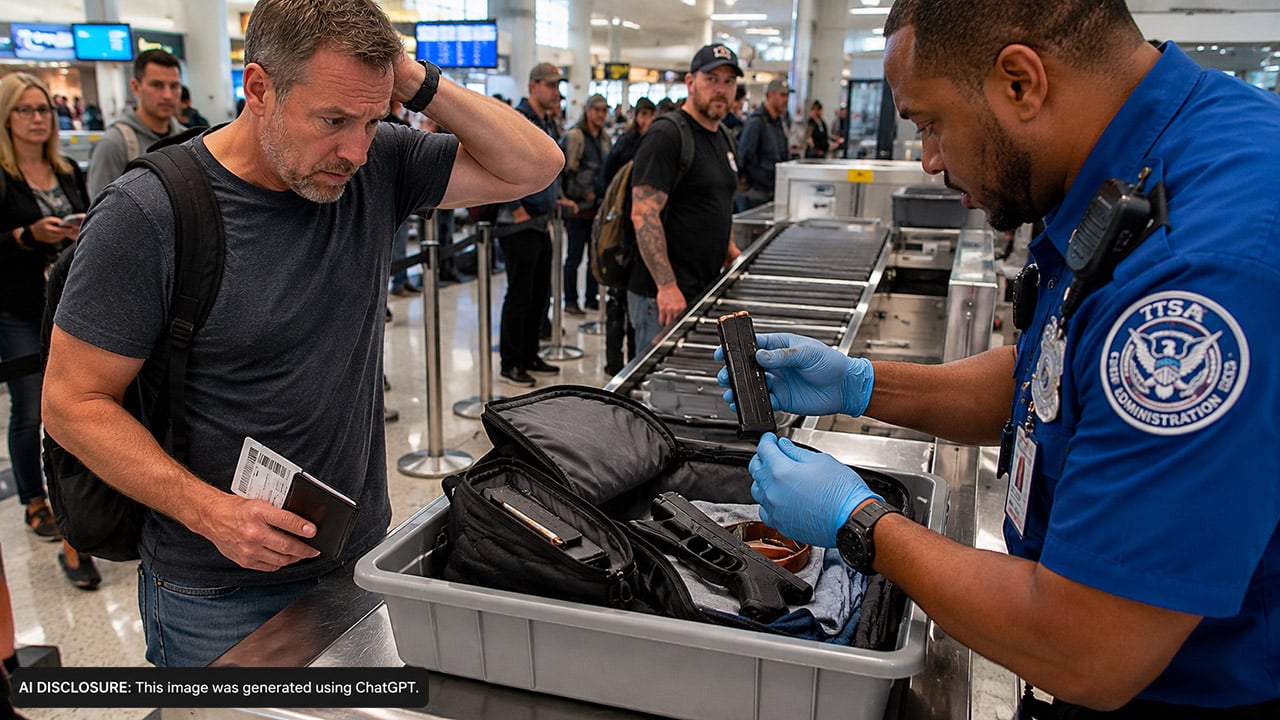
Photo credit: AI-generated image created using ChatGPT. Illustrative only
A guy who travels a lot for work had what sounds like a simple plan: fly with his handgun declared and secured in checked luggage, land in a state that honors his Florida permit, then gear up before walking out to the curb for an Uber. He wasn’t asking how to sneak anything through. He wanted to know the clean, lawful way to do it—specifically, whether he could pull the gun out of the checked bag while he was still on airport property and carry concealed from there.
That question—posted in the original post—is the same kind of thing that trips up plenty of otherwise responsible concealed carriers. And it’s how people end up standing at an airport counter “just checking” on reciprocity, only to realize they’ve created the exact scenario TSA and airport police deal with all the time: a firearm-adjacent problem in a place that has its own set of rules.
The traveler’s plan sounded reasonable on paper
The poster explained he has a Florida concealed weapons license and he travels frequently for work. His intention wasn’t to carry through the sterile area or bring anything into the cabin. He specifically asked about checking the gun “properly in checked bag,” then carrying in a reciprocity state after he lands.
Where it got tricky was the timing and location. He wanted to remove the firearm from his checked luggage “once it is received while still on airport grounds” and conceal it “in private area on airport grounds,” because he’d like to have it on him before getting into an Uber for safety.
Airport property isn’t one uniform “legal zone”
A lot of gun owners think in simple boundaries: inside the terminal versus outside the terminal. But airports are patched together out of different controlled spaces—airline ticket counters, baggage claim, public arrivals hall, parking decks, curbside lanes, and the secure/sterile area behind TSA checkpoints. The legal line isn’t always “outside the building,” and it definitely isn’t “outside the fence.”
The key detail in the question was “still on airport grounds.” Depending on the airport, that can include places where local rules, posted policies, or state-level restrictions can make possession or carry a whole different animal than what you’re used to at home. Even in a state that honors your permit, you can still run into location-based restrictions that have nothing to do with reciprocity.
Reciprocity doesn’t answer the “where can I load up” question
Permit reciprocity is about whether your license is recognized. It doesn’t automatically grant you the right to carry everywhere in that state, and it doesn’t override restricted places. The poster’s bigger concern wasn’t whether he could carry in the destination state at all—he framed it as a “reprocity accepting state”—but whether the airport itself was a spot where he could legally transition from “checked firearm in luggage” to “concealed carry on my person.”
That’s where people get sideways fast. You can do everything right at the departure airport—declared firearm, proper case, checked bag—then land and still foul it up by handling the gun in the wrong place at the wrong time. And once you’re manipulating a firearm in a busy public environment, even a simple mistake draws attention.
“Private area” in an airport can still be public enough to cause a scene
It’s easy to picture a tucked-away corner near baggage claim, a family restroom, or slipping between cars in a parking garage and doing a quick changeover. But airports don’t treat those spaces like a quiet back room at deer camp. They’re heavily monitored, full of cameras, and built around the expectation that people are coming and going unarmed.
Even if someone’s intent is lawful, unzipping a suitcase and handling a handgun on airport property is the kind of thing that can prompt a 911 call from a bystander, an employee, or airport security watching a camera feed. And if a loaded magazine is involved—whether it’s already in the bag or ends up in the wrong compartment—now you’ve turned a “simple question” into a serious interaction.
How the loaded magazine problem usually happens
The headline angle here is the part that bites carriers most often: TSA doesn’t have to find a whole pistol in the wrong place for your day to go bad. A loaded magazine, loose ammo, or a magazine you forgot was topped off can be enough to trigger the kind of scrutiny nobody wants when they’re traveling for work.
What makes this scenario believable is that it starts with normal thinking: “I’ll check it correctly. When I get there, I’ll put it back on me for the ride.” But that transition point—right there at baggage claim or in a parking structure—is exactly where rushed, tired travelers do dumb things. They dig for the case, move items around, forget what’s loaded, set something down, and suddenly there’s a prohibited item in plain view or in a bag that wasn’t supposed to have it accessible.
The practical, common-sense approach if you want it for the Uber ride
The poster’s motive—wanting to be armed before stepping into a rideshare—makes sense from a self-defense mindset. Airports are busy, you’re often carrying expensive gear, and you’re distracted. But the safest and smartest play is usually to treat the airport like a “no handling” environment and wait until you’re well clear of airport property and local restrictions before you start moving guns around.
If you want that gun on you as soon as possible, the clean approach is planning ahead: know the destination state’s rules (not just reciprocity), understand what the airport allows in public areas, and have a clear, low-drama point in your travel where you can secure or carry the firearm without unbagging it in a crowded place. The goal isn’t just staying lawful—it’s avoiding the kind of attention that comes with firearms at airports, even when you’re within your rights.
In the outdoors world, we talk a lot about “don’t make a small problem into a big one.” This is that principle with fluorescent lighting and security cameras. If you’re flying with a firearm, the win isn’t simply getting the case from Point A to Point B. The win is doing it in a way that doesn’t end with a conversation at a counter, a bag inspection, or a loaded magazine becoming the most interesting thing in the terminal.
Like The Avid Outdoorsman’s content? Subscribe to our newsletter so you never miss an article.
Here’s more from us: