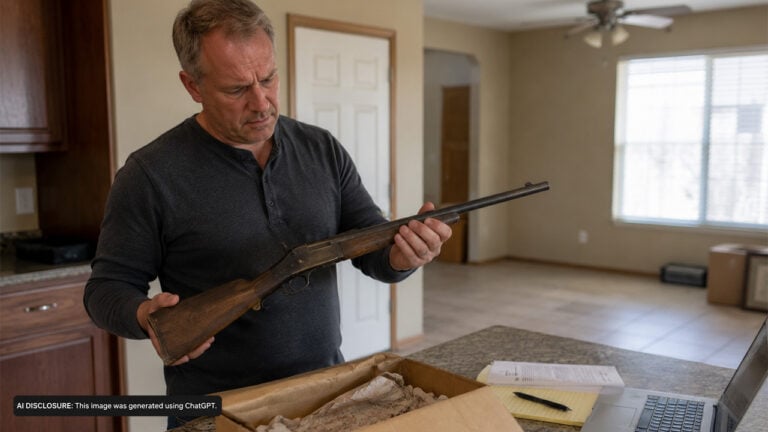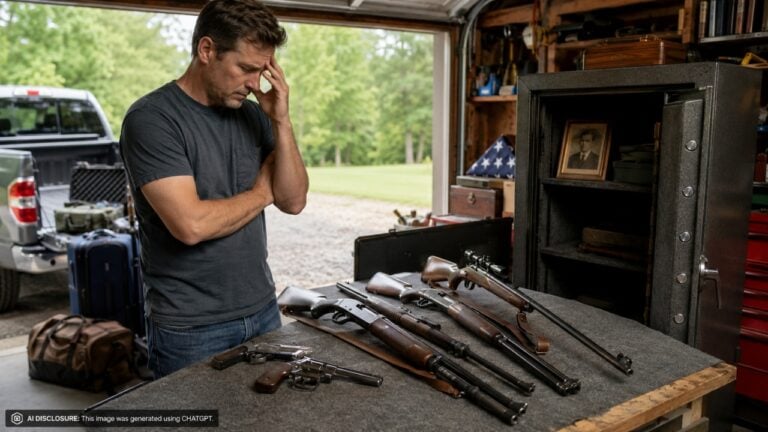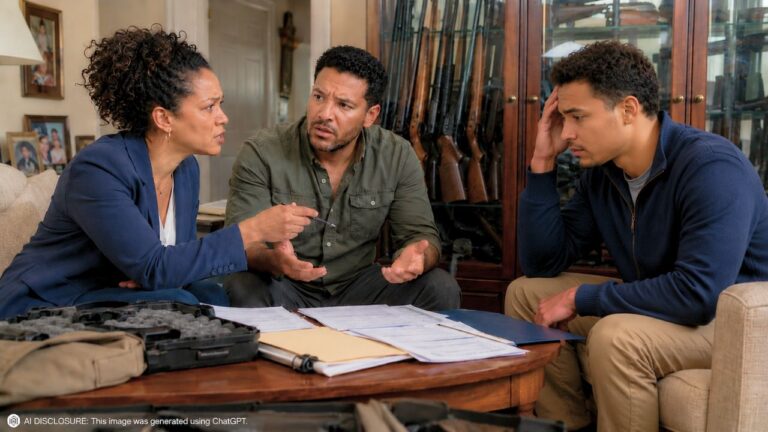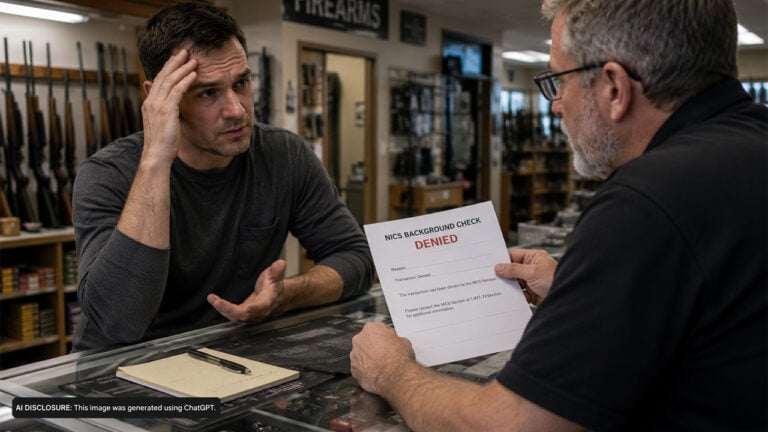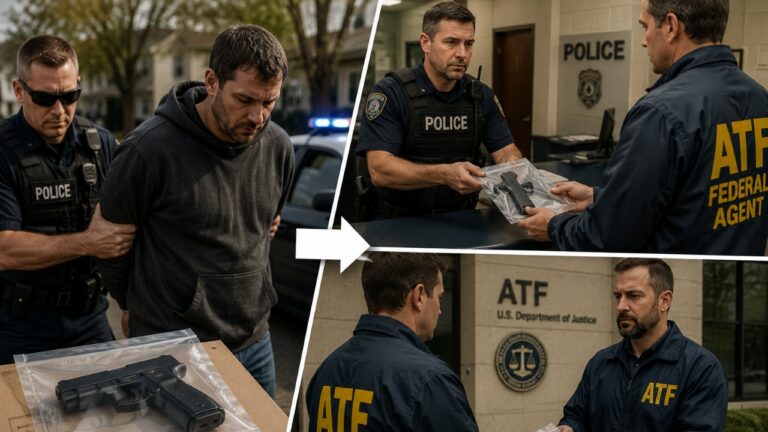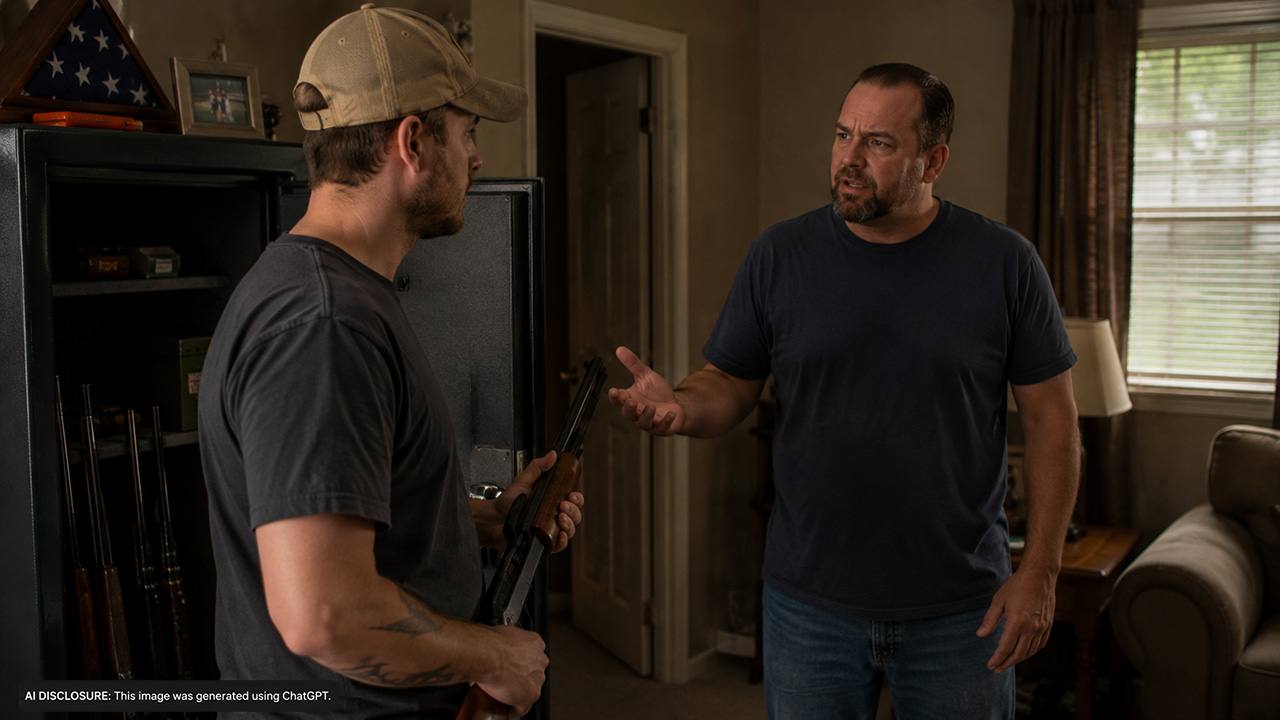
Photo credit: AI-generated image created using ChatGPT. Illustrative only
Every gun safe in America has a story behind it, and sometimes that story gets complicated fast. One Pennsylvania hunter found himself in exactly that spot after storing his dad’s hunting and antique firearms decades ago when his father went away on a nonviolent white-collar felony conviction.
Now the dad is off paper, more than 20 years removed from prison, and convinced the political winds have shifted enough that he can legally own guns again. The son, meanwhile, is staring down a problem a lot of outdoorsmen don’t think about until it’s in their lap: handing over firearms to a prohibited person can put you in the crosshairs, too.
The guns were stored away, not forgotten
According to the original post, the father is a “nonviolent white collar crime felon” who served his time and has had no additional charges since. When he went away, he “had to get rid of his guns,” which included hunting guns and antiques. Like a lot of families do, the firearms didn’t get tossed in a river or quietly sold off at a yard sale—they were stored.
That seems straightforward until you remember what “stored” often means in real life. It can mean dad still thinks of them as his guns. It can mean the son has been the caretaker, not the owner. And it can mean there’s never been a clean legal handoff that matches what state and federal law actually expects when firearms change hands.
One comment on TV can light a fuse in a gun room
The father’s push to get the guns back wasn’t random. The son said his dad believes things have changed because “Trump said nonviolent felons can have guns,” and because he “guess[es] there was a Supreme Court case recently that ruled in favor of a non violent felons.” The dad even went as far as buying a gun case, which tells you he’s not just talking—he’s planning.
This is where a lot of families get sideways. People hear a headline about rights being restored, or a court case that sounds promising, and they assume it’s a green light. But gun law doesn’t work like a light switch. Even when a court ruling makes the news, it may apply to one person’s specific facts, one jurisdiction, or it may not change the law the way folks assume at the gun counter.
In this situation, the son couldn’t find anything showing federal law or Pennsylvania law had been “overturned,” and he was trying to keep his dad from “go[ing] back to prison over something so stupid.” That’s the right instinct, because the cost of being wrong here is high.
The risky part: the son could be the one “transferring” the firearms
When folks talk about felons and guns, they usually focus on the prohibited person holding a rifle or having a pistol in the truck. What gets missed is the step right before that: the moment someone hands the gun over, sells it, “gives it back,” or even leaves it somewhere the prohibited person can access.
If you’re the son in this situation and you hand guns to someone who is still prohibited, you may be stepping into a transfer you shouldn’t be making. And even if you don’t physically hand them over, letting a prohibited person have access can create its own set of problems depending on the facts—what “possession” means can be broader than people think.
This is why the son’s question matters to everyday hunters. A lot of us have stored guns for a buddy during a divorce, held onto Grandpa’s shotgun “for now,” or locked up a family member’s firearms while they got their life straight. Most of the time it’s done with good intentions. But intentions don’t carry much weight if the law says the person can’t possess firearms and you helped make that happen.
A retired lawyer friend and a gut feeling aren’t the same as a green light
The father wasn’t just arguing from cable-news soundbites. The son said his dad has “a retired lawyer friend (not criminal) who is telling him go ahead and do it.” That’s the kind of outside reassurance that can make a hardheaded person dig in even deeper.
But “lawyer” is a broad label. Firearms disability law is its own animal, and the details matter—conviction grading, the specific offense, whether rights were restored, and what Pennsylvania recognizes versus what federal law recognizes. Someone who hasn’t practiced criminal law or firearms law can be confidently wrong, and confidence is exactly what gets people in trouble.
If you’re in the son’s boots, this is where you slow everything down. Don’t argue about politics. Don’t argue about what someone “heard.” Make it about paperwork and authority: show me the statute, show me the restoration order, show me the official documentation that says you can possess firearms again. Anything short of that is just noise.
What the son was trying to do: verify the law without starting a family war
The son asked practical questions a lot of folks would ask: Is it still illegal for felons to have guns in Pennsylvania? Where can he find a solid source? Should he call non-emergency police? He wasn’t trying to get his dad jammed up—he was trying to keep him out of trouble and also keep himself from becoming part of the problem.
That’s a tightrope. Calling the police to “ask a question” can sometimes bring attention you didn’t intend, especially if firearms are involved and there’s already a prohibited-person angle. On the other hand, doing nothing and hoping it works out is how guns end up in the wrong hands and families end up in court.
A grounded way to approach it, in plain outdoorsman terms, is this: before any guns move, treat it like a property-line dispute. You don’t guess where the line is—you look at the survey. Here, the “survey” is official guidance and an attorney who actually works with firearms law in Pennsylvania. If dad truly is eligible again, there should be a clear path to prove it. If he isn’t, you’ve got the documentation to show him, and to protect yourself from being the guy who “gave a felon his guns back.”
The simplest outdoorsman rule: don’t let urgency make the decision
This situation has all the ingredients for a bad outcome: family pressure, politics, a stack of guns with sentimental value, and a person who’s convinced the rules changed. The son is right to want sources and to take it seriously, because one bad handoff can turn into confiscation, charges, and a long-term mess that makes hunting seasons and family gatherings miserable for years.
If you ever find yourself storing firearms for someone who may be prohibited, the safest move is to pause, verify eligibility through reliable channels, and avoid any “just give them back quietly” talk. Guns last a long time. So do legal consequences. Slowing down is almost always the smartest play.
Like The Avid Outdoorsman’s content? Subscribe to our newsletter so you never miss an article.
Here’s more from us: