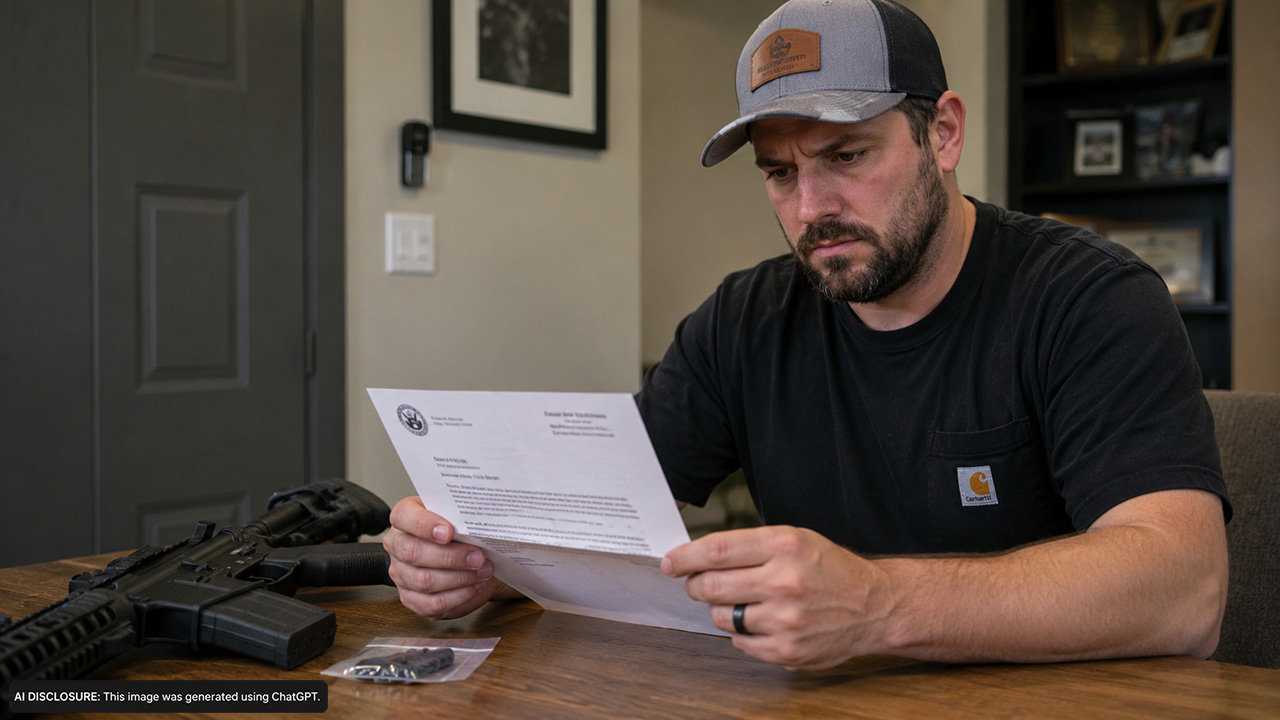
Photo credit: AI-generated image created using ChatGPT. Illustrative only
A gun owner says he did what plenty of regular folks would do when federal agents show up at your door and start talking prosecution: he complied. About a year and a half ago, he says his local ATF office threatened him with charges over an FRT-15 trigger, and he surrendered it. Now he’s got a new letter in the mailbox—one that cites a court case the agency lost last year over the FRT ban, but still reads like it’s trying to keep a tight grip on who actually gets their property back.
A knock from the local office turned into a surrender
In the account shared in the original post, the owner describes being “threatened… with prosecution” by a local ATF office and handing over his FRT. He doesn’t describe a courtroom, an arrest, or a formal seizure process in the post—just a hard choice made under pressure.
That detail matters for anyone who owns guns and gear that’s been in the political crosshairs. Whether it’s a suppressor, a brace, a trigger, or just a plain old hunting rifle with the wrong feature, the real-world stress isn’t theoretical. It’s a uniform at your door and the possibility you’ll be the “example.”
The letter references a lost court fight—but the wording doesn’t sit right
The new development is the letter itself. The owner says the ATF letter references a court case the agency lost last year regarding the FRT ban, and that’s what throws him. If the agency lost, the common-sense expectation is: return the property that was collected under the disputed position.
But, as he describes it, the letter seems to talk out of both sides of its mouth. In one paragraph, he says it states they must “return to all parties… including individuals.” Then the next paragraph narrows it down, saying they only have to return them to “litigants,” specifically including NAGR and TXGR members who were valid in 2023.
If you’ve ever read a government letter that feels like it was written by five different people and approved by three different layers, you know the vibe. One line sounds broad enough to cover everyday owners. The next line sounds like a gate slammed shut.
Why that “members in 2023” line hits rural gun owners in the wallet
Most outdoorsmen don’t join a group because they’re looking for a courtroom fight. They join for training, insurance, advocacy, or just to support gun rights in general. But the way this letter is described, membership status in a particular year could be the difference between getting your legally purchased property back—or being told you’re out of luck.
That’s not just an internet argument. It’s real money. Triggers, optics, and accessories aren’t cheap anymore, and the bigger issue is the principle: if you were pressured into surrendering something you bought over the counter, the least you expect is a straight answer on whether it’s coming back.
Hunters and landowners are used to clear rules, even when we don’t like them. Seasons open and close. Tags are limited. Trespass is trespass. What drives folks crazy is a moving target—especially when the “moving” part comes in the form of a letter that sounds like it’s redefining who counts.
The machine gun label is the part that changes everything
The owner’s frustration sits in a bigger reality: when the ATF treats an accessory as a machine gun, it’s not a slap on the wrist. That label changes the whole legal temperature of the room. Suddenly you’re not talking about an argument over parts—you’re dealing with a category that carries heavy consequences.
In practical terms, that’s why this kind of situation makes regular gun owners sweat. A lot of folks who’ve never had so much as a speeding ticket are one official decision away from being treated like a criminal over something they bought believing it was lawful. Even if you never intended to break a law, you still get stuck dealing with the process.
The post doesn’t include the letter’s full text, and it doesn’t lay out a full timeline beyond “about a year and a half ago” and “a few days ago.” But the core problem is clear: the owner is trying to reconcile the agency’s reference to a court loss with language that appears to limit who gets property returned.
What people in the gun community tend to focus on in situations like this
The owner asks if anyone else has gone through the process and essentially asks what’s going on. That’s usually where other gun owners lean into a few practical points: keep documentation, don’t rely on phone calls, and get clarity in writing.
If you’re ever in this kind of bind, the “outdoorsman practical” approach is the same as dealing with a property-line dispute: paperwork wins. Receipts, correspondence, serial numbers where applicable, and any record of what was surrendered and when. If the agency is saying one thing in one paragraph and another thing in the next, you need to be able to point to the exact wording and ask a direct question about your status.
And it’s worth saying out loud: there’s a big difference between staying respectful and volunteering information. Most folks aren’t looking for a fight; they just want to protect themselves and their families. When the stakes involve felony territory, it’s not “paranoid” to slow down and treat every step like it matters.
This owner’s situation is the kind that makes everyday gun owners feel like the rules only make sense after you’ve already been put through the wringer. He says he complied when threatened, and now he’s reading a letter that appears to broaden and narrow the return policy in back-to-back paragraphs. Whether it ends in a returned trigger or a dead end, the lesson for the rest of us is simple: when an accessory gets labeled like a machine gun, the margin for confusion disappears fast—and you’d better be ready to deal in documents, not assumptions.
Like The Avid Outdoorsman’s content? Subscribe to our newsletter so you never miss an article.
Here’s more from us: