Photo credit: The Avid Outdoorsman
A concealed carrier in Reddit’s r/CCW shared a story that reads like the kind of near-miss people tell after they have already replayed it in their head a dozen times. He said he was at work, went into the bathroom, and nearly had a negligent discharge because a holster screw had worked loose enough that his setup failed at exactly the wrong moment. In the original Reddit thread, he told the story under the title “Check your gear,” which says a lot about how he understood it afterward: https://www.reddit.com/r/CCW/comments/o60mr0/check_your_gear_aka_how_i_almost_had_an_nd/. (reddit.com)
What makes the story hit is that he did not frame it as a mysterious gun problem or a freak accident that came out of nowhere. He framed it as negligence built on complacency. That matters, because a lot of carry mistakes get told in a way that quietly shifts blame toward the gear, the brand, the holster, or bad luck. He did not do that. He said the issue was a loose screw, yes, but he also made it clear that the deeper failure was trusting the setup without checking it closely enough before normal daily life found the weak point for him.
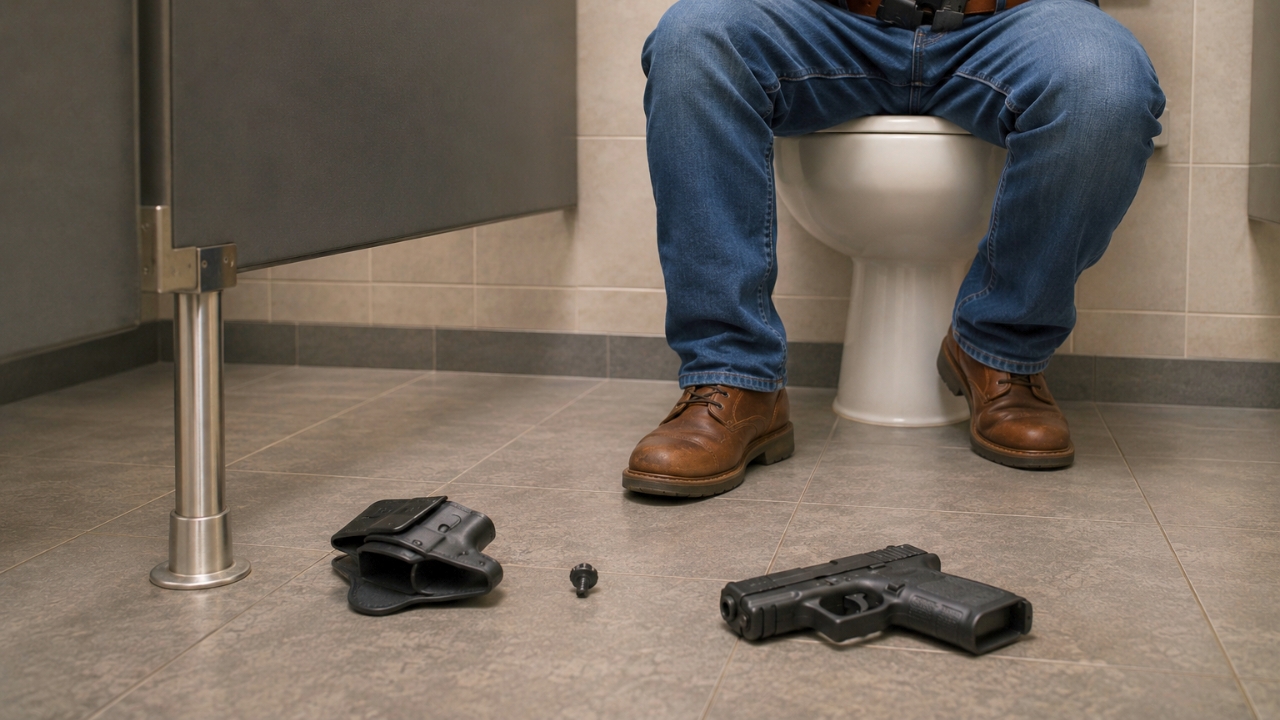
The setting made it worse in a very familiar way. Bathrooms show up over and over in carry stories because they test a concealed-carry setup differently than almost any other everyday environment. Belts loosen. Holsters tip. Shirts get pushed around. Pants drop lower than usual. Normal support angles disappear. If something on the holster has been gradually backing out, a bathroom break is exactly the kind of moment where the problem can stop being theoretical and become immediate. That is what happened here. He was not fighting with the gun, showing it off, or reholstering in a hurry. He was simply in a bathroom at work when a hidden hardware issue got exposed in the worst possible way.
The phrase “nearly turned a bathroom break at work into a self-inflicted shooting” does most of the emotional work because it tells you how close he believed the margin had become. This was not one of those stories where somebody later realizes, in a calm abstract way, that something could have gone wrong. He was describing a moment where he felt the danger right there in front of him. A carry system he trusted had shifted into a position where the wrong movement, the wrong snag, or one more second of bad handling could have put a round into his own body.
That kind of near-miss often lands harder than the more obvious accident stories because it exposes how quietly the problem built up. A loose screw does not announce itself all at once. It usually backs out slowly over time. Maybe the holster still feels mostly right when standing. Maybe the draw still feels okay. Maybe nothing seems off during a normal walk into work. Then the wrong angle arrives, the body moves in a way the setup has not been ready for, and all at once the carrier realizes he has been trusting something that needed attention long before that moment. That seems to be exactly the lesson he was trying to drive home.
The comments under a thread like that usually go straight to maintenance, and for good reason. A lot of experienced carriers responded to stories like his by talking about thread locker, hardware checks, regular inspection, and not treating holsters like permanent “set it and forget it” gear. People spend a lot of time talking about guns, belts, optics, lights, and ammo. Holster screws, rubber spacers, clips, and retention hardware often get less attention even though they are the parts physically responsible for keeping the firearm in place all day. That imbalance is part of what his story pushed back against. The gun may be the most serious object in the system, but the tiny hardware pieces are often the ones deciding whether the whole system holds together under real movement.
There is also something especially unsettling about the work setting. A bad bathroom moment at home is terrible. A bad bathroom moment at work adds a whole second layer of consequences. Even if no shot is fired, the carrier is thinking not only about his own body, but about coworkers outside the door, workplace policy, how much noise the incident might make, who might see what, and how fast a private gear failure could become a public employment problem. That pressure hangs over the story even without a dramatic outcome. A self-inflicted shooting in a workplace bathroom would not just be a medical emergency. It would become a permanent part of how that workplace understands guns and whoever carried one there.
The fact that he blamed complacency instead of the gun is probably the strongest part of the whole account. It turns the story from “look what almost happened to me” into “look what I let slide until it nearly happened to me.” That distinction matters because it keeps the lesson grounded. A loose screw is fixable. A sloppy maintenance habit is fixable. A false sense that “it feels fine enough” is fixable. The story becomes much more useful when the person telling it is honest about where the responsibility really sits.
A lot of carriers will read something like this and immediately think about their own rigs: when did I last check the screws, how much retention do I actually have right now, have I noticed any wiggle lately, have I been ignoring little signs because the holster still basically works? That is the value in a near-miss told honestly. It forces people to look at the boring part of the carry system — the part nobody gets excited about — and admit that the boring part can be the only thing standing between routine daily carry and a moment that gets ugly very fast.
The bathroom setting also brings out a hard truth about concealed carry that people do not always say plainly: everyday life is more dangerous to weak gear than dramatic life. Most failures do not happen during a cinematic self-defense draw. They happen while sitting, driving, bending, undressing, using a stall, getting dressed again, and moving through all the awkward body mechanics that real life throws at the setup. That is why his story works so well as a warning. It does not depend on some rare tactical event. It depends on a bathroom break and one little piece of hardware that had been quietly working toward failure.
And that is where the story lands. A man went to the bathroom at work with a carry rig he thought was fine, only to realize a loose holster screw had put him much closer to a self-inflicted shooting than he ever should have been. He did not blame the gun. He blamed the complacency that let the hardware get to that point. In the end, the lesson was not glamorous at all. It was the same kind of lesson most bad carry stories turn into once the adrenaline wears off: check your gear before real life checks it for you.
Like The Avid Outdoorsman’s content? Subscribe to our newsletter so you never miss an article.
Here’s more from us: