Photo credit: AI-generated image created using ChatGPT. Illustrative only
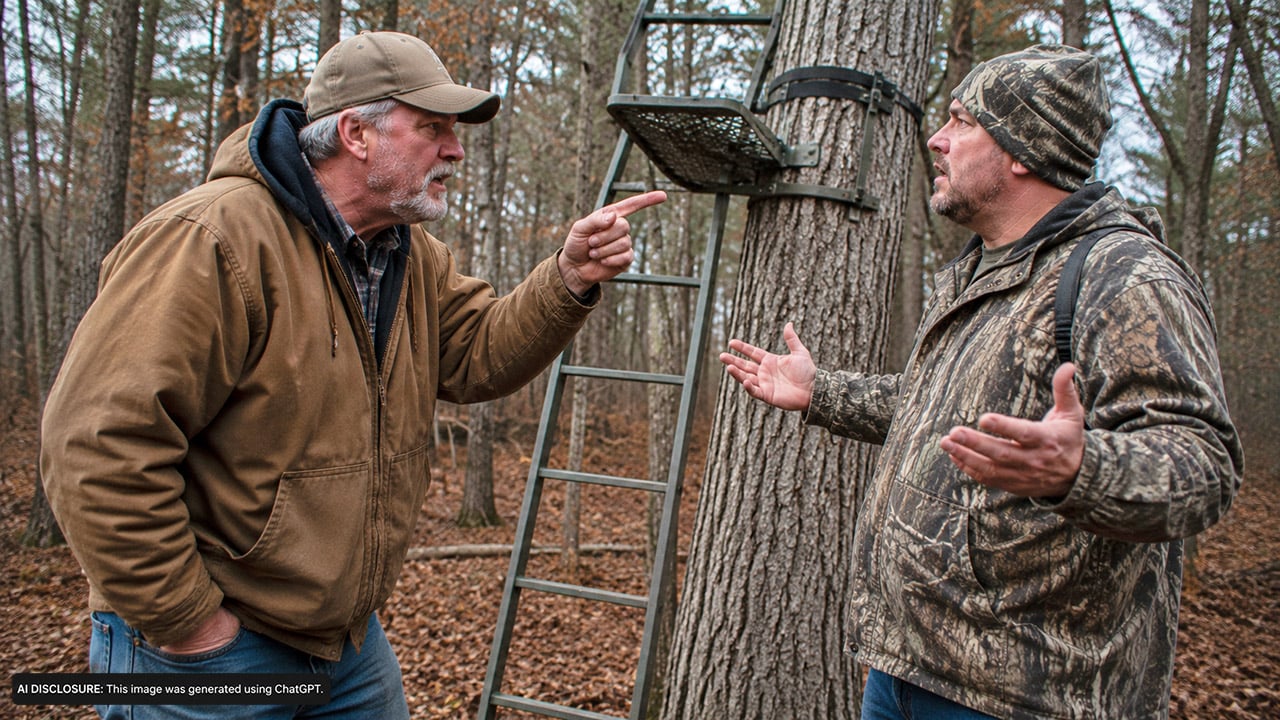
Running a blade down a woods road on your own place is about as normal as it gets—until you spot something that shouldn’t be there. That’s what happened to a Georgia landowner who was maintaining roads on his property near a national forest when he noticed a hunting stand sitting just off the road, only about ten feet from his property line.
In the original post, the landowner said the stand was chained around an old pine tree, close enough to the line that it would be easy for someone to “miss” where public ground ends and private ground starts. But it was still on his side. His questions were straightforward: Can he cut the chain and remove it? Can he sell it to cover the hassle?
A stand on private dirt is more than an annoyance
Most hunters who’ve spent time around public land boundaries know this situation isn’t rare. Somebody finds a hot pinch point near a line, hangs a stand, and hopes nobody notices which side of the paint it’s on. When it’s a portable stand carried in and out each sit, the damage is usually limited to boot tracks and a little aggravation.
But a stand chained to a tree is different. It’s an item left in place, it can scar a tree if it grows into the chain, and it tells you the person plans to come back—often in the dark, often during the rut, and often without asking permission. For a landowner, that’s a safety issue as much as it is a trespass issue.
The property-line detail that matters: “about ten feet”
The landowner described the stand as being roughly ten feet from the property line. That’s close enough that a trespasser might later claim it was an honest mistake, especially if the boundary isn’t clearly marked or if the national forest line isn’t obvious in that stretch of timber.
But “close” doesn’t change whose land it is. If the stand is on private property, it’s not the same as something left on public ground. The practical problem is proving where that stand sat before anything gets moved, because once you drag it out, the argument turns into a pointing match.
Cutting chains and yanking stands can create its own headaches
The first instinct for a lot of folks is simple: it’s mine now, and I’ll remove it however I have to. And sure, the stand and chain are physically on your land. But destroying a chain, even to remove something, is still destroying someone else’s property—property that shouldn’t be there, but property nonetheless.
That’s where these things get sticky. A trespasser who’s bold enough to hang a stand on private land can also be bold enough to argue about it afterward, including tossing around threats about lawsuits or demanding the stand back. Even if their legal footing is weak, the landowner still has to deal with the hassle if it turns into a dispute.
What a smart landowner’s “best course of action” usually looks like
When you find a stand like this, the goal is to solve two problems at once: get the hazard off your property and protect yourself from a messy claim later. A solid first move is documentation—photos of the stand in place, photos showing its relationship to the road and the boundary area, and any visible landmarks that make the location clear.
From there, many landowners lean toward involving the right local authority rather than handling it like a personal tug-of-war. In Georgia, that can mean contacting local law enforcement or the state wildlife folks, depending on the situation. The point isn’t to “make it a big deal.” The point is to create a clean record that the stand was there, it was on private property, and you handled it through the proper channel.
If the boundary isn’t clearly marked, that’s another practical takeaway. Fresh paint, posted signs where legal, and cleared sightlines on corners can prevent “oops” stands from showing up in the first place—or at least make it harder for someone to claim confusion.
The question about selling it is where folks get sideways
The landowner asked if he could sell the stand to offset the cost of removing it. That’s a fair-feeling question—because why should you spend your time and money fixing someone else’s bad decision?
But selling it quickly turns the situation from “removing trespass equipment” into “taking ownership of someone else’s property.” Even when the stand was placed wrongfully, the safest route is usually to treat it like found property tied to an incident, not like a free garage-sale item. The cleanest outcomes tend to involve either an official pickup process, a return through authorities, or whatever the applicable local rules allow after a documented holding period.
In other words: removing it is one thing; profiting from it is another. And if a trespasser later pops up making noise, that “I sold it” detail is exactly the kind of complication you don’t want.
Why this keeps happening around national forest edges
Ground bordering national forest attracts pressure. Hunters get crowded, they walk farther, they start hugging the line to stay away from people, and then the temptation shows up: “Just a little closer. Just one tree over.” A stand placed ten feet onto private property is often the result.
There’s also the plain reality that some folks don’t respect boundaries. They gamble that the landowner won’t notice, won’t care, or won’t want the confrontation. And if the stand is chained to a tree, that gambler is planning to treat your place like an extension of the forest all season long.
For landowners, the best defense is making your lines obvious and checking the edges before and during hunting season—especially near roads, gates, and easy access points. The earlier you catch it, the easier it is to handle calmly and cleanly.
At the end of the day, a chained stand on private land isn’t just “somebody’s gear.” It’s a sign somebody made themselves comfortable on your property without permission. Handle it like you would any other trespass problem: document it, avoid a face-to-face showdown in the woods, and use the proper channels to get it removed without handing the other guy an argument he doesn’t deserve.
Like The Avid Outdoorsman’s content? Subscribe to our newsletter so you never miss an article.
Here’s more from us: