Photo credit: AI-generated image created using ChatGPT. Illustrative only
When predators hit a flock, you expect it to be coyotes, feral hogs, or maybe a stray pack drifting through. What you don’t expect is three pet dogs coming under your fence in the night and turning a quiet sheep pen into a wreck before breakfast.
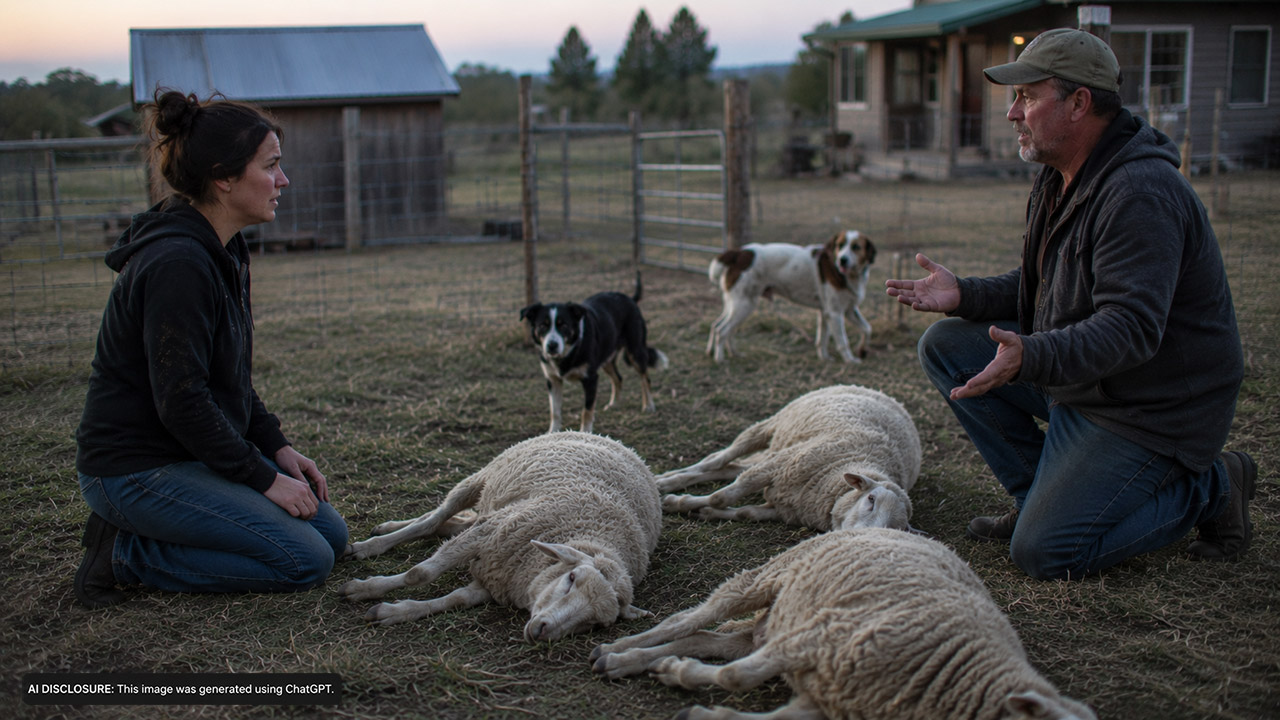
That’s what a homesteader in Parker County, Texas, says happened when the neighbor’s three dogs got onto their property and killed two sheep, badly injuring a third lamb that “may not make it.” The owner also captured video of the attack, which matters—because once the dust settled, getting anyone to take responsibility proved harder than stopping the dogs in the first place.
Three dogs, one fence line, and a fast-moving attack
According to the source post, the dogs came under the fence and went straight to work. Two sheep were killed. A baby sheep was injured badly enough that survival wasn’t guaranteed.
The owner did what a lot of rural folks wish they had time to do in the moment: they documented it. Video evidence of the dogs actively attacking livestock isn’t just “nice to have.” It’s often the difference between a neighbor admitting it happened and a neighbor claiming it didn’t—or that it was “something else.”
The kicker: these dogs reportedly killed goats before
The situation got more frustrating because this wasn’t described as a first offense. The same three dogs were said to have killed five goats belonging to another neighbor a few months earlier, and that earlier incident apparently never involved law enforcement.
That’s the rural trap right there. Folks handle things with a handshake, try to keep peace, and avoid calling the sheriff. Then the behavior repeats, the stakes get higher, and suddenly you’ve got a pattern—without a paper trail.
Calling the sheriff didn’t bring the help the owner expected
After the sheep were killed, the owner called the sheriff and filed a report. They were told it was a civil issue, with the main option being to work it out with the neighbor or pursue it in small claims court.
Animal control was also sent out and spoke with the neighbor’s wife, who was home at the time. She was described as distraught and said they’d pay “whatever they need to.” But the dogs weren’t located and were still out, which is its own problem—because an animal that already ran livestock once doesn’t need much encouragement to do it again.
Later, after a follow-up call, the sheriff’s department reportedly told the owner to call every time the dogs were off the owner’s property and take a picture, so citations could be issued each time. Beyond that, they were told there wasn’t much else available criminally or legally unless the dogs hurt a person or were found “at large.”
A face-to-face talk went sideways fast
That evening, the owner walked over, introduced themselves politely, and told the neighbor what happened: his dogs were on their property and killed sheep. The neighbor’s response, according to the post, was blunt: “you should have shot them.” He repeated that line when asked to ensure the dogs wouldn’t return.
The neighbor also said he would shoot his own dogs but “doesn’t have the heart to do it.” What he didn’t do, according to the owner, was offer a plan to contain them or take steps to prevent another incident.
Then came the money. The owner asked for $360—described as the purchase price of the two dead sheep ($200 for one, $160 for the other). The neighbor said he couldn’t pay that.
Anybody who has kept livestock knows the purchase price is only part of it. Feed, fencing, time, breeding potential, and the plain fact that it’s your animal—those don’t show up on a receipt. But even with a modest reimbursement request, the conversation went nowhere.
The owner’s response
With the situation still active, the owner filed a petition to take the neighbor to court. The goal was twofold: reimbursement for the sheep and an order pushing the neighbor to keep the dogs contained or give them up.
At the same time, the owner started hardening their defenses. They reinforced the spot where the dogs dug under the fence, but they didn’t pretend that would be enough. Three large dogs that have already tested one weak point will test another.
Two bigger steps followed in quick order. First, the owner arranged to buy a donkey gelding to live with the herd full-time, then confirmed they had acquired the donkey. Second, they stated they were buying a firearm within the week and planned to train at the range. They also said that if the dogs return and are harassing animals on their property, they’ll shoot to kill—while noting they didn’t have the means the first time.
This is the part that makes non-livestock folks uncomfortable, but it’s reality in the country: you can’t outsource protection of your animals to a dispatcher and a long response time. If you’re not home, the attack is already over. If you are home, you may have seconds to act.
What people tend to miss about “dogs just got out”
The headline version of these stories always leans on accident—dogs got loose, gate was open, kids left a door ajar. Sometimes that’s true, once. But repeated roaming is ownership, not bad luck.
And there’s a major safety angle that doesn’t stop at sheep. Three big dogs running at night can turn into a threat to kids walking a driveway, a jogger on a county road, or a neighbor trying to break up an attack. Livestock is often the first target because it’s accessible and vulnerable. That doesn’t mean it’s the last.
The owner in this case also raised a point plenty of rural landowners have made for years: if a person came onto your property and started killing your animals, there would likely be criminal consequences. But when it’s dogs, the response can feel like a shrug and a court form—unless someone gets bitten.
Whether that’s how it should be or not, the practical lesson is the same: document everything, report everything, and build layered defenses. Fence repairs help, but so do cameras, lighting, and guard animals—because once dogs learn they can get an easy kill, they tend to come back.
For this Parker County owner, the next few weeks look like a mix of legal pressure and day-to-day vigilance: small claims moving forward, papers being served by the sheriff, and a new donkey standing watch in the pasture. It’s not the kind of “homestead problem” anybody wants, but it’s one a lot of folks recognize—because in the country, your peace and your livestock are only as safe as the weakest neighbor on the fence line.
Like The Avid Outdoorsman’s content? Subscribe to our newsletter so you never miss an article.
Here’s more from us: