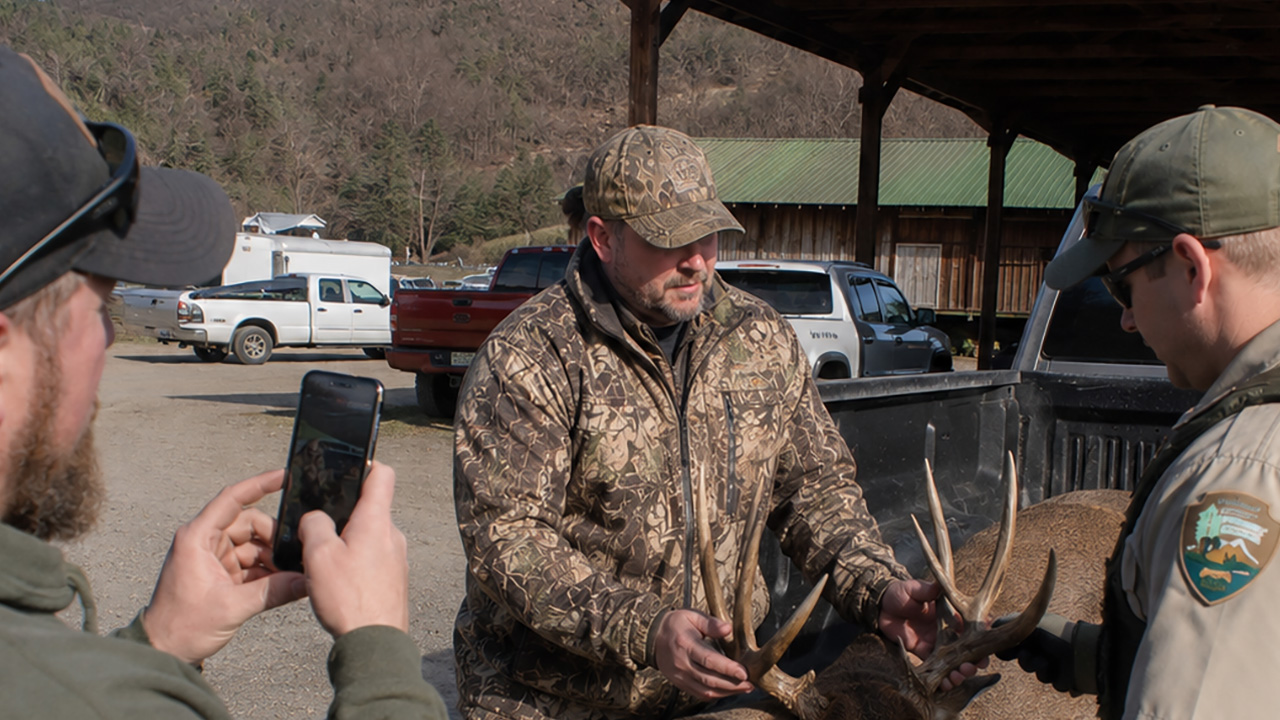
Photo credit: AvidOutdoorsman
It doesn’t take much these days for a hunting photo to turn into a dogpile. One clean grip-and-grin shot, one tag in the wrong place, or one detail folks think looks “off,” and suddenly a guy who did everything by the book is getting treated like he stole something.
That’s exactly what played out after a public-land hunter posted a photo with his buck on Instagram. Within hours, the comments weren’t about the hunt or the meat. They were about legality, ethics, and a whole lot of assumptions—and the pile-on grew into tens of thousands of angry replies and messages.
The post that set it off
The hunter’s photo wasn’t flashy. It was a straightforward end-of-hunt shot: rifle leaned on the pack, buck laid out in the grass, tag visible in the frame. He’d mentioned the unit in a general way and thanked a buddy who helped drag it out.
The problem was the timing. He posted the same evening he killed it, and plenty of people decided the animal looked “too big” for the season they assumed was open. Others zoomed in and claimed the tag placement was wrong, the antlers didn’t match the local rules, or the animal had been shot on private land without permission.
Once the accusation train gets moving, it doesn’t stop for things like facts.
How a few wrong assumptions turned into 40,000 comments
Most of the heat centered on three things: whether the buck met the antler restrictions, whether the tag was filled out correctly, and whether he killed it where he said he did. A handful of accounts posted cropped screenshots and drew circles on the photo like they were running a crime lab, not looking at a hunting picture on a phone screen.
One common claim was that the buck was taken out of season because the poster didn’t include the full context—he was hunting an early management window that’s legal in that area, and he was using a specific tag that doesn’t line up with what most people are used to seeing. Another claim was that the antlers didn’t meet a “four-point rule,” which turned out to be a rule that applies in some zones, not the one he was in.
The internet doesn’t like boring answers, and “different unit, different rule” is about as boring as it gets.
Commenters locked onto tag placement, blood, and antlers
If you hunt long enough, you know how it goes at the check station: some animals bleed more than others, sometimes you take photos before you get the animal completely cleaned up, and sometimes a tag looks odd in a picture because it’s folded or wet or flapping in the wind.
But online, those normal details got turned into “evidence.” People argued about whether the tag was attached properly, whether it had been notched, and whether it should have been on an antler versus a hind leg. A few claimed that because they couldn’t read the handwriting in the photo, it must not have been filled out.
Then came the antler debate. Folks counted points from a single angle and declared it illegal. Anyone who has ever judged a rack in brush or bad light knows how easy it is to miss a brow tine or count a broken tip wrong. When you’re pausing a video or zooming a compressed photo, it gets worse.
There’s also a hard truth here: a lot of people don’t actually know the regulations as well as they think they do. They know the rules where they live, and they assume those rules apply everywhere.
The hunter did the smart thing: he went to the check station anyway
Some guys would delete the post, go quiet, and hope it blows over. Some would clap back and pour gas on it. From what folks around the situation described, this hunter did something better—he kept his paperwork in order, kept his mouth mostly shut, and took the deer through the normal process.
In that state and unit, harvested deer from certain seasons are required to be checked, either physically or by a hybrid system that includes an in-person inspection at staffed stations during peak days. He rolled into the check station like any other hunter: carcass cooled, tag with the animal, license and validations ready.
What happened next is the part that matters, because it’s the part nobody in the comments section can fake.
Game and Fish looked him over on camera and signed off
At the station, wardens and technicians did what they always do. They checked the tag, verified the season and unit, and confirmed the animal matched the rules for that tag. They looked at points, measurement criteria that apply in that area, and the method-of-take requirements.
They also walked through the timeline: when it was taken, where it was taken, and whether it was transported legally. The hunter had the confirmation number and documentation that matched. In other words, the boring stuff was solid—because he’d done it right from the start.
The on-camera clearing wasn’t a dramatic “gotcha” moment. It was the exact opposite: a simple verification at a check station, the kind most hunters experience when they’re required to stop. The staff signed off, recorded the harvest, and sent him on his way.
And that’s the part the online mob never seems to want to accept: a legal kill can look “wrong” to somebody who doesn’t know the local regs, doesn’t understand the tag structure, or just wants to be mad.
What this teaches the rest of us about posting kills online
I’m not here to tell anyone to stop posting hunting photos. But if you do, understand the trade. The minute you post a dead animal, you’re inviting attention from people who don’t like hunting, people who think they’re the hunting police, and people who just want a fight.
There are a few practical habits that keep you out of trouble even when you’re completely legal. Keep your tag and license organized and protected from weather. Take a couple photos that clearly show proper tagging and the animal as it was recovered. If your state issues digital tags or confirmations, screenshot them and save them offline.
Also, be careful about how much location information you share. Not because you’re doing anything wrong, but because strangers will use it to invent a story. A general unit mention can turn into accusations of trespass. A background landmark can turn into “I know that ranch” nonsense. And once that ball gets rolling, you can’t put it back in the bag.
Most importantly, don’t let comment sections dictate your behavior in the field. Follow the regs, hunt ethically, keep your paperwork straight, and let the check station do its job. The woods have enough real problems without adding a made-up one from somebody staring at a zoomed-in screenshot.
In the end, the only opinion that mattered was the one at the check counter—license verified, animal verified, harvest recorded. Everything else was just noise.
Like The Avid Outdoorsman’s content? Be sure to follow us.
Here’s more from us: