Photo credit: AI-generated image created using ChatGPT. Illustrative only
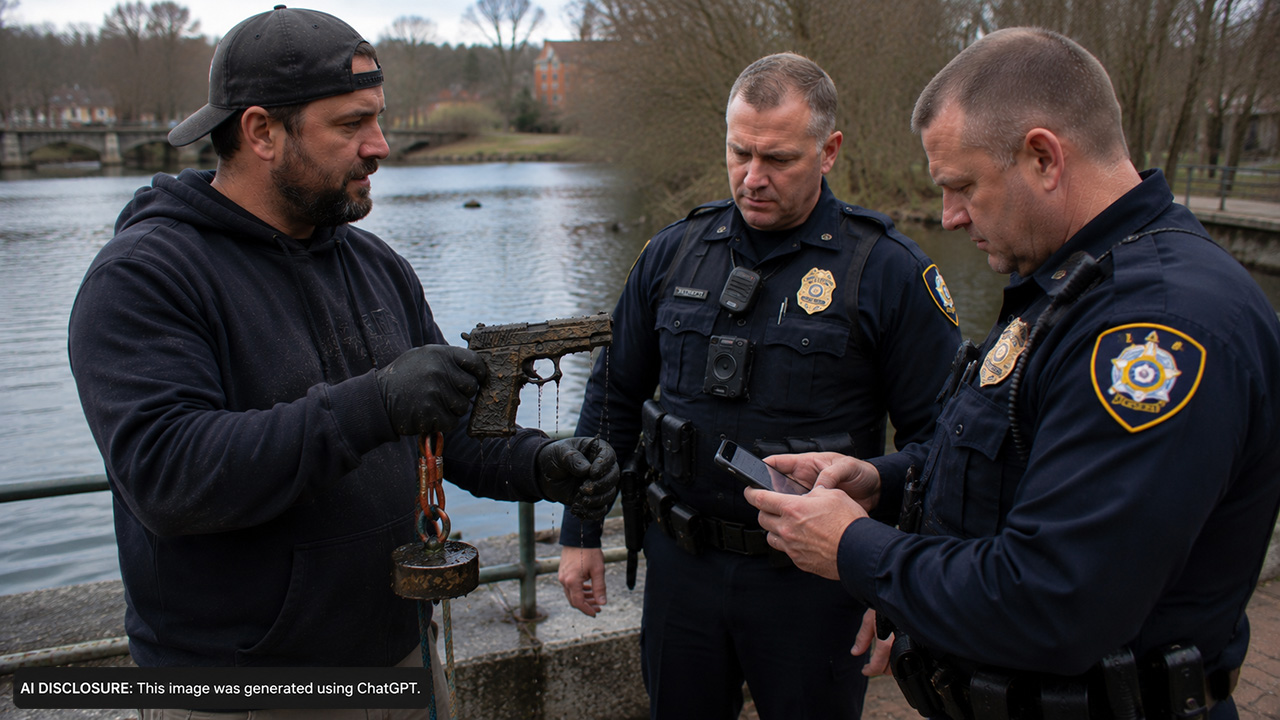
You’re out on the bank, magnet bouncing off rocks and shopping carts, when it sticks hard and comes up heavier than it should. Instead of another chunk of scrap, it’s a handgun—muddy, rusty, and suddenly a whole different kind of problem.
That’s the situation one magnet fisher was thinking through in the original post, asking the question a lot of outdoorsmen have had cross their mind: if you pull a gun from the water, how do you handle it without turning a good day outside into a mess? The big worry wasn’t just safety. It was the possibility the gun could be tied to a crime, and the last thing anybody wants is to “find” something that ends up being on a stolen weapons list once a serial number gets run.
The moment it turns from junk-hauling to evidence
Most magnet fishing finds are predictable—rebar, bolts, old tools, maybe a bike frame. A firearm changes the tone immediately because it can be more than litter. It can be lost property, a stolen gun, or a piece of evidence that somebody tried to ditch.
The post cuts right to the point: there’s concern about people handling guns bare-handed, and the bigger concern that the gun could be connected to a crime. That’s not paranoia. If that serial number comes back hot, the story stops being about magnet fishing and starts being about paperwork, chain of custody, and explaining exactly what you did with it from the time it left the water.
Why bare hands are a bad idea even if you’re “just looking”
The question mentions seeing people touch found guns with no gloves. From a practical outdoorsman standpoint, that’s a mistake on a couple levels. First is the obvious: you don’t know the condition of the firearm, and you don’t know what’s in the chamber or what’s jammed up in the action. Waterlogged doesn’t automatically mean harmless.
Second is the part that makes folks uneasy—fingerprints and evidence. If the gun is tied to something serious, you don’t want your prints and DNA all over it because you were curious. Even if you’re 100% in the clear, you’re volunteering to complicate an investigation and your own day.
The serial-number reality: it can come back stolen
Gun owners understand serial numbers aren’t decoration. They’re how a firearm gets identified, and they’re a straight line to the “stolen” column when a law enforcement database gets checked. The headline angle here is simple: a magnet fisher does the right thing and calls police, and officers run the serial number and find it listed as stolen.
That’s exactly why the original poster didn’t want to keep a gun that might be connected to a crime. Keeping it—and especially taking it home—can create the wrong appearance fast. Even if you had no bad intent, possession of stolen property is a problem nobody needs, and sorting it out after the fact is rarely quick or pleasant.
Call first, handle less, and let the paperwork happen
The post is essentially a “what would you do?” from someone trying to stay on the right side of things: do you report to the police before keeping the guns, and how do you handle it? The common-sense approach outdoorsmen tend to default to is also the simplest: treat it like you just found something that isn’t yours and could be evidence.
That means minimal handling, keep it pointed in a safe direction as best you can, and get law enforcement involved. If you’re on public ground, it’s not your job to decide whether that gun is trash or treasure. If you’re on private property you control, you still don’t gain anything by playing detective. The “win” is being able to say you found it and reported it without turning it into a bigger situation.
The temptation to keep it—and why that’s where people get burned
Let’s be honest: plenty of folks see a found gun as a prize. Even in rough shape, guns have value, and some people like the idea of cleaning one up as a project. But the original poster’s instincts are solid. A firearm isn’t like an old wrench you can soak in oil and toss in the toolbox.
If that gun has a history—stolen, used in a crime, or even just reported lost—trying to claim it can put you in a bind. And even when it turns out to be “nothing,” you may still end up handing it over while it gets checked out. The best case is you lose time. The worst case is you gain a problem that follows you around.
The post highlights two things that matter to people who live around guns and take them seriously: safety and staying clean legally. It’s not about being afraid of law enforcement; it’s about not creating unnecessary suspicion and not contaminating a situation that may involve a victim on the other end of that serial number.
If you’re the kind of person who carries, hunts, and teaches new shooters, you already know the rule: don’t handle unknown firearms casually. A magnet fishing find is the definition of “unknown.” The right move is to slow down, keep your hands off it as much as possible, and make the call so the serial number can be checked the right way.
Pulling metal out of waterways is a good hobby, and it can do some real cleanup. But the minute a firearm comes up on your magnet, it’s not a cool find anymore—it’s a responsibility. Handle it like it matters, because sometimes it does, and you don’t want your name tied to a stolen gun for any longer than it takes to do the right thing.
Like The Avid Outdoorsman’s content? Subscribe to our newsletter so you never miss an article.
Here’s more from us: