Photo credit: Theavidoutdoorsman.com
It was the kind of stop most of us make without thinking—top off the tank, grab a drink, maybe a bag of jerky for the road. A concealed carrier walked into a small convenience store just off a county highway and immediately felt the air change. The clerk’s eyes were wide, and a nervous-looking guy near the counter kept glancing toward the door like he was timing his exit.
Within seconds, it turned into the sort of mess every responsible gun owner hopes to avoid and trains to survive: a robbery in progress, a stranger making bad choices, and no guarantee the next move wouldn’t turn violent.
The robbery unfolded fast at the counter
According to investigators, the suspect had slipped behind the counter line and demanded cash while keeping one hand tucked near his waistband. Whether he actually had a weapon or was just trying to sell the threat didn’t matter to the people standing there. In close quarters, a bluff still gets folks hurt.
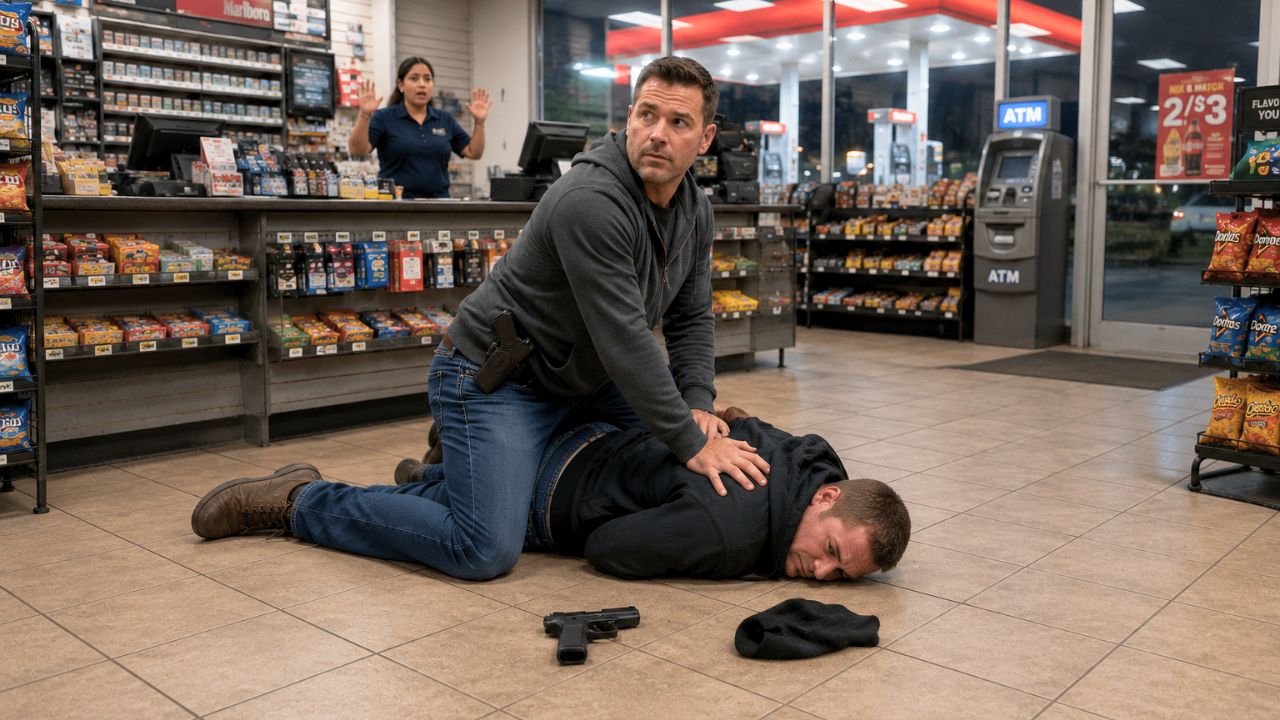
The concealed carrier didn’t charge in like a movie hero. He moved off the “X,” got an angle where he could see the suspect’s hands, and gave a firm command to stop. Witnesses said the carrier drew his handgun and held it at a low-ready position, not waving it around, but making the point clear: the robbery was over.
The suspect froze, then dropped the handful of cash he’d already grabbed. He didn’t rush the carrier, and that’s probably what kept everyone breathing. The carrier kept distance, told the clerk to call 911, and watched the suspect’s hands like his life depended on it—because it did.
Holding a suspect is where “good deed” can turn into “bad day”
Plenty of states allow some form of citizen’s arrest or detention under specific conditions, but that’s not a free pass to play cop. The concealed carrier reportedly ordered the suspect to the ground and kept him there until patrol units arrived. No shots fired. No one injured. From a pure safety standpoint, it went about as clean as it ever does.
But here’s the part that trips people up: the moment you restrain someone—or even keep them at gunpoint—your actions start getting judged under a different lens. Was the threat still active? Could you have safely disengaged? Did you cross the line from stopping a violent felony to unlawfully detaining someone who was no longer a threat?
In the store, it’s easy to see why a carrier would hold the suspect. You’ve got an armed robbery, a scared clerk, and a guy who could bolt into the parking lot and carjack somebody. In a perfect world, the police arrive in two minutes. In the real world, response times vary, and people on scene feel like they’re the only safety plan.
Why the carrier ended up walking into a station later
After officers took the suspect into custody at the gas station, the carrier did what a lot of folks think is the “right” move: he tried to be fully cooperative. He gave a statement at the scene, provided his permit, and later went to the station to follow up—partly to make sure his side was recorded correctly, partly because he didn’t want to look like someone who “brandished and vanished.”
That decision is understandable. It also put him in the middle of an interview process that can feel less like “thanks for helping” and more like “we need to assess whether you committed a crime too.” Once the carrier was in a controlled setting, investigators could slow everything down and examine choices second by second: how long the gun was out, what commands were given, whether the suspect was compliant, and whether any force continued after compliance.
By the end of the visit, the carrier was surprised to learn he was being charged. Not with anything related to the original robbery—but with offenses tied to how he intervened. Think along the lines of unlawful restraint, aggravated menacing-type allegations, or improper exhibition/brandishing depending on the state’s wording.
The legal tripwires concealed carriers forget about
Most of us understand the big principle: you can use force to stop an imminent threat of death or great bodily harm. The problem is that the “imminent” part changes quickly. If the suspect drops the cash, puts his hands up, and backs away, a prosecutor may argue the deadly-force justification is fading by the second.
Another tripwire is pursuit. If a suspect turns and runs, chasing him into a parking lot—or worse, into traffic—can look less like self-defense and more like escalation. Even if you never fire, pointing a gun at someone who is fleeing can be treated very differently than pointing a gun at someone actively threatening a clerk at arm’s length.
Then there’s the citizen’s arrest concept. Some states allow it for felonies committed in your presence. Others narrowly define it, and some practically discourage it with a tangle of conditions. If you detain the wrong person, detain for too long, or use more force than the law allows, you can be the one explaining yourself in handcuffs.
One more that gets overlooked: the moment police arrive, you need to be ready to comply instantly. Officers roll up to “man with a gun” calls keyed up and operating on incomplete information. If you’re still holding someone at gunpoint when they arrive, you can get treated like the bad guy until things sort out.
What folks were arguing about afterward
Gun owners who followed the case mostly split into two camps. One side said the carrier did what any decent person would do—stopped a robbery, protected a clerk, and kept the suspect from hurting someone. They pointed out that criminals don’t deserve the benefit of the doubt, and that letting the suspect walk could have ended with a carjacking, a hostage situation, or a shooting down the road.
The other side focused on the part that makes experienced carriers cringe: continuing to hold the suspect once the immediate danger was over. Plenty of instructors preach a simple rule—create distance, get to safety, be a good witness. They’ll tell you that detaining a suspect is a job for uniformed officers with radios, backup, and legal protections you don’t have.
A third group honed in on the station-house decision. They argued that going in voluntarily without legal counsel can turn a clean self-defense story into a pile of contradictions. Under stress, people misremember details. Times compress, distances stretch, and a single poorly phrased sentence can be interpreted as intent.
The practical lessons for everyday carriers
None of this means you should stand there while a violent felony happens. It means you need a plan that includes what comes after the threat stops. If you draw, you need to know what would make you holster. If you point a gun, you need to know what would make you disengage.
The cleanest outcome for everyone is usually: stop the threat, get the innocent parties to safety, call 911, identify yourself as the reporting party, and comply when officers arrive. If the suspect is fleeing and you’re no longer protecting life in that moment, letting them go can feel wrong—but it often keeps you on the right side of the law.
And if you’re involved in anything like this, it’s worth remembering that “cooperative” doesn’t mean “unprotected.” Give the basic facts needed for safety and the initial report, then get counsel before you try to talk your way into being understood. The carrier in this case learned the hard way that doing the moral thing and doing the legally safe thing aren’t always the same lane.
A good concealed carry setup is more than a pistol and a holster. It’s judgment, restraint, and knowing when the fight is over—before you become the next person being processed and photographed, even after you stopped the first bad act from getting worse.
Like The Avid Outdoorsman’s content? Be sure to follow us.
Here’s more from us: