Photo credit: AI-generated image created using ChatGPT. Illustrative only
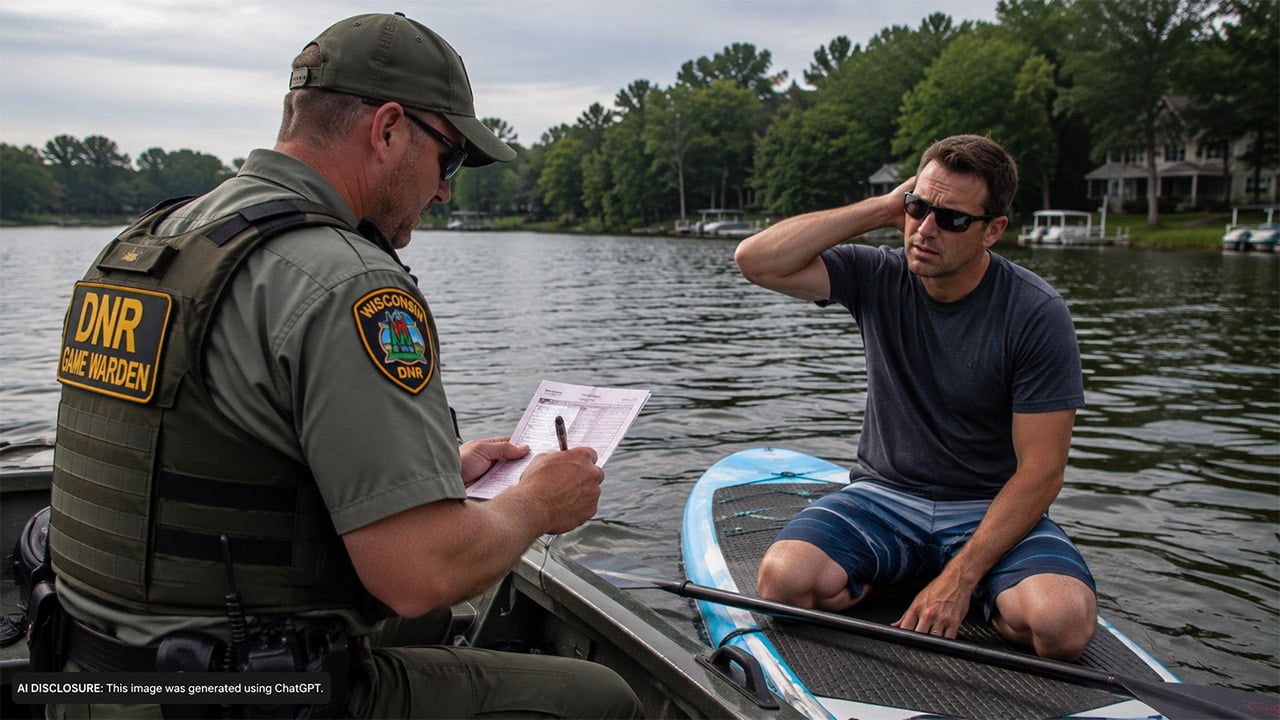
Most folks don’t think of a paddleboard as “a boat,” especially when they’re in chest-high water on a small inland lake. But one Wisconsin paddler learned the hard way that the state can see it differently when a DNR game warden pulls alongside you with a motorboat.
In the original post, the paddler described being about 50 feet from shore in roughly 4 feet of water on a lake that’s only about 7 feet deep at its maximum. They said a warden approached by motorboat, questioned them, and ultimately issued a $232 citation for failing to carry a required flotation device under Wisconsin statute 30.62(3)(a).
On a busy little lake, the warden’s boat changed the whole situation
The paddler wasn’t out on a big, windswept reservoir or a river with current. They described a wide but shallow lake with pontoon traffic and recreational fishing—exactly the kind of place where a conservation warden is likely to be watching for safety issues.
What stood out was the way the contact reportedly happened. The paddler said the motorboat’s wake and close-in presence made their board feel less stable than it had at any point before the stop. Anyone who’s spent time in a canoe, kayak, or on a board knows how fast “calm water” turns sporty when a bigger hull throws waves at you.
“For safety reasons,” the paddler says they were ordered into the boat
According to the account, the warden told the paddler to get into the motorboat “for safely reasons” and bring the paddleboard alongside. Once aboard, the paddler was issued the citation for not wearing or having a life jacket.
This is where the outdoorsman brain starts doing math. If the contact was about safety, forcing someone to transfer from a paddleboard to a motorboat can either reduce risk—or add to it—depending on conditions, boat handling, and how the transfer is done. The paddler’s description suggests they didn’t feel safer during the interaction, especially with the instability caused by the boat’s movement near the board.
The ticket centered on “carry” requirements, not just wearing one
The citation language the paddler shared was “Fail/carry boat floatation devices,” tied to Wisconsin statute 30.62(3)(a). Even without getting deep into legalese, that wording matters in plain English: it points to having the required flotation device with you, not necessarily having it strapped on your body at every second.
That’s a common hang-up for folks who come from the hunting and fishing world. We’re used to rules that hinge on possession—license on you, tag on the animal, plug in the shotgun, orange on your back. On the water, many states treat paddleboards like small vessels for safety gear purposes, and wardens tend to enforce the “you need one on board” rule the same way they would for a canoe or kayak.
The paddler’s own description makes clear they didn’t have a life jacket with them. Whether you’re in 4 feet of water or 40, that’s the piece that can turn a “warning and move on” stop into a payable citation.
The part that really rubbed them wrong: dropped off and told to walk in shallow water
After writing the ticket, the paddler said the warden told them he’d drop them off where they first put in. But because the lake was shallow, they say the boat stopped about 50 feet from shore and the warden had them get back out into the water and walk the board to land.
That detail is what the paddler focused on when they asked if they had an argument to get the $232 bond dropped. In their mind, being ordered into the boat for safety, then being put back into the water to wade out, felt contradictory—and maybe even like “abandonment.”
From an outdoors perspective, it’s easy to understand the frustration. If the officer’s stated reason was safety, sending someone off on foot in the lake after a boat stop sounds like a mixed message. At the same time, shallow water can limit where a prop-driven boat can safely operate. A warden might not be able to physically get to the shoreline without risking the boat, the motor, or the paddler’s board.
What people tend to focus on in these situations: the law doesn’t care how shallow it is
Even without a stack of comments included in the source material, you can almost predict the practical pushback any warden—or any boater who’s seen bad days—would give: people drown in shallow water all the time. Knock your head, cramp up, get tangled, panic, or get hit by a wake at the wrong angle, and “it’s only four feet” stops mattering.
On small lakes with pontoon traffic, the hazard isn’t just depth. It’s chaos. A pontoon throws a wake. A bass boat can appear quick. And a paddleboarder is low to the surface and easier to miss, especially with sun glare and weekend traffic.
That’s why a lot of states treat paddleboards like vessels, and why enforcement often doesn’t change just because you’re close to shore. Fifty feet from land sounds close until you’re in trouble, winded, or disoriented. Wardens see the ugly outcomes, so they tend to write the ticket where the statute gives them the authority.
How a paddler can avoid this same headache on Wisconsin waters
This story is the kind of thing that gets prevented before you ever touch the water. If you’re running a paddleboard on a lake with motor traffic and a warden presence, assume you need the basics: a properly fitting U.S. Coast Guard-approved PFD on board, and ideally on your body if conditions get choppy.
A lot of paddleboarders also run a leash, because if you fall off, the board can scoot away faster than you’d think—especially when wake and wind are working together. And if you’re going to be around pontoons and fishing rigs, bright colors and staying predictable helps too. The goal isn’t to “beat a ticket.” It’s to keep a simple afternoon from turning into a rescue situation.
As for the paddler’s question about fighting the citation based on being told to get in the boat and then wade out: it may feel inconsistent, but it doesn’t change the central issue described in the ticket—no life jacket carried. When you’re sharing water with heavy weekend traffic, the cheapest piece of gear you can bring is the one that keeps you floating if everything goes sideways.
Like The Avid Outdoorsman’s content? Be sure to follow us.
Here’s more from us: