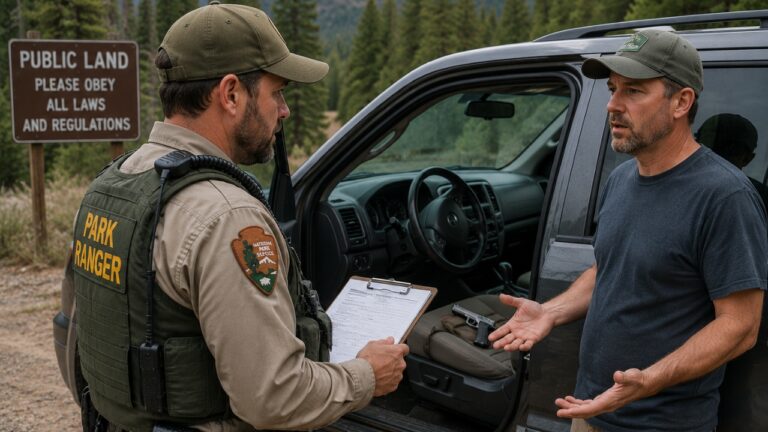
Photo credit: Theavidoutdoorsman.com
Buying a place in the country comes with a certain kind of excitement. You’re already picturing a gun room, a reloading bench, maybe a freezer full of venison by next season. Then you open a closet in the back bedroom and find a heavy steel gun cabinet bolted through the studs, locked up tight, and clearly not something the previous owner planned to carry out on moving day.
That’s exactly the kind of surprise that turns a normal home purchase into a mess of safety questions, property-rights arguments, and “don’t touch it” advice from half your buddies. And when the seller shows back up claiming what’s inside still belongs to him, the situation goes from annoying to serious in a hurry.
A locked cabinet became the first red flag
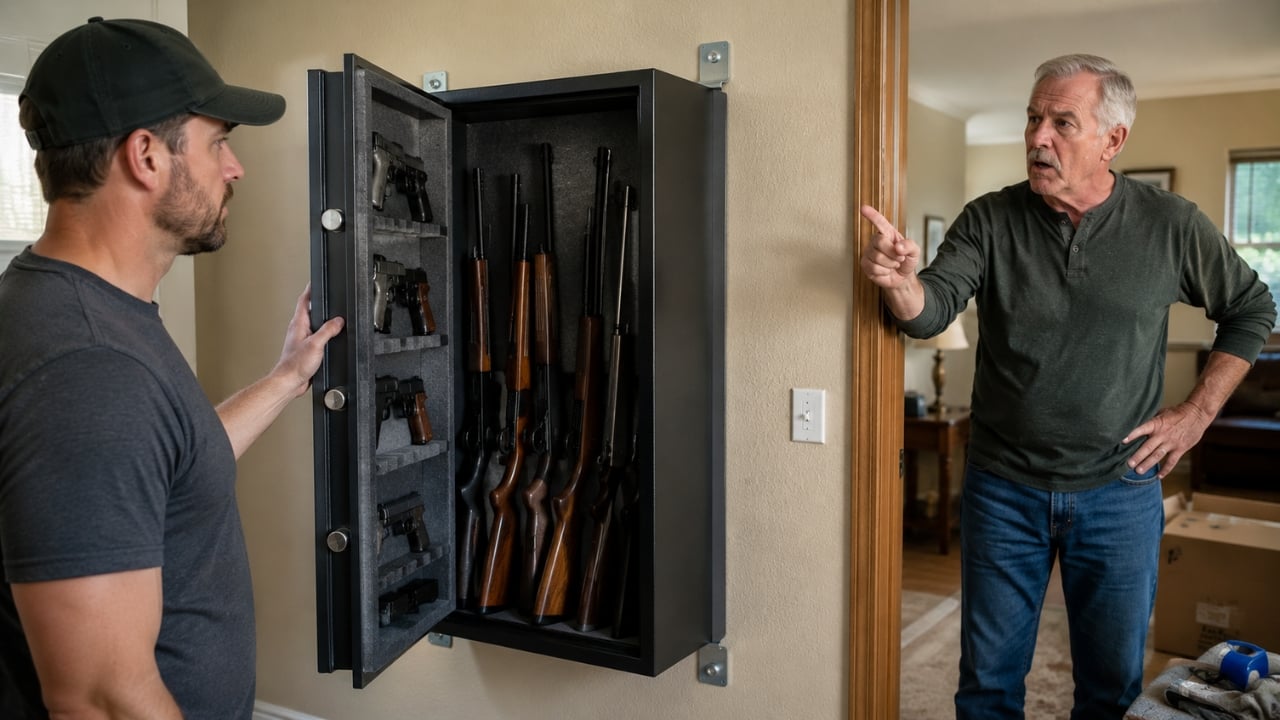
The new homeowner noticed the cabinet during a walk-through after closing. It wasn’t a cheap plastic locker—this was a full-size steel cabinet, anchored to the wall and floor like it was meant to stay put. The key wasn’t on the key ring, the combination wasn’t written anywhere obvious, and none of the paperwork left behind mentioned it.
Most folks have seen sellers forget paint cans, old appliances, or a pile of scrap lumber. A locked firearms cabinet is different. You don’t know if it’s empty, loaded up, or holding something that creates a legal headache the second you start messing with it.
The seller’s call changed the whole tone
Within a day or two, the previous owner reached out saying he’d “left some items” and needed to pick them up. When the new homeowner asked what items, the answer was blunt: guns. Not a single rifle—multiple firearms, supposedly still inside that locked cabinet.
That’s where the temperature goes up. When you buy a house, anything left behind often becomes part of the property unless the contract says otherwise. But firearms aren’t like a couch. Even if you’re a gun guy, you don’t want to be the one guessing where ownership starts and ends, especially if the other party is already acting like they can show up and take what they want.
The new owner wasn’t interested in a driveway argument. He also wasn’t interested in letting someone he barely knows step back into the home to retrieve firearms. That’s a personal security issue, not just a “lost and found” issue.
Safety and liability were the real problem
Every responsible gun owner I know had the same gut reaction: don’t try to pry it open, don’t drill it, and don’t “see if you can get it” with a buddy’s tools. A locked cabinet bolted into a newly purchased home creates a weird situation—those guns might be perfectly legal, or they might be stolen, improperly stored, or tied up in something you don’t want near your name.
There’s also the simple safety concern. If the cabinet contains loaded firearms and something gets knocked around during an attempted move or forced entry, you’ve just created risk for no good reason. Even if nothing goes wrong physically, you could still end up explaining to an officer or a court why you were forcing open a container that wasn’t yours.
In a lot of rural areas, folks are used to handling things handshake-style. But once guns and a locked container are involved, the smart move is to slow down and get it handled cleanly.
The paperwork matters more than feelings
Most purchase agreements have language about what conveys with the home and what does not. Appliances, fixtures, and anything attached to the structure are usually spelled out. A cabinet bolted to studs sure starts to look like a fixture—until you remember what’s inside can be treated very differently than the cabinet itself.
The seller’s claim that the firearms are still his might be true in the plain-English sense. He bought them, he owned them, and he forgot them. But property law and gun law don’t always follow the same “common sense” trail, and the cleanest path is usually documentation: serial numbers, proof of purchase, and something in writing that shows the firearms are his and not abandoned property.
The new homeowner’s side of the fence is simple too: he owns the house now, and he’s responsible for what’s inside it. If something happens—break-in, theft, a kid finds a key later—he’s the one living with it. That’s why letting the seller “just swing by” isn’t a casual favor.
A calm plan beat a driveway showdown
Instead of meeting the seller alone, the new homeowner took the conservative route: keep the cabinet secured, communicate in writing, and insist on a scheduled pickup that didn’t involve the seller roaming through the home. The basic idea was to treat it like any other high-liability property exchange—witnesses, clear boundaries, and no improvising.
In situations like this, a lot of folks choose to have the exchange happen with a neutral third party involved, whether that’s an attorney, a real estate broker, or local law enforcement present to keep things orderly. Not because anyone’s trying to “get someone in trouble,” but because firearms bring out strong emotions, and strong emotions lead to bad decisions.
If the seller can’t produce keys or a combo, that becomes another layer. The new owner shouldn’t be put in the position of defeating a lock to access items he’s being told he can’t legally keep. It’s one thing to help someone retrieve property; it’s another to become the guy who forced open a gun cabinet and took possession, even temporarily.
What outdoorsmen zeroed in on right away
Predictably, the loudest opinions focused on two things: abandoned property and “possession.” Plenty of folks argued that if it was left behind after closing, it’s now the buyer’s. Others countered that guns don’t magically become yours just because they’re sitting in your new closet, and that treating them like leftover furniture is how you end up in a mess.
A lot of outdoorsmen also pointed out the practical angle: if the seller truly cared about those firearms, he would’ve handled it before closing, listed them in the contract, or at least left keys and a note through proper channels. Forgetting a cabinet full of guns doesn’t happen to a careful person. That doesn’t automatically make the seller a bad guy, but it does justify the buyer being guarded.
And then there’s the security crowd, who saw a different risk: a seller who knows the home layout, knows where valuables are, and now has a reason to return. Whether his intentions are good or not, it’s not smart to normalize access after the deal is done.
If you’re ever in this spot, treat it like a safety problem first and a property dispute second. Don’t force the cabinet. Don’t hand out access codes to your new home. Keep every message and voicemail. And push the entire situation into daylight—scheduled meeting, clear proof of ownership, and a controlled handoff.
Most of the time, the clean ending is simple: the seller proves what’s his, the buyer gets the cabinet out of his house, and everyone goes their separate ways. But the right way to get there isn’t a handshake at the front door—it’s a careful, documented process that keeps guns secured and tempers low.