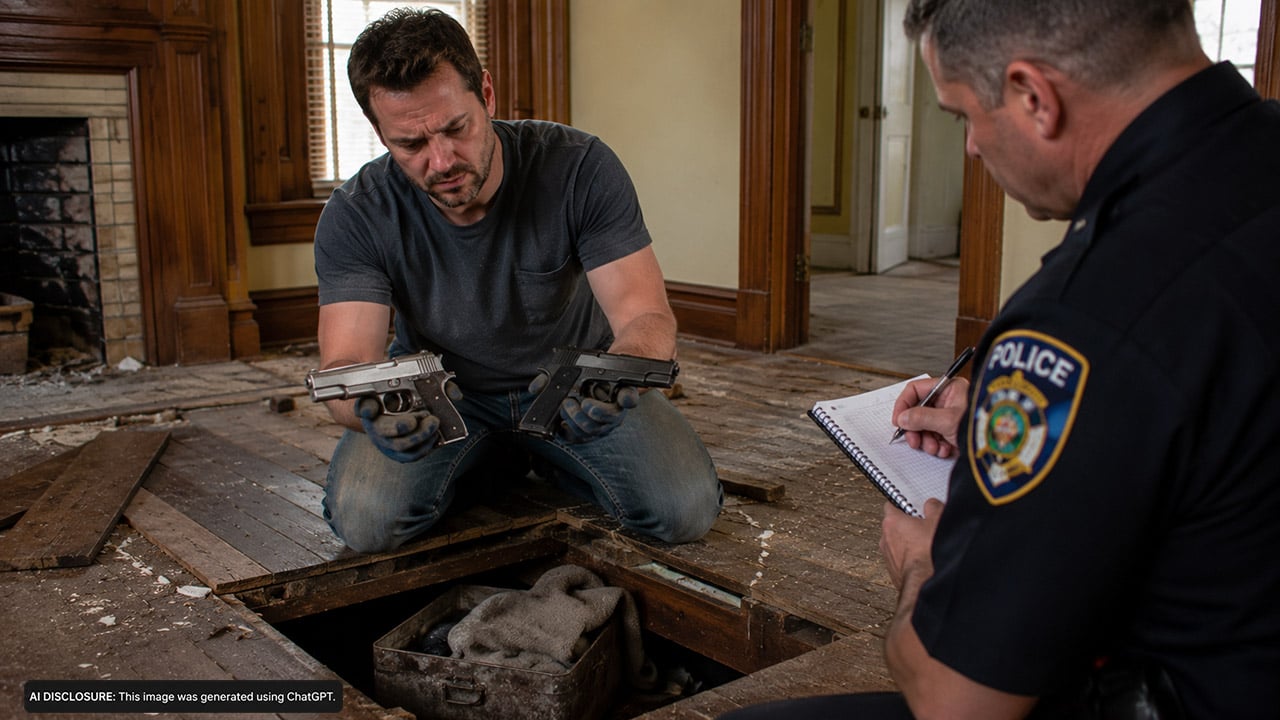
Photo credit: AI-generated image created using ChatGPT. Illustrative only
When you inherit a house, you expect to deal with leaky faucets, old paint, maybe a shed full of rusted tools. What you don’t expect is to peel back part of the structure and find firearms stashed away like somebody planned to come back for them.
That’s exactly what one Michigan resident’s friend ran into, according to the original post. While cleaning up an inherited home described as “a mess,” they found a false wall with multiple handguns hidden inside—and no paperwork in sight to show who owned them or whether they were even legally possessed.
A hidden cache turns a cleanup project into a serious problem
In the outdoors world, plenty of us have bought or inherited properties with surprises: old traps in a barn, forgotten ammo cans, maybe a dusty shotgun in a closet. But a deliberate hiding spot—especially a false wall—changes the feel of it.
It’s one thing to find Grandpa’s revolver in a bedside table. It’s another to find multiple handguns tucked behind construction meant to keep them out of sight. Right away, you’re dealing with two problems at once: safety and legality.
The first priority is safe handling and secure storage
Before the legal side even comes into view, you’ve got to make sure nobody gets hurt. If you’re not 100% comfortable confirming a firearm is unloaded, the smart move is to stop and get help from someone who is—preferably a qualified gun shop, instructor, or local law enforcement on a non-emergency call.
And if there are kids, curious relatives, or contractors coming and going, those guns can’t just sit on a counter while you “figure it out.” Secure them in a locked safe if you have one. If you don’t, separate them from any ammunition you find and keep them in a locked, inaccessible spot until you know what the proper next step is in your area.
Michigan paperwork questions aren’t just paperwork questions
The person asking for help said their friend hadn’t found any documentation tied to the handguns—at least not yet. That’s common in estate situations. Houses get cleaned out in waves, papers end up in boxes, and records might be buried under years of mail.
But with handguns, the lack of paperwork isn’t a minor inconvenience. Depending on the model and how it was originally acquired, there may be registration or purchase records that matter. And if the firearms belonged to the previous owner but were never properly documented, or if they belonged to someone else entirely, the inheritor doesn’t want to accidentally step into possession of stolen property.
The stolen-gun risk is the part that can bite hard
Even if your gut tells you the guns were just “stashed for home defense” years ago, you can’t assume that’s the full story. A handgun hidden behind a wall could be somebody’s idea of a safe place—or it could be a way to keep a gun out of plain view because it had a problem attached to it.
That’s where the headline angle hits home for gun owners: if one of those handguns runs through a serial number check and comes back as stolen from an old burglary—say, one reported in the late ’90s—your plans change fast. Nobody wants to be the person holding a stolen pistol because they tried to do the right thing and clean up an inherited property.
The practical concern is straightforward: once a firearm is identified as stolen, you likely won’t be keeping it, and you don’t want to create a situation where it looks like you were trying to hang onto it or move it quietly.
What folks tend to recommend in situations like this
The post itself is short and sticks to the main question: “what is the proper way to handle these (Michigan, USA)?” Even without a long comment thread pasted in, the usual advice in scenarios like this tends to center on a few common-sense moves.
First, don’t sell them, don’t gift them, and don’t start moving them around from truck to truck while you decide what to do. That’s how a simple discovery turns into a complicated conversation if you get pulled over, have a break-in, or somebody sees them and calls it in.
Second, consider contacting the appropriate local authority to ask how to surrender or verify status without putting yourself in a bad position. Many agencies have a way to handle found property and can advise on safe transfer procedures. If you’re concerned about how that conversation might go, talking to a Michigan attorney who understands firearms law is money well spent—especially if the house is part of an estate with multiple heirs.
A practical, outdoorsman mindset: treat it like a boundary line dispute
If you’ve ever dealt with a property-line issue, you already understand the right mindset here. You don’t go marching up to the neighbor swinging a chainsaw because you “think” the fence is wrong. You get the survey, you get the facts, and you keep your hands clean.
Same idea with hidden handguns. Don’t assume they’re legal, don’t assume they’re illegal. Don’t assume they’re yours just because they’re inside a house you now own. You slow down, document what you found (dates, locations in the home, and general condition), and you take the route that’s boring and defensible.
Because if one of those serial numbers ties back to an old burglary report, the story stops being about inheritance cleanup and starts being about returning somebody else’s property—and proving you handled it responsibly from the start.
Inheriting a home can be a blessing, but it can also hand you problems you didn’t ask for. When firearms are part of that surprise, the best play is simple: make it safe, don’t move too fast, and get the right local guidance before you do anything that can’t be undone.
Like The Avid Outdoorsman’s content? Subscribe to our newsletter so you never miss an article.
Here’s more from us: