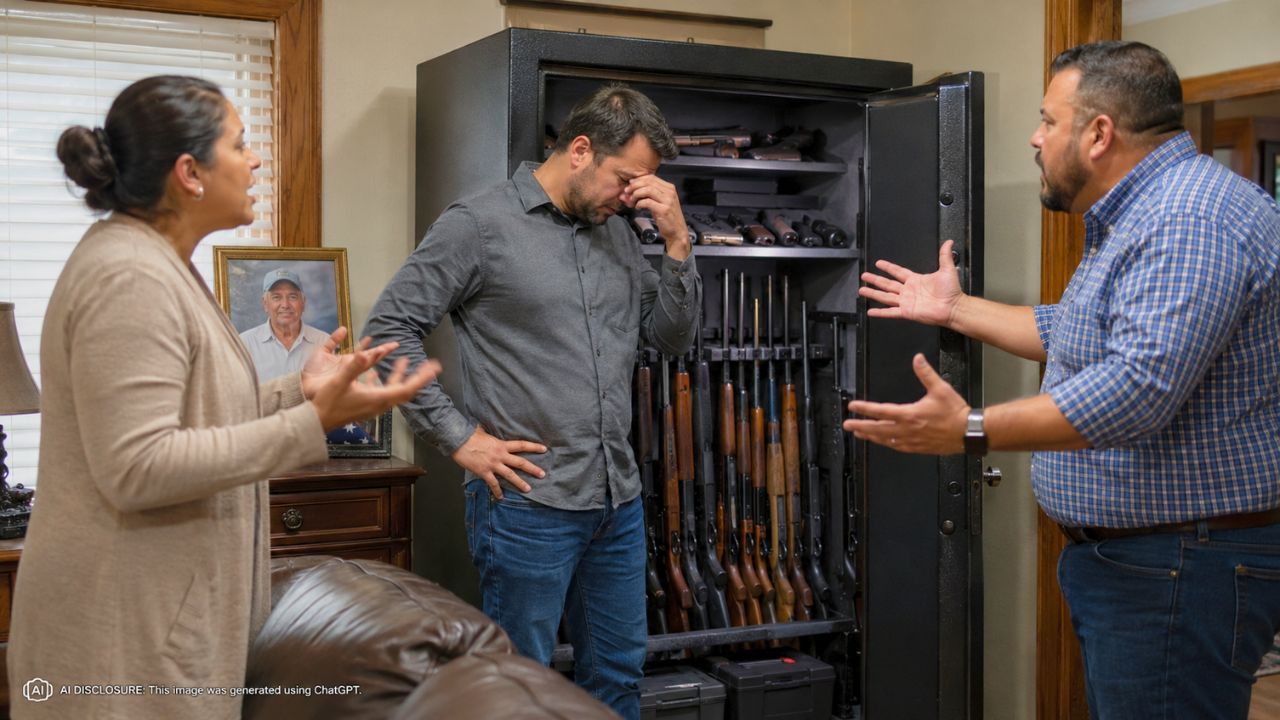
Photo credit: AI-generated image created using ChatGPT. Illustrative only.
When a gun owner passes, the stories start fast: “He told me that old deer rifle was mine,” or “Grandpa promised me the pistols in the safe.” Most families can sort it out with a will, a written list, or at least a clear executor who can keep everybody honest. But when none of that exists, even a lifetime collection can turn into a locked-up mess.
That’s where one son found himself after his dad died in early May, leaving behind “at bare minimum, 80 guns.” In the original post, he explained that his father lived in Alabama while he’s based in Wisconsin, and the lack of a will put the whole estate into probate—right when the firearms were already being moved around.
A big collection, a long-distance problem, and no paperwork
Eighty-plus firearms isn’t a “throw it in the truck and go” situation, especially when you’re crossing state lines and trying to do it the right way. The son said his step-mother initially volunteered to hold onto the guns for a time while he figured out the best way to bring them back without it getting “ridiculously expensive.” That’s a pretty common arrangement in rural families—somebody local keeps the safe locked up while the out-of-state kids handle travel, work schedules, and funeral costs.
It also puts a lot of trust in the person doing the holding. With that many guns—various “sizes and shapes”—you’re not just dealing with dollar value. You’re dealing with sentimental pieces, hunting guns tied to memories, and the simple fact that unsecured guns moving through the wrong hands can create a safety and legal problem fast.
The “sell a few” conversation that turned into consignment
The son said they briefly discussed selling some of the more common firearms to help cover funeral and travel expenses. That’s another thing that happens in real life: families need cash, and a few extra shotguns or basic rifles can lighten the load without breaking up the heart of a collection.
But in this case, he said the step-mother took that conversation to mean she could take all of them to a consignment shop near her to sell. That’s not a small miscommunication. Moving a couple common guns is one thing; hauling a whole collection into a store pipeline is something else entirely, and once it happens, it’s hard to un-ring that bell.
From the outdoorsman’s angle, this is the moment where the situation stops being “family cleanup” and starts being “chain-of-custody.” When guns go from a home safe to a third-party business, everyone suddenly wants documentation, and they should.
Probate reality: “Mine” and “his” aren’t the same thing
The consignment store reportedly told the son they need legal documentation showing the guns are legally his—and that the step-mother hadn’t handed them over “in good faith.” That’s not the shop being difficult; that’s the shop trying not to get wrapped up in an estate fight or accused of trafficking in property that didn’t belong to the person who dropped it off.
Without a will, the estate goes through probate, and ownership doesn’t just snap to whoever had the closest relationship or whoever was told a promise at deer camp. “Dad said I’d get them” might be true, but the paper trail and the probate process are what count when a third party has possession and money is about to change hands.
And with 80-plus guns, it’s not just one item to argue about. It’s dozens of serial numbers, potential heirlooms, and enough value that people get stubborn—even decent people who are grieving. That’s why probate courts exist, and it’s why stores want a clean answer before they list anything.
The divorce twist that could change everything
The son also said his father and step-mother “had fully divorced in March of this year,” just a couple months before his father passed. He suspects she didn’t disclose that to the consignment shop.
That detail matters because a lot of folks hear “step-mom” and assume “surviving spouse.” But if a divorce was finalized before death, the legal status is different than many people assume around a kitchen table. That doesn’t automatically answer who gets what—there can be property divisions from the divorce, separate estate rules, and whatever Alabama’s intestate (no will) laws say about heirs—but it’s a major factor in who has standing to claim property and who doesn’t.
From a practical standpoint, it also changes how you’d approach it as a gun owner. If the person holding the guns isn’t a spouse, and may not be an heir, then the safest move isn’t “talk it out later.” The safest move is “freeze everything” until the legal authority is clear—because once the guns are sold, you’re not getting them back. You’re trying to chase dollars, and good luck matching dollars to sentimental value.
What people tend to focus on in cases like this: authority, inventory, and a hard pause
The post itself asks a simple question—what document proves the guns are his and not hers—but the real-world answer usually starts earlier than that. Before anybody can prove ownership of individual firearms, someone has to be recognized as having authority to act for the estate. In plain terms: the person the court recognizes to manage the estate is the one who can typically collect property, stop sales, and handle transfers legally.
The next issue is inventory. When a collection is that big, you need a list: make, model, serial number, and where each gun went. Whether you’re a hunter with a few rifles or a collector with a full safe, that inventory is what keeps “I think it was Dad’s” from turning into accusations. It also protects the shop, because a reputable store wants to be able to show what came in, who brought it, and why they believed it was a lawful consignment.
And then there’s the hard pause: don’t let more guns move. When the ownership is in question, movement creates risk—loss, theft, unsafe storage, and legal trouble for everyone involved. It’s not about being vindictive. It’s about keeping a complicated situation from turning into an irreversible one.
What this should teach gun owners: promises fade, paperwork doesn’t
This whole mess is the reason every serious gun owner should have a plan that’s more than “the kids will figure it out.” A will is the cleanest route, but even a written inventory paired with clear instructions on who gets what can save your family a pile of heartburn. If you’ve got a safe full of guns and you’ve told three different people “that one’s yours,” you’re planting the seeds for a fight.
For the son in this case, the immediate problem is that the guns are already in the hands of a consignment store that wants legal documentation before it does anything else. With probate involved and a recent divorce in the mix, the fastest way to stop damage usually isn’t arguing about verbal promises—it’s getting the estate process moving, getting recognized authority in place, and getting a clean accounting of every firearm before a single one leaves on a sales receipt.
Firearms are tools, investments, and memories all at once. When someone dies without a will, they can also become leverage. If you want your family to remember you for the hunts and not the court dates, put it in writing and lock it down while you’re still here.
Like The Avid Outdoorsman’s content? Subscribe to our newsletter so you never miss an article.
Here’s more from us: