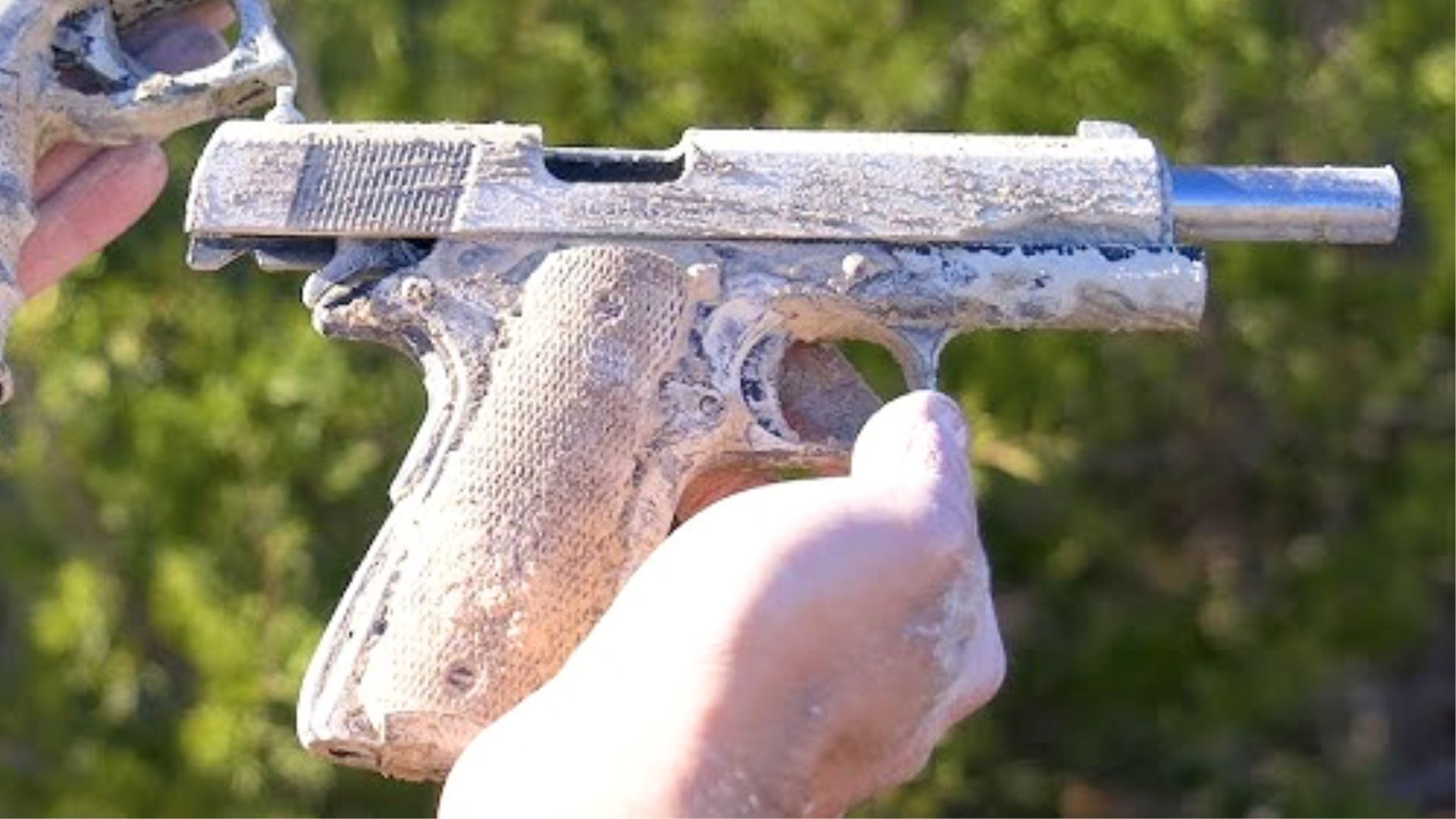
Photo credit: Texas Plinking/YouTube
Some pistols don’t fail quietly — they teach you. They make you rethink what “reliable” really means after you’ve cleared your tenth jam in a single box of ammo. They remind you that marketing doesn’t equal function, and that a handgun that runs smooth on a clean range can choke the second it faces dirt, cold, or poor maintenance. A lot of shooters have learned their hardest lessons not from catastrophic failures, but from pistols that fail unpredictably — enough to keep you guessing, enough to make you doubt them when it matters most. These are the pistols that turn frustration into experience and experience into better judgment.
Remington R51

The Remington R51 was hyped as a modern revival of a classic design, but in practice, it became a reliability nightmare. Its hesitation-lock mechanism was overly sensitive to fouling and manufacturing tolerances. Many shooters experienced failures to feed, failures to extract, and even out-of-battery detonations in early production runs.
Even after the re-launch, the R51 struggled to earn trust. When it worked, it shot softly and pointed well, but “when” was the key word. It reminded shooters that clever engineering doesn’t mean dependable performance. You can polish it, tune it, and run premium ammo, but it’s never going to match the consistency of a proven design. The R51 was a masterclass in how reputation can’t replace real-world reliability.
Taurus PT111 Millennium G2 (early production)

The Taurus PT111 G2 had potential — affordable, compact, and comfortable. But early production models were plagued with mechanical inconsistencies. Some guns ran fine, others couldn’t make it through a single magazine without a malfunction. Feeding problems, premature slide lock, and trigger reset failures were common enough to frustrate loyal owners.
Taurus eventually improved the design in later generations, but those early pistols made a lot of shooters swear off the brand. The lesson was clear: “budget-friendly” doesn’t always mean dependable. You might save money at the counter, but you’ll pay for it in time, patience, and ammo testing. Those early PT111s showed that reliability isn’t something you can afford to compromise on — not in a defensive pistol.
Kimber Solo Carry

The Kimber Solo Carry looked promising on paper — a sleek, premium micro 9mm meant for concealed carry. But once shooters hit the range, it became notorious for its pickiness. It refused to cycle reliably unless fed specific high-pressure defensive loads. Use standard 115-grain FMJ or cheap range ammo, and you’d quickly find yourself clearing jams instead of practicing.
The Solo’s tight tolerances and lightweight design made it unforgiving of dirt or weak ammunition. Some owners loved it once they found the right ammo brand and cleaned it obsessively, but most realized it demanded more maintenance than it was worth. It’s a perfect example of a pistol that teaches you not to fall for looks or marketing — because confidence fades fast when every magazine feels like a test run.
SIG Sauer Mosquito

The SIG Mosquito taught countless shooters a hard truth about rimfire pistols: tight tolerances and dirty ammo don’t mix. It looked like a miniature P226, but it inherited none of that model’s reputation for reliability. The Mosquito was infamous for failures to feed, light strikes, and picky ammo preferences.
If you kept it spotless and fed it high-quality .22 LR, it ran fine for a few hundred rounds. But most shooters expect rimfire guns to be forgiving, and the Mosquito was anything but. It required constant attention, cleaning, and specific lubrication just to behave. It’s a pistol that made you appreciate the reliability of cheaper, simpler .22s — and reminded everyone that complexity and rimfire don’t go hand in hand.
KelTec PF-9

The KelTec PF-9 was one of the earliest micro 9mm carry guns to hit the market, and while it was light and concealable, it also proved painfully inconsistent. The long, heavy trigger and snappy recoil made limp-wristing common, leading to frequent feeding issues and stovepipes. Even when gripped properly, the rough machining and stiff recoil spring made reliability a coin toss.
It’s not that every PF-9 was a failure — some ran fine. But the ones that didn’t became lessons in mechanical sensitivity and shooter technique. It taught many carriers that “small and light” usually means more recoil, more maintenance, and less margin for error. If you wanted a gun you could trust, the PF-9 showed that you needed to test it thoroughly before betting your safety on it.
Remington RP9

The Remington RP9 was supposed to be Remington’s big comeback into the polymer pistol market. Instead, it ended up being another stumble. Early models suffered from feeding failures, inconsistent ejection, and trigger reset issues. Shooters reported that the oversized grip and odd magazine geometry made reloads awkward and failures more likely.
It wasn’t inherently unsafe — just unreliable enough to erode confidence. Some units ran smoothly after a long break-in, while others never settled in. The RP9 is one of those pistols that reminds you that brand names mean little when the execution falls short. It’s a pistol that should have been a workhorse but instead became another entry in Remington’s long list of “almosts.”
Colt All American 2000

The Colt All American 2000 was a bold attempt to bring polymer pistols into Colt’s lineup, and it failed spectacularly. Its rotating barrel system was overly complex, and early production suffered from poor tolerances and weak materials. The result was a handgun that jammed frequently and wore out faster than expected.
Shooters who tried to like it quickly learned that good intentions can’t save bad execution. The trigger was heavy, the ergonomics awkward, and reliability inconsistent even with premium ammunition. The All American 2000 became one of those cautionary tales — a pistol that taught the entire industry what happens when design ambition outpaces testing.
AMT Backup .380

The AMT Backup was designed to be a rugged, stainless pocket pistol, but in reality, it was a jam-prone handful. Its tiny size made it difficult to grip firmly, and the heavy double-action trigger didn’t help accuracy or consistency. Combine that with rough feed ramps and tight chambers, and reliability was always questionable.
Many owners learned that the Backup was anything but. It needed frequent cleaning and very specific ammo to function without hiccups. In theory, it was a smart concept for deep concealment. In practice, it was the kind of gun that makes you carry a backup to your backup. It taught a generation of shooters to never assume that smaller means simpler or more reliable.
Astra A-75

The Astra A-75 was a Spanish-made compact pistol with solid ergonomics and decent accuracy, but its reliability was hit or miss. The heavy slide and stiff recoil spring made cycling sluggish, especially with lighter loads. Some guns ran great, others jammed often enough to keep you guessing.
It’s a well-made pistol, but manufacturing variations made consistency rare. Even with good magazines and clean lubrication, some examples just never settled into dependable operation. Shooters who owned one either praised it as underrated or cursed it as a lemon — and sometimes both in the same breath. It’s one of those pistols that proves even solid design can’t make up for uneven execution.
Luger P08

The Luger P08 is a historical masterpiece but a maintenance headache. Its toggle-lock design is beautifully engineered and maddeningly sensitive to dirt, weak ammo, or cold weather. Even a little fouling or rough handling can cause failures to feed or return to battery.
It’s the kind of pistol that shows you the line between craftsmanship and practicality. When clean and properly lubed, it runs with elegance. But take it into real-world conditions, and it quickly reminds you why modern designs replaced it. The Luger doesn’t teach reliability through consistency—it teaches it through failure. Every jam is a reminder that precision doesn’t always equal durability.
Detonics Pocket 9

The Detonics Pocket 9 was one of the early attempts to make a compact 9mm for concealed carry, and while it looked tough, reliability was never its strong suit. The short slide and heavy recoil spring made it finicky with ammo, and feed issues were common. Some shooters couldn’t make it through a magazine without a malfunction.
Its construction was solid, but the design simply pushed physics too far for the time. The Pocket 9 taught shooters that compact doesn’t always mean practical. It looked great, shot well when it worked, and was ahead of its time — but only in concept. It’s one of those pistols that made the idea of carrying a backup gun make perfect sense.
*This article was developed with AI-powered tools and has been carefully reviewed by our editors.