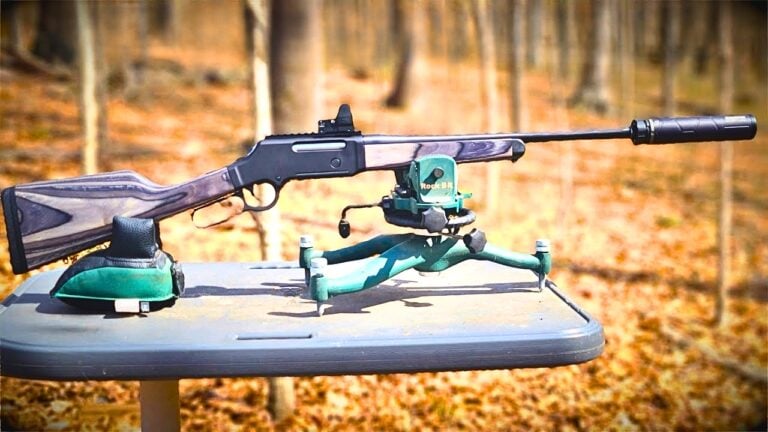
Photo credit: Savage Arms
A round that falls like a rock at distance can wreck your chances when you’re trying to stretch your shot. Ballistics matter—especially when wind, range, and target size come into play. Some cartridges were never designed for long-range performance, and when you push them past a couple hundred yards, gravity takes over fast. These are the rounds that may work fine up close but leave you fighting drop charts and missed shots once you step things out.
.45 ACP

The .45 ACP is legendary at close range, but it was never built for distance. Its heavy, slow-moving bullets bleed speed quickly, and the drop past 100 yards gets ridiculous. You’re talking feet of holdover where other rounds only need inches.
If you’re thinking about using it outside of defensive distances or handgun competitions, you’ll see how poorly it holds up. Gravity doesn’t cut this round any slack, and that’s why you’ll never hear of it as a distance performer.
.30-30 Winchester

The .30-30 has put more venison on the table than most calibers out there, but distance is not its strong suit. With blunt-nosed bullets designed for lever actions, it sheds velocity fast and drops heavily after 200 yards.
For wooded hunts and brush country, it’s perfect. But step into open country, and the drop curve will frustrate you. You’ll be holding sky-high just to land shots where you want them, and wind drift only makes it worse.
.44 Magnum

A powerhouse in revolvers and lever guns, the .44 Magnum carries authority up close but doesn’t stretch well. Those heavy bullets start dropping quickly once they leave the muzzle, and by 150 yards you’re already dealing with extreme holdover.
Hunters who love it for hogs or deer at close range rarely take it further, because accuracy fades and trajectory looks like a rainbow. It’s excellent for power in the right setting, but it’s not the cartridge you want when distance matters.
.45-70 Government (Standard Loads)

The .45-70 is iconic for big game at moderate ranges, but it’s not going to give you flat-shooting performance. Traditional loads throw heavy slugs at modest speeds, and the bullet arc gets dramatic after 200 yards.
Yes, modern loads improve things, but even then you’ll deal with serious drop compared to more modern hunting cartridges. It’s devastating inside its lane, but once you step outside of it, you’ll see gravity win in a hurry.
.357 Magnum

Like the .44, the .357 Magnum performs well inside handgun ranges and in lever rifles at closer distances. But it lacks the velocity and aerodynamic profile to handle distance with any consistency.
Push it past 100 yards, and you’ll notice how quickly it drops. Shots that seem easy with other rifle rounds turn into a guessing game. It’s popular for versatility, but range shooters quickly find its limits when trying to stretch it out.
.410 Bore Slugs

The .410 has its place, but when it comes to reaching out, it’s not the round you want. The small, lightweight slugs lose energy quickly and drop drastically at any distance past 50 yards.
It works for small game and certain close-range hunting scenarios, but once you push it, the trajectory becomes unpredictable and the energy just isn’t there. Hunters who’ve tried to stretch it quickly learn why it stays in the “close-range only” category.
7.62x39mm

The 7.62×39 is reliable and widely used, but flat shooting isn’t part of its resume. Its trajectory drops fast after 200 yards, making it hard to stay precise at longer distances.
In an AK or SKS platform, it works exactly as designed—close to medium-range effectiveness. But try to push it much further, and you’ll see why long-range shooters don’t touch it. It drops more like an old hunting round than a modern rifle cartridge.
12-Gauge Slugs

Big, slow, and effective at close range, 12-gauge slugs are devastating inside 100 yards. The problem comes when you try to reach further—drop is extreme and energy bleeds out quickly.
Hunters using slugs in shotgun-only states know the limitations well. You can zero for 100, but once you try 150, you’re already lobbing rounds in. It’s powerful but not designed for distance, and the trajectory proves it every time.
.38 Special

The .38 Special works fine in revolvers for defense and target practice, but it’s one of the worst performers at distance. Its slow velocity means bullets start dropping almost immediately, and beyond 50 yards the trajectory gets out of hand.
It’s not meant for long-range shooting, and anyone who’s tried knows the frustration. You can use it for training and close-up work, but stretching it doesn’t deliver reliable accuracy.
.300 Blackout (Subsonic)

While supersonic .300 Blackout rounds can stretch decently, the subsonic loads suffer huge amounts of drop. Designed for suppressed shooting, these rounds run slow and start falling fast, even inside 150 yards.
It works perfectly for what it was designed for—short-range suppressed use—but if you treat it like a distance round, you’ll be dialing elevation like crazy. It shows how purpose-built rounds shine in their lane but fail outside of it.
*This article was developed with AI-powered tools and has been carefully reviewed by our editors.