Photo credit: MEDIAIMAG/Shutterstock.com
Most snake encounters are not the dramatic, slow-motion kind people imagine. They are quick, close, and messy. You step where you did not really look. You reach under something because you are in a hurry. You grab a board, climb over a log, or walk a trail edge at dusk and suddenly the whole situation changes in one second. That is how these encounters go bad. Not because snakes are hunting people, but because the distance collapses before you have time to think. Wildlife agencies keep making the same point: bites usually happen when a snake is surprised, cornered, stepped on, or handled by somebody who made the wrong move at the wrong time.
That is also why the worst encounters tend to follow the same pattern. They happen in places with poor visibility, around cover, after dark, or during those split-second decisions when somebody tries to kill, grab, or “deal with” the snake instead of backing off. The CDC says venomous snakes can cause lasting effects even though most people do not die from bites, and the National Park Service stresses that many bites are provoked, whether by accident or by somebody trying to capture, harass, or kill the animal.
Stepping over logs, rocks, and brush without seeing the landing spot
This is one of the fastest ways to create a bad snake encounter. You are not looking at the far side clearly, your foot comes down close, and now the snake has almost no room to do anything except react. That is why park guidance keeps warning people to watch where they place hands and feet and to avoid tall grass or shrubby cover where visibility is poor. In the real world, this is the kind of encounter that happens before your brain has even fully registered what you are seeing.
It gets worse when people try to correct the situation too fast. A blind hop backward, a stumble sideways, or a panicked second step can turn one close call into a real bite risk. Texas Parks and Wildlife says to freeze when snakes are known to be nearby until you know where they are, then allow the snake to retreat. That advice sounds basic, but in a close encounter it matters because rushed movement is often what makes a tight situation worse.
Reaching under boards, rocks, tin, or yard junk
A lot of bad encounters happen with hands, not feet. Somebody reaches under a board pile, moves sheet metal, lifts a rock, pulls scrap from behind a shed, or grabs something from a dark corner without checking first. That is exactly the kind of setup agencies warn about. Texas Parks and Wildlife notes that many bites happen when an unsuspecting person lifts a log or rock under which a snake was hiding, and copperheads are especially notorious for bites when they are accidentally picked up or disturbed under cover.
The dangerous part is how ordinary the chore feels. You are not “in snake country” in your mind. You are doing yard work, cleaning up, stacking wood, or fixing something around the place. But to a snake, that pile of junk or cover is shelter. When your hand gets there before your eyes do, the encounter goes from normal to bad in a heartbeat. That is why so much official guidance comes back to the same rule: never put hands or feet where your eyes have not been first.
Trying to kill, catch, or move the snake yourself
This is one of the dumbest and fastest ways to turn a manageable encounter into an emergency. It also happens all the time. The National Park Service says most bites occur when a person provokes a snake by accidentally stepping on it or purposely trying to capture, harass, or kill it. Texas Parks and Wildlife says most bite victims nowadays are people who deliberately come in contact with snakes by hunting, catching, or handling them, and that the majority of bites result from unnecessary risks.
People convince themselves they are “handling the problem,” but what they are really doing is forcing the snake into a defensive corner at close range. That is when there is no room for mistakes. A shovel miss, a bad grab, a stick that is too short, one wrong step toward the head — that is how people get tagged. The safer move is the boring one: keep your distance and let the snake leave or call the right local professional if it truly needs to be removed.
Night encounters when you are walking without a light
After dark, the margin for error gets thin fast. You are working with worse visibility, slower recognition, and a much better chance of stepping close before you know there is a problem. National Park guidance specifically tells people to carry a flashlight after dark and use it in areas where rattlesnakes may be active. That is not overkill. It is one of the simplest ways to avoid the kind of encounter that gives you no time to react.
This is especially true around campsites, cabins, sheds, rural yards, trailheads, and driveways where people get comfortable and stop paying attention. They know the ground, so they assume the ground is safe. Then a snake is stretched across a path, tucked near a step, or moving between cover while the person is moving too casually to catch it early. In those encounters, the mistake happens before the person even realizes a decision was being made.
Tall grass, boulders, and trail edges where snakes disappear into the background
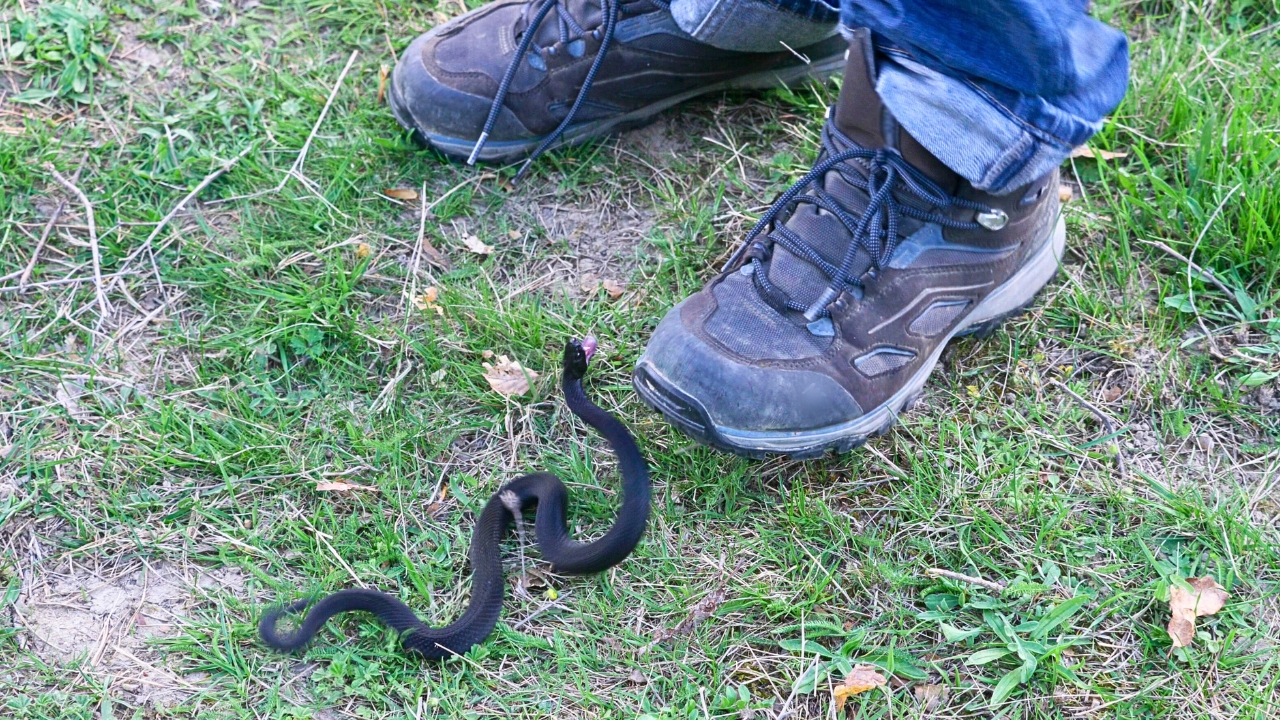
The encounter that leaves no room for mistakes is often the one where the snake had all the camouflage and you had none of the visual warning. Sequoia and Kings Canyon warns that rattlesnakes are commonly found in grassy areas and around boulders, while other park guidance warns against brush and shrubby areas with poor visibility. That matters because these are the exact places where people keep moving forward on habit until the snake is already at boot distance.
That is also why people need to stop depending on the rattle like it is some guaranteed alarm system. Snakes do not always announce themselves in time, and some bites happen precisely because somebody expected a louder warning than they got. When the cover is good and the approach is close, the encounter happens on the snake’s terms, not yours.
The close call that becomes worse because of bad first aid or delay
The encounter does not end with the bite. It can keep getting worse if the person wastes time on folk remedies, tries to treat it alone, or delays getting help because they think it is “not that bad.” Multiple National Park pages now say clearly to call 911 immediately and not attempt to treat a snakebite yourself. They also note that many home remedies do more harm than good.
That matters because the whole point of these fast encounters is that they leave little room for mistakes. The first mistake may be stepping too close. The second is often trying to tough it out or play backyard medic. The correct move is not glamorous: get away from the snake, keep the bitten person calm, and get medical help fast. That is how you keep a bad encounter from turning into a much worse one.
The worst encounters are usually built on one careless moment
That is the thread running through all of this. The snake encounter that happens fast and leaves no room for mistakes is usually not some freak event. It is one careless step, one blind reach, one rushed cleanup job, one nighttime walk without a light, or one bad decision to handle a snake that should have been left alone. The official guidance is remarkably consistent across agencies: snakes generally want to avoid people, and bites most often happen when people crowd, surprise, or mess with them.
That is why avoiding the encounter is usually much simpler than surviving it. Slow down. Look before you step or reach. Do not handle snakes. Do not assume the rattle will save you. Do not walk dark ground blind. Those are the habits that create space, and space is the one thing these encounters never give you once they start.
Like The Avid Outdoorsman’s content? Subscribe to our newsletter so you never miss an article.
Here’s more from us: