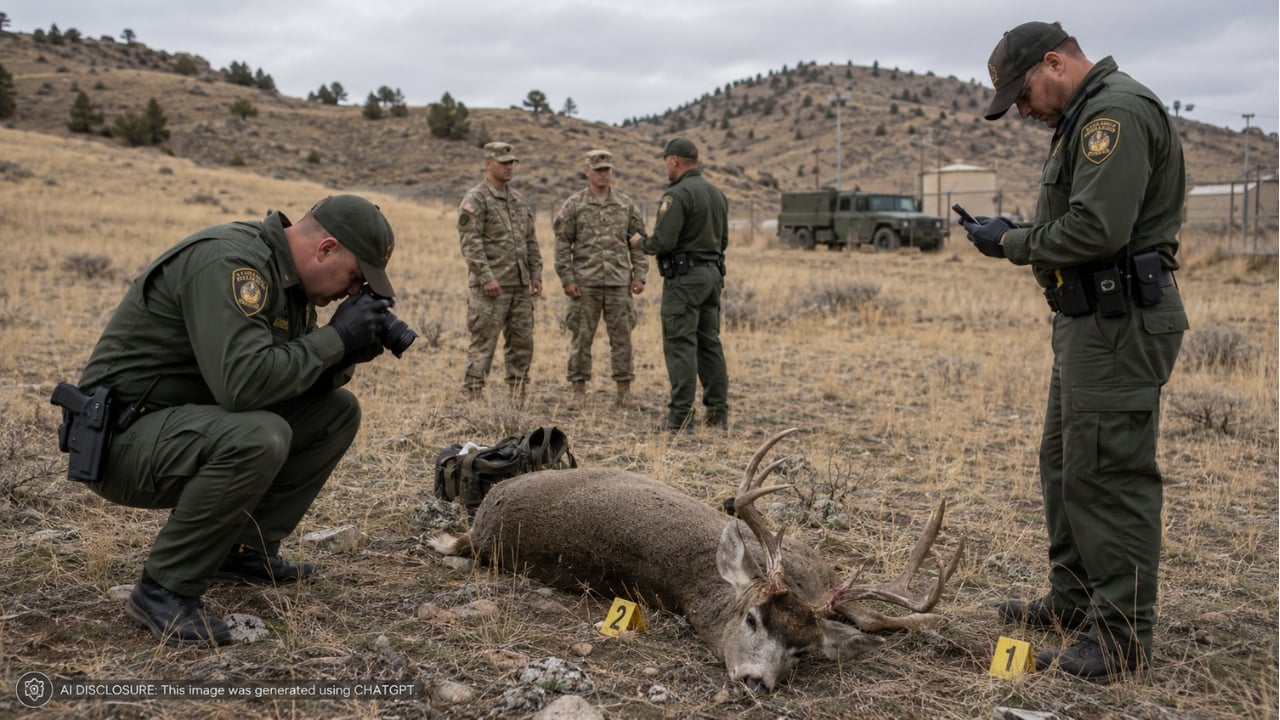
Photo credit: AI-generated image created using ChatGPT. Illustrative only
Poaching cases usually break open one of two ways: a hunter finds a carcass that doesn’t look right, or someone can’t keep their mouth shut. On Fort Carson in Colorado, it was both—sloppy field work on the ground, and a digital paper trail that didn’t do anyone any favors.
The details come from the original post covering a Colorado Parks and Wildlife (CPW) case involving three active-duty soldiers convicted on misdemeanor wildlife charges after mule deer were illegally killed on the base and nearby state land.
A gut-check crime scene: sawed antlers and abandoned meat
The whole thing started in November 2024 when a hunter reported a poached mule deer buck to Fort Carson Conservation Law Enforcement Officers (CLEOs). Those officers called for CPW help, and Wildlife Officer Deme Wright responded.
What she found wasn’t a normal “I did my best” field situation. The buck had only a piece of its hindquarters removed, and its antlers had been sawed off. About 100 yards away sat a dead doe, also partially processed and abandoned. Wright said, “It didn’t look like a normal harvest… That’s when you slow everything down.”
Hunting on a military base isn’t a free pass
A lot of folks don’t realize you can legally hunt on some military installations. But “legal to hunt there” doesn’t mean you get to freelance the rules. You’re still bound by local and federal wildlife laws, and on a base you’ve also got boundaries, access rules, and enforcement that can get serious in a hurry.
In this case, investigators later tied the activity to multiple instances of trespassing on both military and state lands. That’s the kind of detail that matters because even if a person claims they were “just hunting,” where they stood, where they drove, and where the animal fell can turn a bad decision into a stack of charges.
Physical evidence led to a vehicle—and then the internet did the rest
Wright processed the scenes and followed physical evidence that pointed toward a vehicle associated with the case. That’s the unglamorous part of game warden work: track what’s there, keep your timeline straight, and don’t assume it’s only one animal or one day.
From there, it moved fast. Wright uncovered social media images that identified Army Sergeant Jacob Curtis Keyser and Army Staff Sergeant Juan Salcedo. Search warrants for Keyser, his vehicle, and his cell phone turned up evidence of poaching and added proof of repeated trespass.
Cell phone photos didn’t just show trophies—they brought times, dates, and coordinates
Most hunters take pictures. That’s normal. What isn’t normal is taking pictures of illegal kills and leaving the metadata trail intact. Wright didn’t mince words: “There’s no way a 21-year-old doesn’t take pictures of everything he shoots.”
According to CPW, cell phone imagery documented more poaching activity and provided digital metadata—times, dates, and specific locations—linked to each image. Investigators also extracted messages and videos that, in Wright’s words, showed “deliberate disregard for hunting laws.” In other words, it wasn’t a one-off mistake that could be explained away as confusion in the field.
The price tag: 30 charges, forfeited rifle, suspension points, and more than $27,000 in fines
By the time the dust settled, three soldiers had been convicted of multiple misdemeanor wildlife charges tied to poaching five mule deer on Fort Carson and one on surrounding state land.
Keyser faced 30 wildlife charges, was fined $19,005, and was issued 180 suspension points. CPW also ordered forfeiture of his hunting rifle, and it will be destroyed. Salcedo faced 15 charges, was fined $8,817, and was issued 65 suspension points. A third soldier—unnamed in the material provided—was fined $900 for disposing of illegally taken venison before Keyser’s initial interview with Wright. Added together, that’s $28,722 in fines.
Why law-abiding hunters care: it burns trust, access, and everyone’s time
It’s easy for non-hunters to hear “poaching on a base” and file it under “somebody else’s problem.” But the fallout lands on regular folks—the ones who buy tags, follow seasons, and drag the whole deer out instead of grabbing a hindquarter and leaving a mess for someone else to find.
Wright credited Fort Carson CLEOs, the 4th Judicial District Attorney’s office, and “timely reporting from hunters who discovered the crime scene” for pushing the case forward. She also laid out the real-world damage: “Poaching is a serious, costly crime which harms legitimate sportspersons, wildlife viewers, small business owners and taxpayers.” And she made CPW’s stance plain: “If you poach in Colorado, I’ll follow the evidence, I’ll find you, and I’ll cut your rifle into scrap metal.”
There’s still another shoe that can drop. CPW is also holding a suspension hearing to determine how long any hunting and fishing suspensions will run, with the possibility of a lifetime ban that can follow a person across state lines through the Interstate Wildlife Violator Compact.
If you hunt public land, private land, or anywhere with a gate and a boundary line, the lesson is simple: the woods are full of witnesses now—other hunters, base officers, and your own phone. Do things the right way, and you’ve got nothing to worry about. Try to cut corners, and that “quick” decision can turn into a years-long headache with a five-figure bill attached.
Like The Avid Outdoorsman’s content? Subscribe to our newsletter so you never miss an article.
Here’s more from us: