
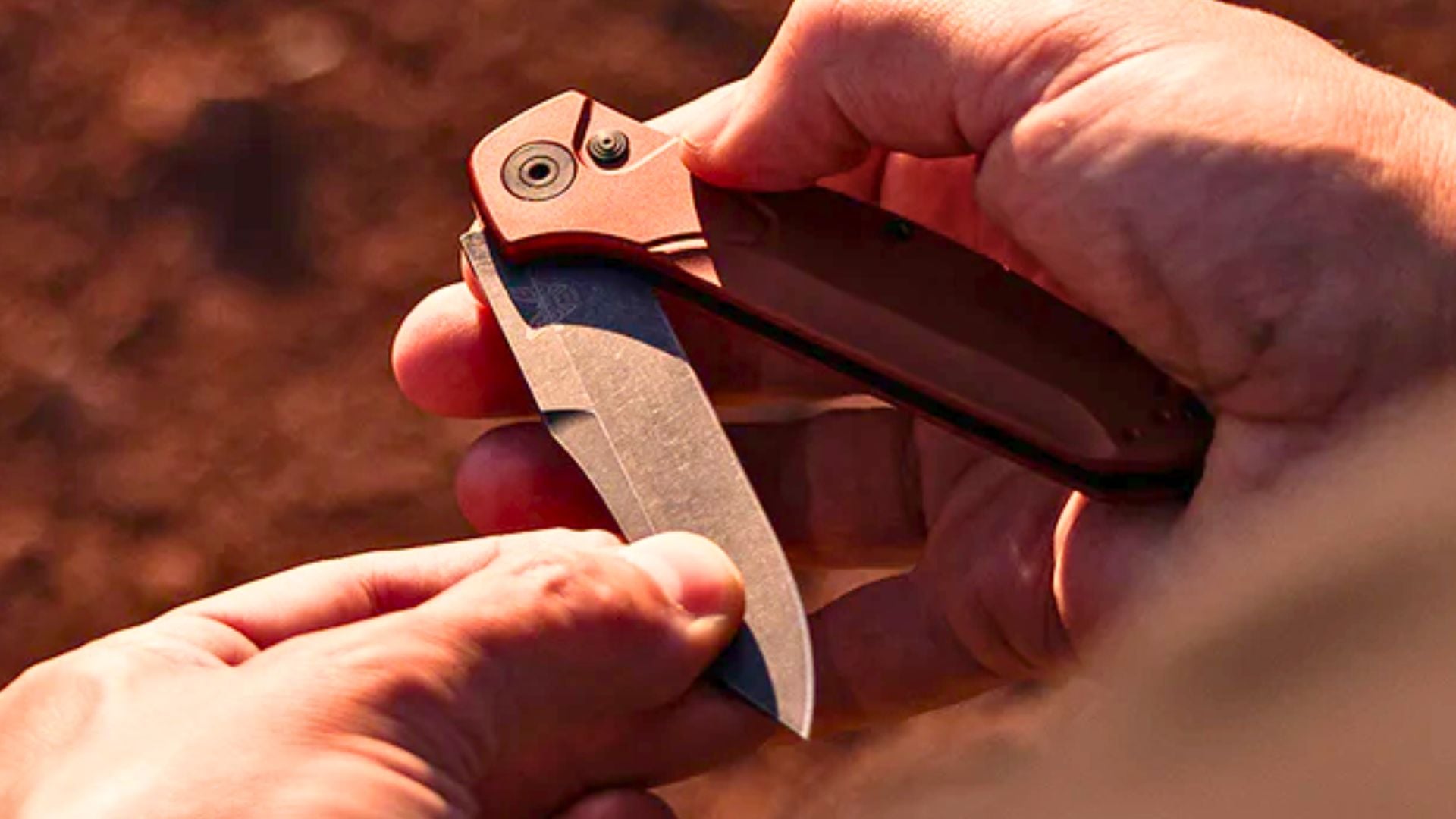
Photo credit: Benchmade Knives
Blade play doesn’t usually show up overnight. It creeps in slowly as tolerances relax, hardware shifts, and stress gets routed to places that weren’t meant to carry it. Some knives seem fine for months, then suddenly feel loose no matter how carefully you tighten them. Others stay rock solid year after year with the same pocket time and use.
That difference isn’t luck, and it isn’t magic. It comes down to design choices, machining priorities, and how forces are managed every time the blade is opened, locked, and used. Knives that never develop blade play aren’t accidental successes. They’re built with specific mechanical decisions that favor long-term stability over short-term feel.
Lock geometry that redirects force
Knives that resist blade play usually start with smart lock geometry. Instead of allowing cutting force to drive straight into the pivot, the lock redirects stress into stronger contact points.
When force gets transferred to a stop pin, lock face, or tang interface, the pivot is spared from gradual deformation. Over time, this prevents the microscopic movement that eventually becomes blade play. You notice it in knives that feel just as solid months later as they did when new. Good geometry doesn’t rely on tight screws to stay firm. It relies on physics doing the work consistently.
Oversized pivots with proper support
A larger pivot doesn’t automatically mean better, but properly supported pivots matter. Knives that stay tight often use pivots with more surface contact and better load distribution.
That added contact reduces wear on threads and bearing surfaces. Instead of flexing under stress, the pivot stays stable. Over time, this prevents the slow loosening that plagues smaller or poorly supported designs. You don’t feel movement developing because there’s nowhere for it to start. It’s a quiet design choice with big long-term benefits.
Hardened stop pins doing real work
Stop pins aren’t just spacers. In knives that resist blade play, they’re hardened and positioned to absorb repeated force.
Every time you open or use the knife, energy transfers into that stop pin. If it’s soft or undersized, wear happens quickly and tolerances shift. When it’s properly hardened and sized, the pin protects the rest of the system. The blade stops in the same place every time, which keeps lockup consistent and prevents movement from creeping in.
Even washer wear instead of point loading
Washers play a bigger role than many people realize. Knives that stay tight usually use washers that wear evenly rather than concentrating friction in one spot.
Uneven wear creates slack. Even wear preserves alignment. Bronze or phosphor washers with proper surface contact gradually polish themselves instead of degrading. That slow, controlled wear keeps the blade centered and stable. You don’t get sudden looseness because nothing wears unevenly enough to create it.
Lock faces designed to self-stabilize
Some locks actually improve with use. Well-designed lock faces mate more completely over time instead of slipping or rounding off.
When lock surfaces are cut correctly, pressure increases contact area rather than reducing it. That self-stabilizing effect keeps the blade locked in the same position after thousands of cycles. Poorly cut lock faces do the opposite, gradually slipping until movement appears. Knives that never develop blade play almost always have lock faces that were designed with long-term engagement in mind.
Hardware that resists vibration
Daily carry exposes knives to constant micro-vibration. Screws back out slowly, not suddenly. Knives that stay tight use hardware that resists that process.
This includes quality fasteners, proper thread engagement, and sometimes thread treatments applied at the factory. You don’t need to constantly re-tighten because the hardware was chosen to stay put. Over months of carry, that matters more than most people expect. Stable hardware is quiet, invisible, and essential.
Frame and liner stiffness
Flex is the enemy of long-term tightness. Knives that resist blade play usually have frames or liners stiff enough to resist torsion during use.
When a knife flexes, stress transfers unevenly into the pivot and lock. Over time, that flex becomes wear. Stiffer frames keep everything aligned even under load. That rigidity doesn’t have to mean heavy, but it does mean well-designed internal support. You feel the difference when a knife never seems to “settle” into looseness.
Bearing systems tuned for control, not speed
Ultra-fast actions often rely on looser tolerances. Knives that stay tight usually tune bearings for control rather than pure speed.
That means consistent contact, proper race dimensions, and bearings that don’t rely on slack to feel smooth. The result is an action that stays consistent over time instead of degrading. You don’t gain blade play just to keep the knife flicky. Long-term stability wins over short-term excitement.
Tolerances set for use, not unboxing
Some knives feel incredible out of the box because tolerances are pushed right to the edge. Knives that never develop blade play are often set slightly more conservatively.
That small margin allows parts to wear in without crossing into looseness. Instead of starting perfect and degrading fast, they start good and stay good. It’s a design philosophy that prioritizes longevity over first impressions. Experienced users recognize it immediately.
Lock types that absorb impact
Certain lock designs inherently protect against blade play by absorbing shock before it reaches the pivot. Lockbacks, Tri-Ad locks, and well-executed compression locks do this well.
They isolate impact forces and prevent repeated battering of pivot components. Over time, that isolation preserves alignment. You don’t feel movement because the stress never gets a chance to migrate. The lock does its job quietly and consistently.
Blade tangs cut for stability
The shape of the blade tang matters more than most people think. Knives that stay tight often have tangs cut to maximize contact with the lock and stop pin.
More contact area means less localized wear. Instead of digging in or rolling edges, forces get spread evenly. That keeps the blade stopping in the same place every time. It’s subtle, but it’s one of the reasons some knives never feel “used” even after years of carry.
Assembly that prioritizes alignment
Even the best design fails if assembly is sloppy. Knives that resist blade play are assembled with attention to alignment, torque, and spacing.
Everything starts square and stays square. Screws aren’t overtightened, washers aren’t crushed, and components seat properly from day one. That clean starting point allows the knife to wear in predictably instead of drifting. You can’t fix bad assembly later, which is why this step matters so much.
Designs that don’t rely on constant adjustment
Finally, knives that never develop blade play aren’t designed to need constant tuning. They don’t depend on perfect screw tension to stay solid.
Instead, they use geometry, materials, and load paths to maintain stability naturally. You carry them, use them, and forget about them. That’s the real mark of a well-designed folder. It stays tight because it was never relying on luck in the first place.
Like The Avid Outdoorsman’s content? Subscribe to our newsletter so you never miss an article.
Here’s more from us:


