
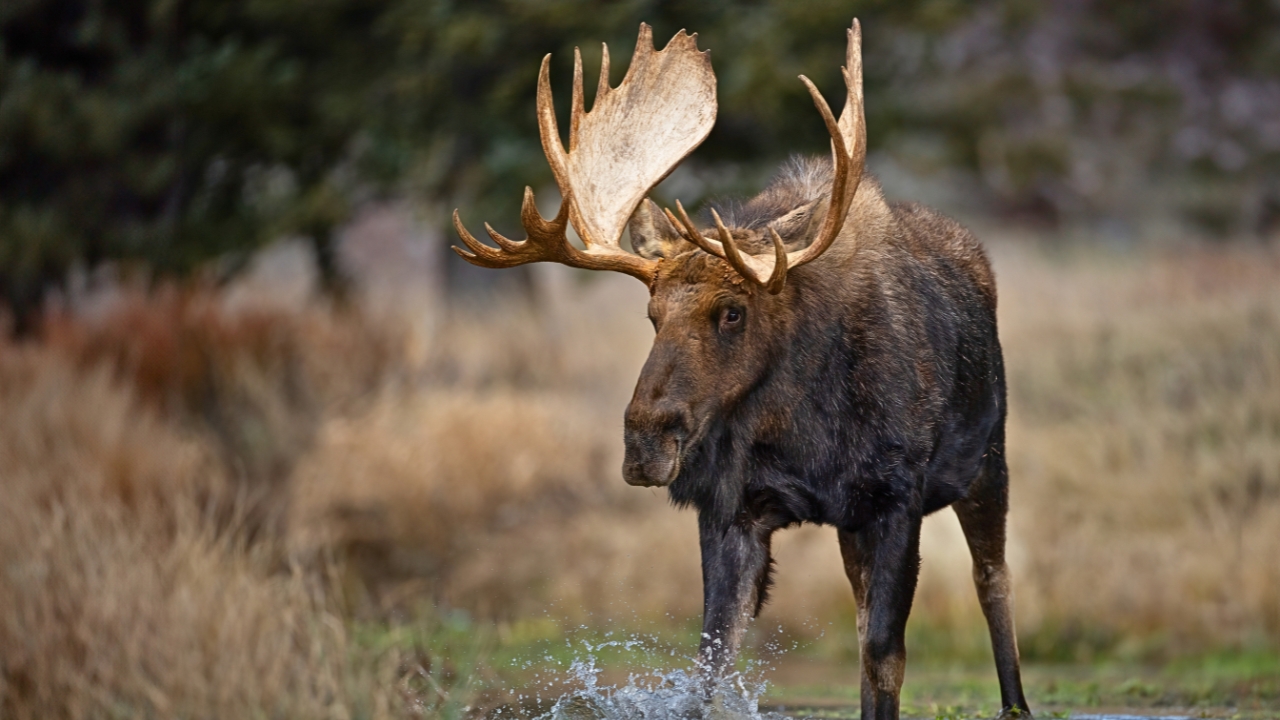
Photo credit: Harry Collins Photography/Shutterstock.com
If you want to see wild moose in the U.S., you are mostly looking north and high. Moose still hold on in places with cool weather, wet ground, thick cover, and enough browse to keep a huge animal fed. That usually means northern forests, mountain drainages, willow bottoms, and edges where timber meets marsh. They are not spread evenly, and they are not common everywhere people imagine, but there are still parts of the country where they remain a real part of the landscape.
Some of these places hold large, long-established populations. Others have smaller but still legitimate moose numbers tied to reintroductions or mountain habitat that fits them well. If you are hoping to spot one, the key is understanding where moose still make sense biologically, not where people wish they did. These are some of the best-known places in the U.S. where wild moose are still roaming.
Alaska
Alaska is still the heavyweight if you are talking about wild moose in the United States. Moose are widespread across the state in suitable habitat, ranging from Southeast to the Arctic Slope, and they are common enough that people in many parts of Alaska treat encounters with them as a normal part of life. The Alaska Department of Fish and Game says they are prevalent in most areas of the state, which tells you how different Alaska is from the lower 48.
That broad distribution matters because it is not limited to one valley or one famous park. You can find moose in river bottoms, willow flats, timber edges, and even around communities where habitat overlaps with roads and neighborhoods. If you want the most reliable overall state for wild moose, Alaska is the easy first choice. There is simply more country there where moose still live like moose have always lived.
Maine
Maine is the strongest lower-48 moose state, and that is not much of a debate anymore. The Maine Department of Inland Fisheries and Wildlife says the state has the largest moose population in the lower 48, with estimates commonly put around 60,000 to 70,000 animals. That makes Maine one of the few places outside Alaska where moose are not only present, but abundant enough to shape travel, hunting, and wildlife watching culture.
If you are trying to actually see one, the big draw is northern and western Maine, where timber country, wetlands, and back roads give moose the kind of cover and feed they need. The state tourism office also notes Maine holds the largest concentration of moose in the continental U.S. For anybody in the East, Maine is still the most realistic place to have a true wild moose encounter.
New Hampshire
New Hampshire still belongs on the list because moose remain established there, especially in the northern part of the state. New Hampshire Fish and Game says moose can be broadly considered as three populations: northern New Hampshire, the White Mountains, and southern New Hampshire. That tells you they are not confined to one tiny corner, even if northern habitat remains the stronghold.
The state’s current moose population is estimated at about 3,000 animals, according to New Hampshire Fish and Game. That is well below the late-1990s peak often cited in state reporting, but it is still a real, huntable, established population. If you spend time in the North Country or the White Mountains and stay alert at dawn and dusk, New Hampshire remains one of the better eastern states to cross paths with a wild moose.
Vermont
Vermont still has wild moose, and the Northeast Kingdom remains the part of the state most closely tied to them. The herd is not what it once was at its peak, but moose are still a real part of Vermont’s wildlife picture, especially in the colder, less developed northeastern corner. Recent reporting on Vermont’s moose hunt shows the state is still actively managing that population, even while winter tick pressure remains a serious issue.
That is the key with Vermont: moose are still there, but they are more localized and more affected by habitat and parasite pressure than many casual readers realize. You are not looking at Maine-level numbers. You are looking at a state where moose remain part of the landscape in the right region, especially around the Northeast Kingdom, where sightings still happen often enough to keep the species in regular management discussions.
Minnesota
Minnesota is one of the last strong moose states in the Midwest, and northeastern Minnesota is where the story is centered. The Minnesota DNR’s 2025 survey estimated about 4,040 moose, and the agency says the population has remained relatively stable for nearly a decade after earlier declines. That makes Minnesota important because it still holds a genuine, established moose population in the lower 48.
You are mainly talking about the northeastern part of the state, where boreal forest, wetlands, and cooler habitat still support them. Minnesota is not the broad moose country it once was, but it is still one of the few places in the U.S. where seeing a wild moose is more than a lucky accident. If you are in the right part of the Arrowhead, the possibility is very real.
Washington
Washington surprises some people, but it should not. The Washington Department of Fish and Wildlife says there were about 5,000 moose estimated in the state as of 2015, with the majority in the Selkirk Mountains and smaller populations in the north Cascades, Okanogan country, and the Blue Mountains. That is enough to make Washington one of the more legitimate moose states in the West.
What matters most is where they are concentrated. Northeast Washington is the heart of it, especially the counties tied to the Selkirk system, though the species has spread into other mountain zones as well. WDFW is also actively monitoring moose in the northeast, which shows these are not stray animals wandering through. They are part of an established population that still uses that landscape in a meaningful way.
Montana
Montana still offers plenty of real moose country, especially across the western half of the state. Montana Fish, Wildlife & Parks says moose occupy forested landscapes throughout western Montana, including places like the Cabinet Mountains, the Centennial and Big Hole valleys, and even wetland-linked prairie habitat farther east along major riparian corridors. That is a broad footprint for such a large animal.
What makes Montana worth watching is the variety of habitats they use. In the right drainages, you are looking at classic willow-and-timber moose country, while other animals hold in wetter prairie corridors and river-bottom cover. They are not packed into one postcard location. They are spread through a lot of good country. If you spend time in western Montana’s colder, brushy bottoms, you still have a legitimate chance to run into one.
Colorado
Colorado is one of the clearest examples of a western state where moose went from absent to established. Colorado Parks and Wildlife notes that moose were once only transient there, but reintroduction work beginning in 1978 built a stable breeding population. Today, CPW says the state’s moose populations are thriving, which is a major shift from what Colorado looked like decades ago.
That matters because you are not talking about the occasional wanderer anymore. Moose are now a recognized part of Colorado’s wildlife scene, especially in North Park and other higher-elevation willow and wet meadow country. Walden was even designated the “Moose Viewing Capital of Colorado.” If you spend time in the right mountain habitat, seeing a moose in Colorado is no longer unusual. It is one of the more successful large-game restoration stories in the West.
Wyoming
Wyoming still has real moose country, even if some individual herds have had a tougher time than they did decades ago. State wildlife information shows moose occupy mountain ranges in northwestern and western Wyoming, along with the Bighorn Mountains and the Snowy Range. That gives Wyoming a broad enough footprint to remain one of the better Rocky Mountain states for wild moose.
The important thing is not to think of Wyoming as one uniform moose zone. Distribution depends heavily on elevation, wetlands, willows, and mountain habitat that can carry them year-round. Some herds have declined, but the species is still established across multiple mountain systems. If you are glassing creek bottoms, willow parks, and cool timber edges in the right parts of Wyoming, you are still in genuine moose country.
Utah
Utah is not the first state many people picture for moose, but it absolutely belongs here. Utah wildlife officials say the state is home to roughly 2,500 to 3,000 moose, found mainly in northern and northeastern Utah and along parts of the Wasatch Front. That makes Utah one of the more overlooked states where wild moose are still a real, established part of the landscape.
What makes Utah interesting is how often moose and people end up sharing space. The state notes that moose are commonly found in foothill habitat and sometimes move into more populated areas, where relocations can be necessary. So while Utah does not have the same reputation as Alaska or Maine, the animals are there, and in the right mountain and foothill country, they are very much still roaming.
Like The Avid Outdoorsman’s content? Subscribe to our newsletter so you never miss an article.
Here’s more from us:


