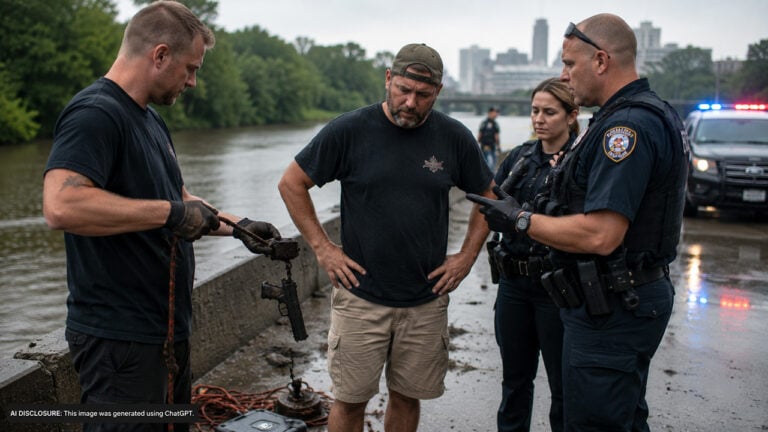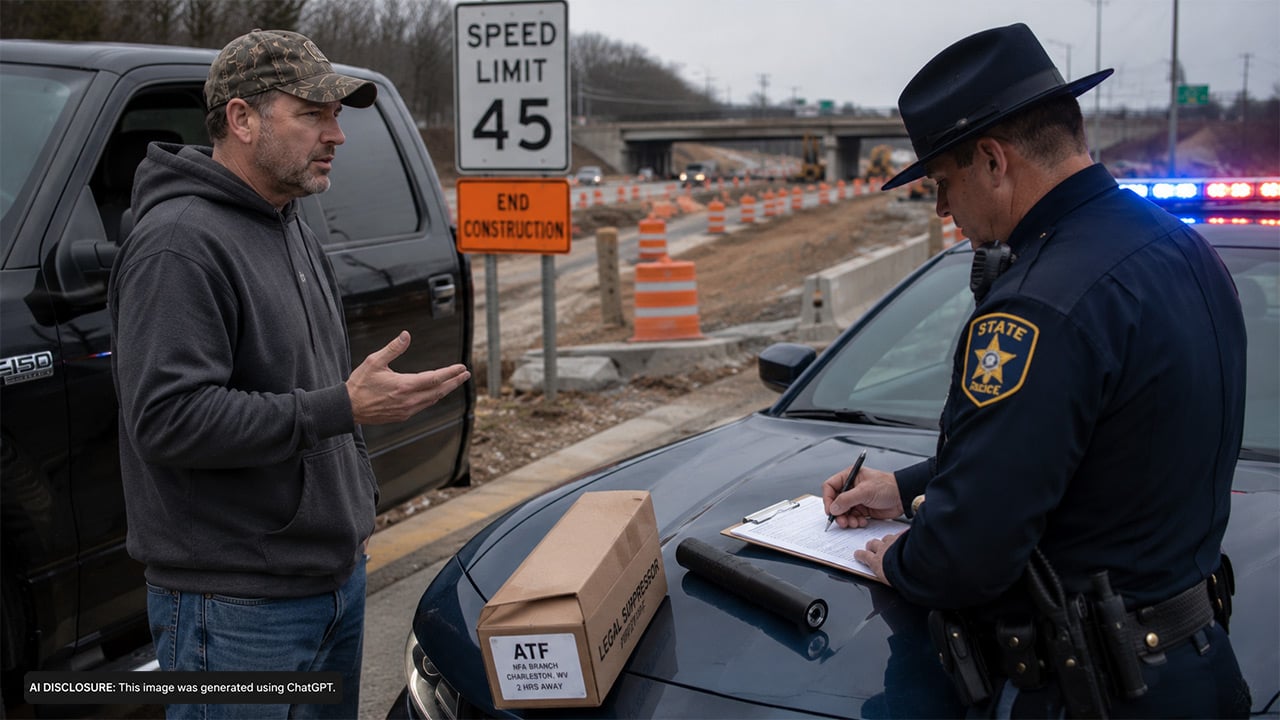
Photo credit: AI-generated image created using ChatGPT. Illustrative only
A lot of us have had that one traffic stop where you can feel it sliding downhill, even when you know you’re the one who stepped in it first. In this case, it started with a speeding violation in a construction zone and ended with a suppressor taking a little road trip—first to a police station, then to a federal field office two hours away.
The story comes from the original post, where the gun owner laid out how a routine stop turned into a paperwork standoff, a temporary seizure of a legal NFA item, and eventually a face-to-face visit from an ATF agent at his doorstep.
A speeding stop in a construction zone set the hook
The driver admitted he was doing 65 in a 55 mph construction zone. That’s the kind of ticket that’s already going to hurt, and in many places the fines get doubled when workers and cones are involved.
The officer approached the passenger side, asked for the usual license and registration, and then scanned the vehicle. The driver said the officer noticed he had an AR-15 and a suppressor in the car.
“Officer safety” turned into a request for the rifle
Once the officer saw the firearm, he asked for it under the umbrella of officer safety. The driver said he allowed the officer to take the rifle while he handed over his documents.
Then came the long wait. The driver described sitting there while the officer returned to his patrol car and took his time before coming back with the ticket details—and questions about the suppressor.
The suppressor paperwork became the real argument
After explaining the construction-zone ticket and doubled fine, the officer shifted to the “NFA accessory” on the rifle and asked for paperwork. The driver responded: “I don’t have it on me…”
According to the account, the officer pressed him on whether he truly didn’t have it or just didn’t want to show it. The driver said the paperwork wasn’t on his person and told the officer he didn’t feel compelled to provide it during the stop, adding that simply having an NFA item wasn’t probable cause.
The officer then laid out what he described as three options: show paperwork right there, go to the station and present it to leave with the suppressor, or have it “run through the ATF.” The officer also told him he had no experience dealing with the ATF and couldn’t say what would happen if it went that route.
The driver said he wasn’t comfortable proving ownership on the side of the road and called it unconstitutional. The officer told him he wasn’t going to debate constitutional law during a traffic stop, and that if the driver wanted his suppressor back it would be at the station.
When he tried to cooperate, the decision was already made
At that point, the driver said he changed course: “ok I’ll show you the paperwork.” But the officer allegedly shut that down with: “no it’s too late, you wanted to play games, so that ship has sailed.”
The officer returned the AR-15—minus the suppressor. So instead of driving away with a speeding ticket and a rifle, the driver drove away with a speeding ticket and a rifle missing a serialized NFA item he legally owned.
That’s the part that will make any hunter or range guy’s stomach tighten up. Not because you’re trying to hide something, but because you know how expensive suppressors are, how much time and paperwork goes into buying one legally, and how quickly your property can end up behind a counter when the wrong person decides to make a point.
The pickup window came and went, and then it became federal
A week later, the driver got a call from the police department saying the suppressor could be picked up. The dispatch caller asked if he was available. He told them he was at work and wasn’t sure he could leave to get it.
The next week, the same thing happened—another call, same question, same answer. The driver said he was honestly too busy to just leave work for it.
Not quite a week after that, he called the police department intending to finally retrieve it. That’s when he was told the suppressor had been turned over to an ATF field agent office, which he said was two hours away.
This is where the practical reality hits. In the outdoors world, folks aren’t always ten minutes from the sheriff’s office. Plenty of us work jobs you can’t just walk away from, and plenty of us live a long drive from any office that keeps banker’s hours.
An ATF agent brought it back—after a simple ask
The driver called the ATF field office a couple days later and explained he couldn’t easily pick up the suppressor due to the distance. He said he convinced them to bring an agent to his area instead.
The only thing the ATF asked, according to the story, was that he be available and show them the tax stamp. Days later, an agent showed up at his doorstep.
The driver described the agent as “kinda chill” and said the agent explained something that’s worth remembering: the stamp exists because local law enforcement doesn’t have access to that NFA registration information. In the end, the driver said he finally got his suppressor back.
What outdoorsmen can take from this without turning it into a roadside fight
There are a couple lessons here that don’t require anyone to “win” an argument on the shoulder of a highway. First, a construction-zone stop is already a bad place to test how stubborn you can be. When it’s cones, workers, and doubled fines, the officer has a clean reason to stop you and plenty of time to dig in.
Second, if you’re traveling with NFA items, think about the most practical outcome, not just the theoretical one. The driver in this story made clear he didn’t have the paperwork on him and didn’t want to present it. Whether you agree with his point or not, it ended with his suppressor separated from him and later handed off to a federal office two hours away.
Third, don’t ignore the “go pick it up” window if you get it. The driver was busy—most of us are—but those early calls from the police department were the easiest path to getting his property back. Once it left the local department, the inconvenience multiplied.
And finally, keep your cool. The moment the interaction turned into a “pissing match,” the outcome stopped being just a speeding ticket. If you’re transporting guns to the range, heading to hunt, or just moving gear around, it’s worth remembering that a calm, practical approach usually costs less than making a point on the side of the road.
Like The Avid Outdoorsman’s content? Be sure to follow us.
Here’s more from us: