Photo credit: AI-generated image created using ChatGPT. Illustrative only
Most folks who run a suppressor legally do it for the same reasons they wear good ear pro and keep a safe backstop: they’re trying to be responsible. But one Pennsylvania shooter says a routine range session turned tense fast when a state game officer stepped in and started talking arrest before taking more than a quick glance at the paperwork.
In the original post, the shooter said he was threatened with arrest if he couldn’t produce his ATF Form 4 for the suppressor he was using. He did have the form with him, but the interaction still left him asking whether others had run into the same kind of pressure.
A suppressor on the line drew attention
The shooter’s account is short, but the scene is easy to picture if you’ve spent any time at public ranges or state lands. A suppressor stands out, even though they’re becoming more common. It doesn’t matter if you’re shooting safely and minding your own business—somebody is going to notice.
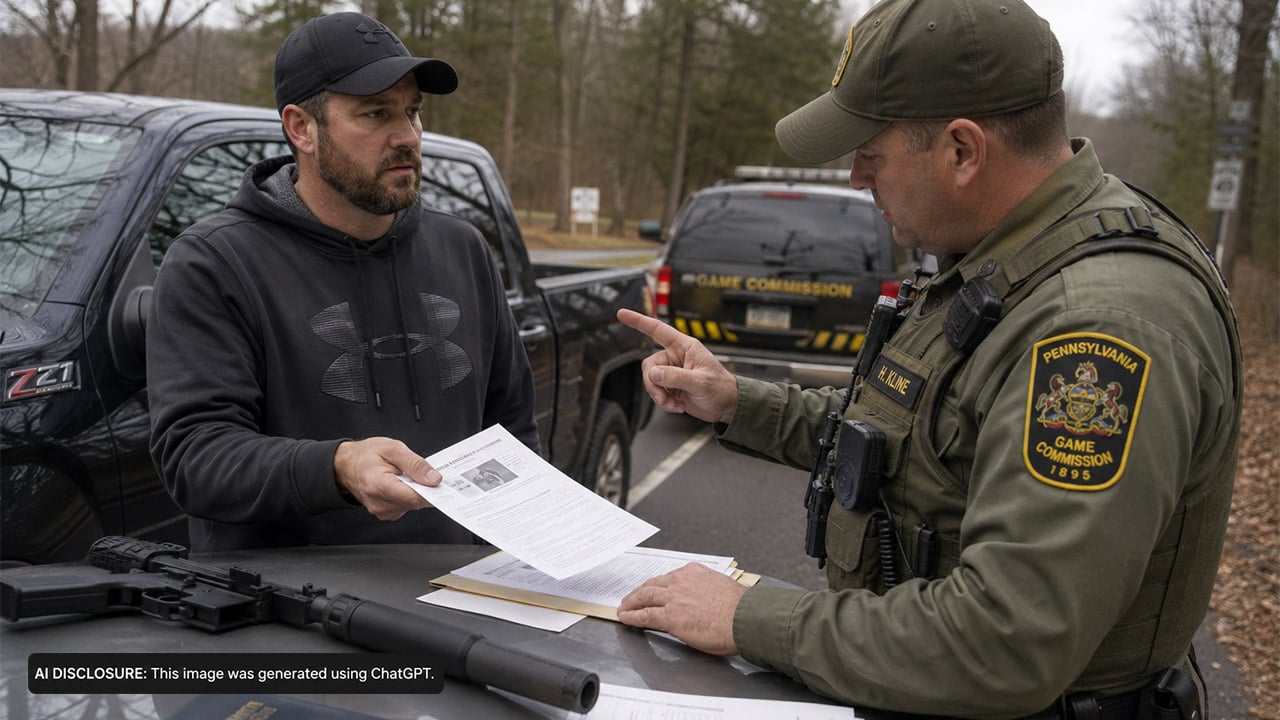
According to the shooter, that “somebody” was a Pennsylvania Game Commission officer, described in the post as a “pa game commissioner.” The officer reportedly approached and made it clear that if the shooter couldn’t provide the Form 4 for the suppressor, an arrest was on the table.
The arrest warning came before the paperwork check
The part that will make most law-abiding gun owners grind their teeth is the order of operations. The shooter said the officer threatened him with arrest first, then asked for the documentation.
Carrying paperwork for NFA items is one of those habits many folks pick up because it can keep a minor hassle from turning into a major problem. The shooter said he produced his Form 4. That should’ve been the end of it—verify it, hand it back, and move along.
But in this case, the shooter felt like the officer wasn’t really interested in verifying anything so much as making a point.
He says the officer barely looked at the Form 4
After the shooter showed the form, he says the officer didn’t actually check it in any meaningful way. In the post, the shooter wrote that the officer “didn’t even verify anything” and “only saw the folder paper which all you could see was the stamp.”
If that’s accurate, it’s a strange mix of aggressive and careless. On one hand, the officer was willing to talk about taking someone to jail over a suppressor. On the other hand, when proof was provided, the officer apparently didn’t take the time to confirm the details that would matter.
For outdoorsmen, that’s the worst kind of interaction: high stakes, low effort. It leaves you feeling like you can do everything right and still get jammed up depending on who walks up and what mood they’re in.
Why this hits a nerve for lawful hunters and shooters
Suppressors are legal to own in Pennsylvania if you follow the federal process. That’s the whole point of the Form 4—tax paid, background checked, registered, and approved. The shooter’s complaint isn’t about being asked for documentation; it’s about being threatened with arrest and then having the documentation treated like a prop instead of proof.
In the real world, these encounters don’t happen in a courtroom with calm voices and plenty of time. They happen on the side of a range bench, or near a truck, or out on a piece of state ground where you’re already trying to keep your attention on safety.
And when the conversation starts with “you’re going to jail if you can’t show me X,” it immediately changes your posture. You’re no longer just a guy shooting; you’re a suspect trying to prove you’re not a criminal.
Practical takeaways if you run NFA gear in the field
The shooter’s story is a good reminder that “legal” and “hassle-free” aren’t always the same thing. Whether you’re target shooting, sighting in for deer season, or spending a morning knocking down steel, the best move is to assume you may need to prove what you’ve got.
First, keep your documentation accessible. The shooter had his Form 4 with him, which likely prevented the situation from getting worse. A hard copy in a folder works, and many owners also keep a digital copy available, but the key is being able to produce it without fumbling around or escalating the moment.
Second, don’t confuse “asked for proof” with “guilty until proven innocent,” even if it feels that way. Stay calm, keep the muzzle discipline and range etiquette tight, and treat it like any other official contact—short, respectful, and to the point.
Third, remember how quickly the tone can shift. If an officer leads with threats, it’s not the time for an argument about policy or opinions on suppressors. The safest, smartest play is to comply with lawful requests, provide the paperwork you have, and get back to shooting once the contact is over.
He’s not asking for a fight—he’s asking if this is normal
The shooter ended his post with a simple question: “Has anyone else been threatened with arrest before?” That’s what makes this feel like a conversation you’d hear in any hunting camp or gun club parking lot. Not a grandstanding speech—just a guy trying to figure out if he had a one-off bad encounter or if this is something suppressor owners should expect.
At the end of the day, suppressors are safety equipment as much as anything. They cut down blast, they make training more comfortable, and they can make it easier to communicate on a firing line. When someone goes through the legal process and then gets treated like a criminal anyway, it doesn’t encourage compliance—it discourages it.
If you’re running NFA items in Pennsylvania or anywhere else, the lesson is simple: have your paperwork, keep your composure, and don’t assume common sense will be the first thing you run into. Sometimes it’s the last.
Like The Avid Outdoorsman’s content? Be sure to follow us.
Here’s more from us: