Photo credit: AI-generated image created using ChatGPT. Illustrative only
It’s one thing to pull up old carpet and find a few lost coins or a rusty pocketknife. It’s another to peel back a closet floor and stare at a hidden safe you didn’t know you bought.
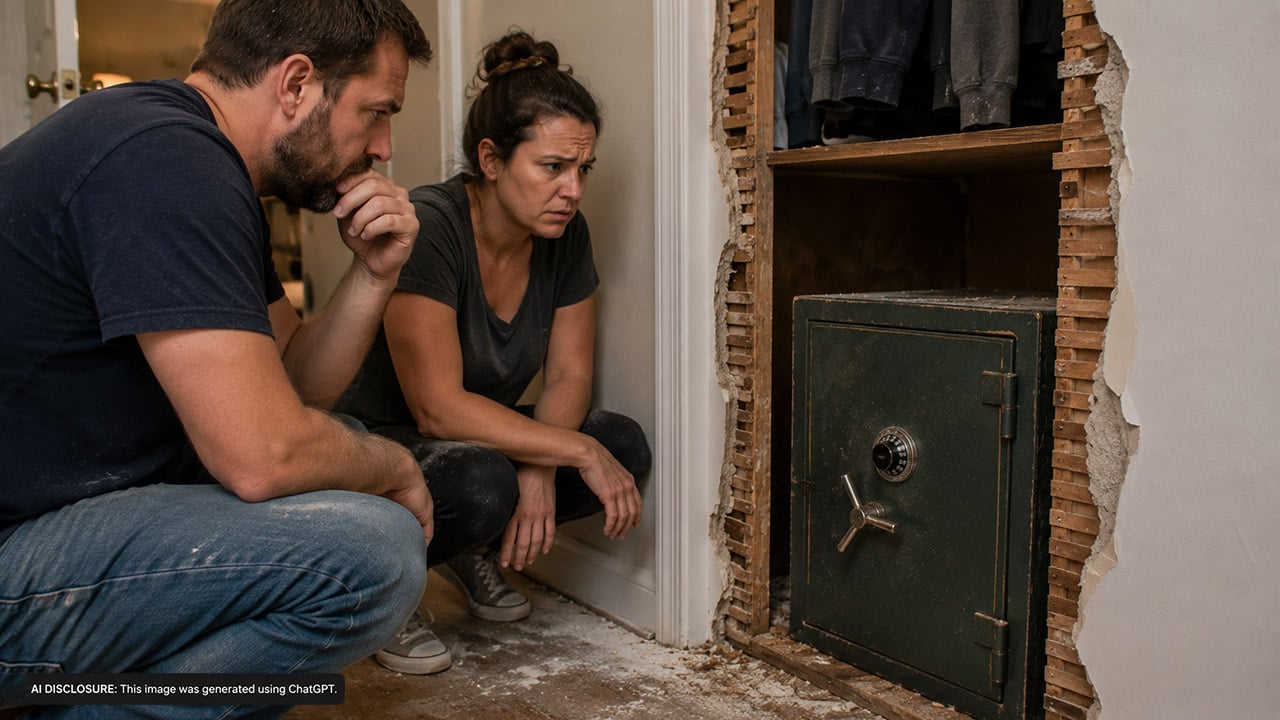
That’s exactly what happened to a couple who had just closed on an estate-sale home and started remodeling. Under the carpet in a closet, they found a floor safe set flush into the concrete, complete with a cover so the carpet laid flat—like it had been planned from day one. Their full rundown is in the original post, but the short version is this: now they’re wondering what’s legal, what’s ethical, and how not to turn a renovation surprise into a mess.
A hidden safe that looked intentional
This wasn’t a cheap lockbox tucked on a shelf. The safe was in the floor, about 2 feet by 2 feet, and appeared “high end.” It sat flush with the concrete, and the carpet showed impressions suggesting a dresser had been placed over it for years—good concealment without looking suspicious.
The house itself was a new build from the 1990s, owned by a father who lived there alone until he passed. The property was sold by the only child, a son who lived out of state and said he’d never lived in the home. On the seller’s disclosure, nearly everything was marked “don’t know,” which isn’t uncommon when an heir sells a parent’s property and genuinely doesn’t have the history.
The seller didn’t hand over a combo—maybe because he didn’t have it
The big detail: no safe combination was provided with the closing documents or keys. That doesn’t automatically mean anyone was being shady. If the father had the safe installed and kept the combo private, it’s completely plausible the son never knew it existed.
But from a buyer’s perspective, it’s still a curveball. A safe is a fixture in a different way than a forgotten toolbox in the garage. It’s anchored, concealed, and purpose-built to hold valuables—or at least that’s what everyone’s mind jumps to.
The questions every rural homeowner thinks about right away
Once you’ve got a hidden safe under your roof, the imagination starts running. Could it be cash? Paperwork? Jewelry? Old firearms? Or, on the darker side, could it be something you don’t want in your possession at all?
The homeowners laid out the same questions most of us would ask standing in that closet: Do they legally have rights to whatever is inside? Should they contact the son and see if he knows or can guess the combination? If they open it and there’s property inside, is it moral to keep or sell it? And practically speaking—how do you even get into a safe like that?
Legality and ethics aren’t the same thing, and that’s the trap
In the outdoors world, we’re used to clear lines: property boundaries, seasons, tags, what’s yours and what isn’t. This situation is fuzzier, because it mixes real estate, estate matters, and plain old common sense.
On one hand, when you buy a house, you typically expect anything permanently attached to it to convey with the sale. A floor safe sure feels like it’s “part of the house.” On the other hand, the contents can feel like personal property—especially if it’s something that obviously belonged to the deceased owner.
That’s where people get jammed up. The couple’s worry about reaching out to the son is understandable: once you ask, you might open the door to a dispute over what’s inside. But if you don’t ask and you open it, you could end up with something that brings the son back into the picture anyway—only now with more tension.
The smart way to think about opening it without creating a bigger problem
There are two separate issues here: opening the container and handling whatever’s inside. Even if you feel confident you own the safe because it was part of the structure, the contents can create a whole different set of problems depending on what they are.
If it’s paperwork, you may have identity documents, wills, old stock certificates, or personal records that clearly tie back to the deceased owner. If it’s cash or valuables, you’ve got an ethical dilemma at minimum. And if it’s anything regulated—like certain firearms or controlled items—you don’t want your first move to be “let’s pry it open and see.”
From a pure homeowner-practical standpoint, the safest route is usually to slow down. Document what you found (photos of the safe in place, how it was concealed, the condition of the area). Then think through who you’d call if the contents are sensitive: a real estate attorney for guidance, the closing agent, or even the local non-emergency line if you’re worried about contraband. Nobody wants to involve extra people, but the wrong surprise can get expensive fast.
Why reaching out to the son could still be the cleanest play
The homeowners considered contacting the son to see if he knew about the safe or could provide the combination. That’s a reasonable instinct. If the seller truly didn’t know, a heads-up could clear the air and give everyone a chance to act like adults before anyone starts drilling, cutting, or prying.
There’s also a practical angle: if the son can produce a combo, it saves you from damaging a safe that’s embedded in concrete. Anyone who’s done real remodeling knows what happens next—broken tile, busted slab edges, dust everywhere, and a repair job that turns into a bigger project.
But the couple’s hesitation also makes sense. Once you initiate contact, you may create an expectation that you’ll turn over anything found inside, even if the law in your state says otherwise. That’s why folks often choose to run the question through a professional first—someone who can tell you where the line usually sits in your area without turning it into a fight.
What “cracking a safe” really means in the real world
People hear “hidden safe” and think Hollywood. In real life, opening a quality safe usually comes down to hiring a locksmith or safe technician who knows how to open it with the least damage possible. That matters when the safe is mounted in a slab and you don’t want to tear up your closet floor.
Just as important, a professional approach creates a cleaner record of what was done and when. If anything questionable is inside, you’re better off being able to say you handled it responsibly instead of looking like you were trying to break into something that wasn’t yours.
And if you’re a gun owner, you already know this lesson: secure storage is serious business, and tampering with it carelessly is a good way to get hurt or create legal headaches. Treat an unknown safe like you’d treat an unknown firearm—don’t assume it’s empty, don’t get casual, and don’t let curiosity outrun judgment.
Finding a hidden floor safe during a remodel is the kind of surprise that makes a good campfire story—right up until the moment it turns into a dispute with an heir or a call you didn’t want to make. The couple’s best advantage here is that they found it early, before the closet went back together, and they’re thinking through the legal and moral angles before taking action. That’s the kind of steady, practical decision-making that keeps a “cool find” from becoming a long-term problem.
Like The Avid Outdoorsman’s content? Subscribe to our newsletter so you never miss an article.
Here’s more from us: