Photo credit: AI-generated image created using ChatGPT. Illustrative only
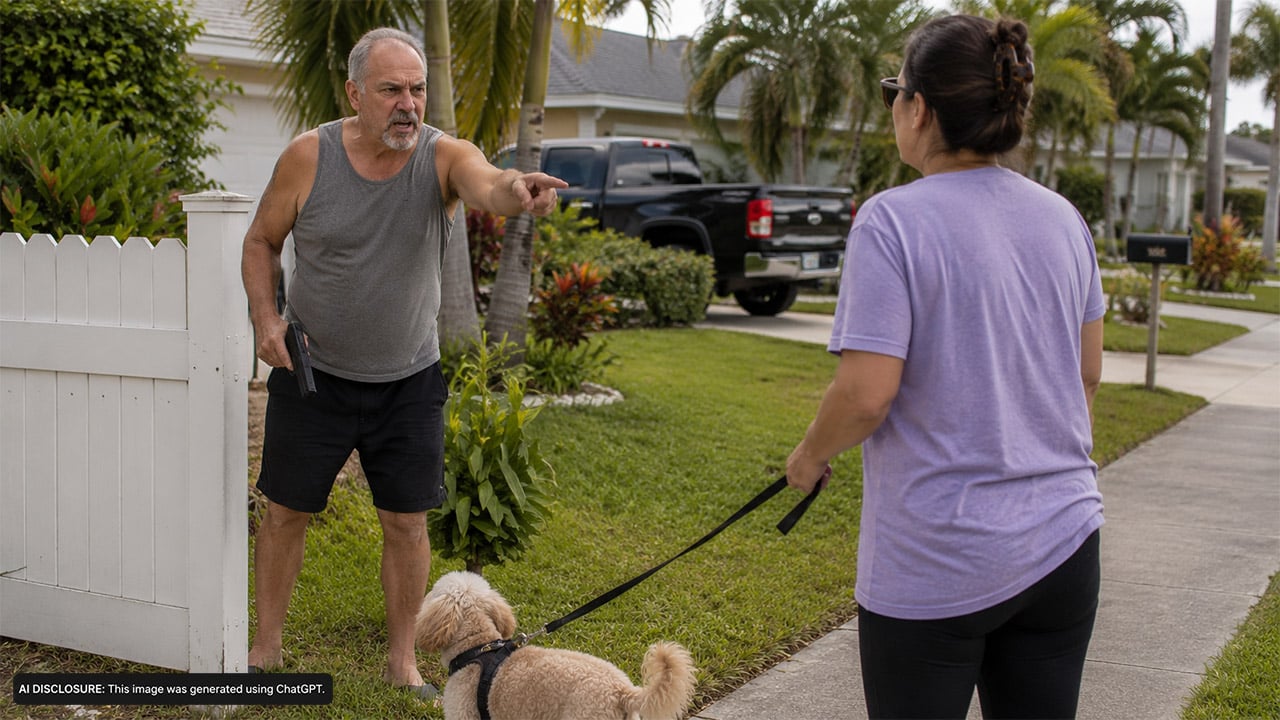
A morning dog walk on the sidewalk shouldn’t turn into a personal-safety problem, but that’s exactly what one Florida couple says happened when a neighbor came out of a backyard, threatened to shoot their leashed dog, and then tried to find out where the woman lived. The account was shared in the original post, and the details are the kind that make the hair on your neck stand up if you’ve spent any time around property disputes and “get off my lawn” types.
According to the husband, his wife was walking their Shiba Inu on a leash along the sidewalk with poop bags—normal, responsible stuff. The dog “very rarely bark[s],” and there was no mention of the dog leaving the sidewalk, rushing anyone, or causing a scene. Still, the neighbor allegedly stepped out and made the threat, then followed it up by asking where she lived, which she refused to answer.
How a routine sidewalk walk turned into a threat
Most of us who live in gun country understand that words carry weight. Saying you’re going to shoot something isn’t the same as complaining about dogs or asking someone to keep their pet away from your fence line. It’s a threat of deadly force, and it changes the entire situation from “annoying neighbor” to “potentially dangerous person.”
The other detail that matters here is location: this wasn’t described as someone cutting through a backyard or letting a dog run loose. It was a leashed dog on a sidewalk. That’s exactly where you’d expect to see folks walking pets, pushing strollers, or running in the morning.
Why “where do you live?” is a big red flag
If the threat wasn’t enough, the follow-up question is what would make most people’s instincts kick in. When someone asks where you live right after threatening to shoot your dog, it doesn’t sound like they’re trying to have a civil conversation or swap phone numbers like normal neighbors. It sounds like they’re trying to identify you for later.
From a practical standpoint, the wife did the right thing by not giving that information out on the spot. In rural areas and tight subdivisions alike, people tend to figure out where you live eventually. But you don’t help them in the moment when they’re hot and acting aggressive.
What to do next if you’re worried about your dog’s safety
If you’ve ever dealt with a hostile neighbor, you already know the first rule: don’t escalate and don’t play street lawyer in the yard. The goal is to create a paper trail, tighten up your routine, and give yourself options if this person decides to repeat the behavior.
Start with documentation while it’s fresh. Write down the time, exact location, what was said as accurately as you can remember, and what the neighbor looked like and where they came from (back gate, side yard, etc.). If the neighborhood has cameras—doorbells, driveway cams, HOA systems—this is the time to see if any footage caught the encounter.
Next, think about changing the walk route for a while. That’s not “letting them win.” It’s buying time and space while you figure out whether this was a one-off blowup or a pattern. If you do keep walking that direction, going as a pair instead of alone can help, and keeping a phone ready (not buried in a pocket) matters.
And for dog owners, keep doing what they were already doing here: leash on, dog under control, pick up after it. When you’re in the right, staying in the right gives you leverage if this turns into a formal complaint later.
Where the legal and the real world meet in Florida
Florida is full of responsible gun owners, and it’s also full of people who talk big. The problem is you don’t get to know which one you’re dealing with until it’s too late. A threat to shoot a leashed dog on a public sidewalk is the kind of statement that many folks would reasonably interpret as intimidation, and it’s not something a person should ignore and hope disappears.
This is where contacting local law enforcement to report the threat can make sense. Not because anyone expects a SWAT team response over a bad neighbor moment, but because a report creates a record. If the neighbor keeps it up—or if the situation escalates—you don’t want the first official record to start after something worse happens.
At the same time, it’s smart to avoid going onto the neighbor’s property to “clear things up.” Don’t knock on their back gate. Don’t argue across a fence. People who make threats over nothing sometimes look for a reason to claim they felt “threatened,” and that’s a headache you don’t need.
The outdoorsman’s angle: responsible carry isn’t about winning an argument
In a lot of Florida, folks carry legally, and plenty of dog walkers do too. If you’re one of them, this is the kind of situation where mindset matters more than hardware. Carrying doesn’t make you the neighborhood referee. It’s there for the worst day, not for a shouting match with a guy who already sounds unstable.
The best play is to stay calm, don’t trade threats, and leave. Create distance, call it in if you believe it was a credible threat, and let documentation do the heavy lifting. If you carry pepper spray or a similar tool where legal, it’s worth remembering that not every problem should jump straight to lethal-force thinking—especially when the initial conflict is about a dog and a neighbor running their mouth.
Also worth saying: if you’re a gun owner reading this, the neighbor’s behavior makes all of us look bad. Responsible folks don’t threaten to shoot somebody’s pet on a leash, and they sure don’t press for a home address after the fact.
What people tend to focus on in situations like this
When a story like this gets discussed, most of the practical feedback usually circles around the same few things: report it, document it, and stop giving an aggressive person opportunities. People also tend to bring up cameras—doorbell cams, body-worn video on your phone, or even just recording audio if your state allows it—because proof beats a “he said, she said” every time.
Another common theme is keeping the dog’s behavior airtight. Even though the owner described the Shiba as rarely barking and always being leashed, it’s still smart to double down: no flexi-leash drifting into lawns, no stopping near the neighbor’s property line, and no lingering if you see that person outside.
Lastly, folks often point out that a threat against a dog is sometimes a preview of how that person handles conflict in general. Today it’s the dog. Tomorrow it’s “slow down on my street” or “your kids are too loud.” That’s why early documentation matters.
In the end, this wasn’t about a dog acting up—it was about an adult choosing to threaten violence and then trying to gather personal information. The safest path is simple: don’t engage, keep your routines controlled, document everything, and make sure there’s a record if the neighbor decides to pull that stunt again.
Like The Avid Outdoorsman’s content? Be sure to follow us.
Here’s more from us: