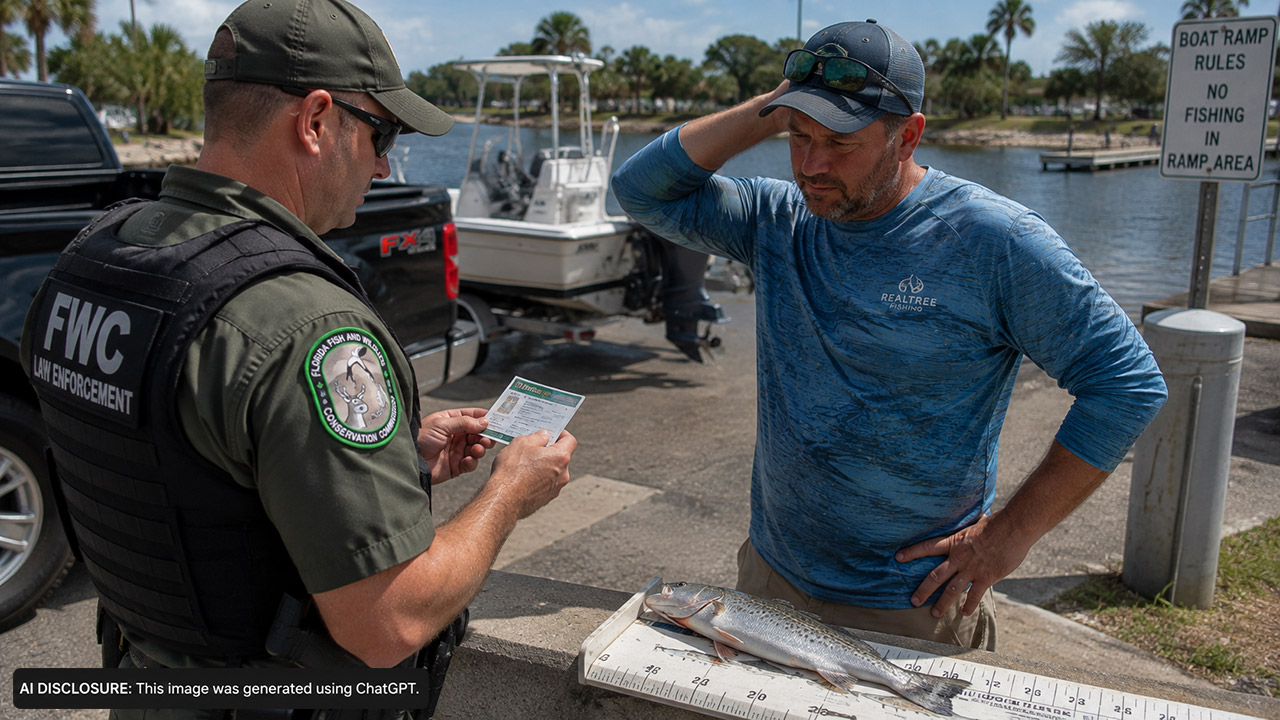
Photo credit: AI-generated image created using ChatGPT. Illustrative only
Anybody who’s spent time on saltwater knows how fast a “quick trip to fish” can turn into a lesson. One out-of-state visitor to Florida found that out the hard way after a stop by the Florida Fish and Wildlife Conservation Commission (FWC) turned a simple mistake into a misdemeanor citation and a surprise set of probation-like strings attached.
In the original post, the angler said he was leaving after fishing when FWC contacted him and found two issues: his Florida visitor fishing license had expired a few days earlier (the officer mentioned it on the ticket but didn’t cite him for it), and he had kept a snapper he believed was a mangrove. It turned out to be a mutton snapper—14 inches long when the legal minimum is 18.
A routine check turned into a second-degree misdemeanor
The fish was the real problem. The angler admitted he misidentified it and called it “an honest mistake,” but it was still an undersized mutton snapper in the cooler. That’s the kind of infraction that game wardens don’t treat like a parking ticket, because size limits are one of the main tools that keep a fishery healthy.
The officer cited him and told him to request a diversion program since it was his first time. On paper, that sounds like the common-sense option: take a class, pay a fine, learn the rules, and keep a criminal conviction off your record.
The “diversion” offer sounded simple—until the details showed up
When the court date came around, the angler joined by Zoom since he lives out of state. He said the judge was pleasant and offered diversion. The State Attorney’s office signed him up, and he got a call from an intake officer for the program.
That’s when the tone changed. Instead of a straightforward course and a fee, he said the program looked like full-blown probation: travel restrictions, surrendering firearms, monthly check-ins with a probation officer, community service, and supervision costs—on top of program fees and a mandatory donation to FWC.
If you’re an outdoorsman who travels, hunts, and owns guns, that list isn’t just inconvenient. It can collide with how you live your life.
Why the probation terms hit hunters and gun owners extra hard
This wasn’t just about paperwork. The angler said he travels regularly for family and that he’s a hunter and gun owner. He also said he was scheduled to volunteer at two charity events in October, both centered around hunting and firearms—exactly the kind of community involvement you’d think would be viewed as a positive, but also exactly the kind of setting that could become complicated if you’re ordered to surrender firearms or restricted in where you can go.
Outdoors folks understand that “restrictions” aren’t theoretical. If you’re told you can’t travel without permission, that can mean missed family events, missed work trips, and a constant need to ask someone else before you cross a state line. If you’re told to surrender firearms, that can mean missing hunting season, changing how you store your guns, and potentially impacting other rights and responsibilities tied to lawful ownership.
The timing pressure: sign now, ask questions later
One of the worst parts of his story is the timing squeeze. He called the judge’s assistant and was told to bring concerns up to the judge at the court date at the end of the month. But his first scheduled date with a probation officer would happen before that, and the program paperwork needed to be turned in quickly.
That’s a real bind for anyone, but especially for someone who’s out of state and trying to keep a clean record. Diversion programs can be a lifeline, but once you start signing and reporting, the system can treat you like you’ve accepted those terms—even if you thought you were agreeing to something closer to a class and a fine.
The angler’s questions were straightforward: should he ask the judge to take the misdemeanor instead, would that upset the judge, what would it do to his record, and is there anything he can do about the probation restrictions?
What people tend to focus on in cases like this
Even without a pile of back-and-forth reactions included in the source, the pressure points in this kind of situation are the same ones hunters and anglers talk about at the ramp and around the cleaning table.
First is fish ID and measurement. Mangrove (gray) snapper and mutton snapper can fool a new saltwater angler, especially if you’re fishing unfamiliar water, the light is low, or the fish is coming out of an ice slurry. But “I thought it was” doesn’t change the species-specific rules. Second is license management—an expired license by a few days is easy to do when you’re traveling and distracted, but it’s also completely preventable with a calendar reminder and a quick check before you go.
Third—and this is the big one—is that “diversion” doesn’t always mean “easy.” In some places it’s a short online course. In others, it can come with probation-style supervision and conditions that feel heavy compared to the original mistake. When firearms are part of your normal life, those conditions can matter as much as the fine.
The first lesson is simple: if you’re not 100% sure on a fish, don’t keep it. Take a photo, let it go, and catch another. A lot of seasoned anglers follow a personal rule that’s stricter than the law—if it’s barely legal, it goes back. That one habit can keep an honest mistake from turning into a citation.
The second lesson is to build a “before you launch” checklist that includes your license status. Nonresident licenses, short-duration passes, and trip planning make it easy to misread dates. Five minutes on your phone before you fish can save you months of hassle.
The third lesson is to treat diversion like a contract, not a handshake. If you’re offered diversion, ask what it actually requires—class, probation supervision, reporting, travel permissions, firearm restrictions, and total cost. If you’re out of state, those details aren’t “fine print.” They’re the whole deal.
And finally, when the charge is described as a misdemeanor, it’s worth slowing down. A criminal record can follow you into job applications, professional licensing, and some firearm-related situations depending on your state and circumstances. If you’re being asked to choose between accepting a conviction and accepting restrictive supervision, that’s the point where many outdoorsmen decide it’s time to get real advice and not just guess.
At the end of the day, this wasn’t a story about a guy trying to skirt the rules. It reads like a visiting angler who made two avoidable mistakes—one on paperwork, one on fish ID—and then got blindsided by how serious the “easy option” could become. Florida’s saltwater opportunities are worth the trip, but the rules are part of the cost of admission, and the consequences can reach a lot farther than the fillet table.
Like The Avid Outdoorsman’s content? Subscribe to our newsletter so you never miss an article.
Here’s more from us: