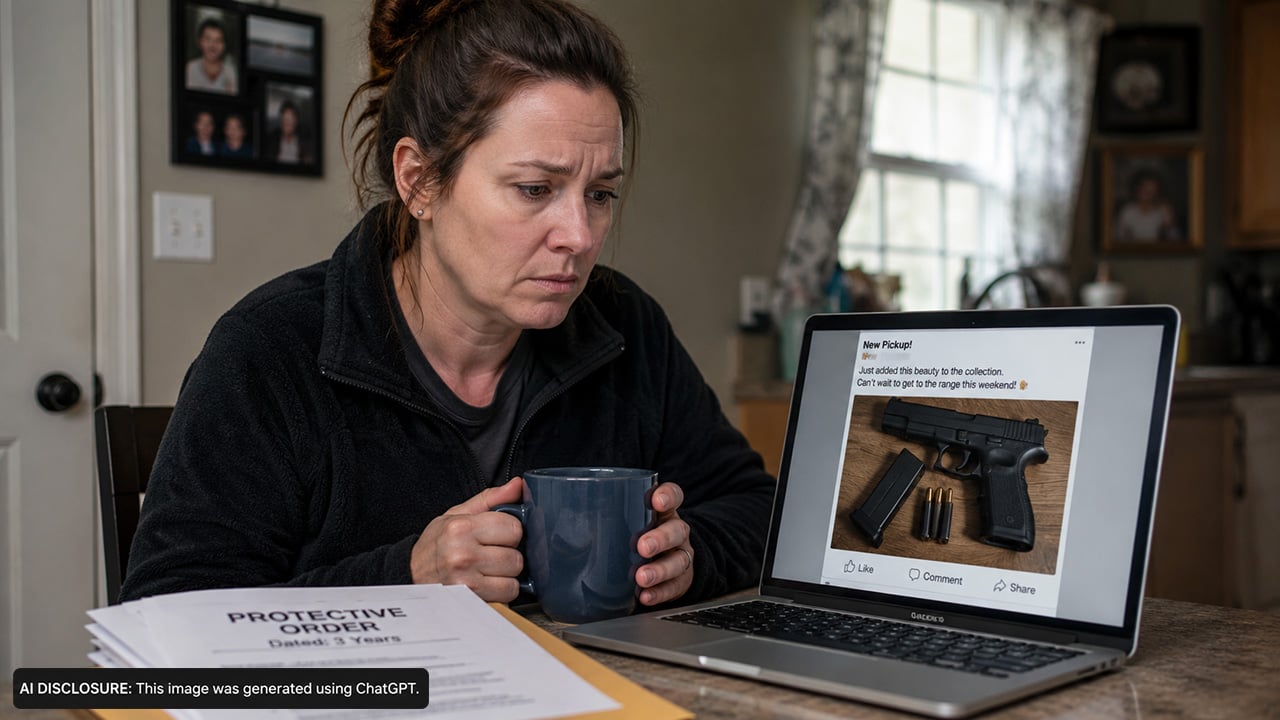
Photo credit: AI-generated image created using ChatGPT. Illustrative only
A protective order is supposed to buy someone breathing room. For one Kentucky woman, that space got a lot smaller after she learned her violent ex—who lives across the line in Tennessee—had posted online about a gun getting stolen out of his truck and wanting to buy another.
In the original post, she said she has a three-year protective order against him and that the paperwork didn’t specifically say he had to surrender firearms. But at the bottom, it warned that under federal law he cannot have a gun. She also believes the gun he previously had “wasn’t even a legal one,” and she has screenshots of the social media post. Her questions were plain: Is he allowed to have a gun? Should she report it? And who would she even call?
The part a lot of folks misunderstand about protective orders and guns
People hear “protective order” and assume it automatically means “no firearms.” In real life, it depends on what the order is, how it’s written, and what findings the judge made. Some orders include specific language about surrendering guns. Others don’t spell it out, even if other laws may apply.
What jumped off the page here was her description that the document itself included a federal-law warning at the bottom saying he cannot have a gun. That kind of language is often there for a reason, and it’s not something to shrug off. If a court order is in place and the conditions line up with federal restrictions, possession can become a serious problem fast—even if the order doesn’t have a bold “firearms surrender” paragraph.
Crossing state lines makes it feel complicated, but it doesn’t make it safer
This situation has that common border-state twist: she’s in Kentucky, he’s in Tennessee. That can make people hesitate because they’re not sure which state “owns” the issue, or whether a local agency will take it seriously.
But from a practical, safety-first standpoint, the danger doesn’t care about state lines. A violent ex with access to a gun is a threat whether he’s five miles away or fifty. The poster wasn’t asking how to pick a fight or stir up drama—she was trying to figure out whether this is the kind of thing you document and report before it turns into a knock at the door.
The “stolen gun out of the truck” detail is a red flag all by itself
Anybody who spends time around gun people has heard this story: a firearm left in a vehicle gets stolen. Sometimes it’s a smash-and-grab. Sometimes it’s a vehicle that wasn’t locked. Either way, it’s the exact opposite of responsible storage, and it turns a bad situation into a community problem.
If his post really did claim a gun was stolen out of his truck, that’s not just a personal inconvenience. It means there may be a firearm in circulation that shouldn’t be. And if the owner is already someone the poster has a protective order against, it raises the stakes—because now you’ve got the risk of replacement gun shopping on top of a missing firearm that might not have been properly owned in the first place.
“His old one was never legal” is serious, but it’s also easy to misread
The woman said she knew the gun he had “wasn’t even a legal one.” That can mean a lot of different things in everyday conversation. Some folks use “not legal” to mean the person wasn’t allowed to have it. Others mean the gun itself was illegal (like an unlawfully modified firearm), or that it was stolen, or that it wasn’t transferred properly.
Without getting into technical weeds, the practical takeaway is this: if she has reason to believe the firearm was illegal or unlawfully possessed, that’s not the kind of suspicion you handle by sending messages, making threats, or trying to play detective. It’s the kind of information you preserve—screenshots, dates, anything that shows what was said and when—and pass to the right authorities.
What she can do without escalating the situation
She asked the most important question first: “Should I report him? Can I? And to whom?” From a common-sense outdoorsman’s standpoint, the answer is: if you have an active protective order and credible information he’s attempting to obtain a firearm, it’s reasonable to notify law enforcement rather than carrying it alone.
A practical route is starting with the agency that handles protective-order enforcement where she lives, since they can take the report and help point it to the proper jurisdiction. Because he lives in Tennessee, it may also involve contacting law enforcement in his area. If the court that issued the protective order has a domestic violence office, victim advocate, or clerk who can point her toward the right channel, that can also help—especially when the paperwork includes language referencing federal firearm restrictions.
The key is to keep it clean and factual: she has a protective order, she has screenshots indicating he’s looking to buy another gun after claiming one was stolen, and the order itself warns about firearm possession under federal law. No back-and-forth with him. No “I’m going to report you.” Just document, report, and let the system do what it’s supposed to do.
Why gun owners should care about this even if they’ve never dealt with a protective order
Most hunters and shooters I know take firearms responsibility seriously. They lock them up, keep them out of vehicles when they can, and they understand that a “truck gun” left unattended can become somebody else’s gun in a hurry. This story hits on the flip side: when a person with a history of violence is shopping for a replacement, the consequences can land on an innocent person first.
It also highlights a hard truth: legal gun ownership and protective orders can intersect in ways that confuse regular folks. Paperwork doesn’t always shout the rules in plain language, and people assume “if it’s not written in big letters, it doesn’t count.” That’s not a bet anyone should be making when there’s a court order and a violent past involved.
For the Kentucky woman who posted, the smartest move isn’t to wait and see whether that next purchase happens. It’s to treat those screenshots like a time-stamped warning sign, report it through appropriate channels, and keep her focus where it belongs—on staying safe and keeping distance, not on trying to personally enforce the rules.
Like The Avid Outdoorsman’s content? Be sure to follow us.
Here’s more from us: