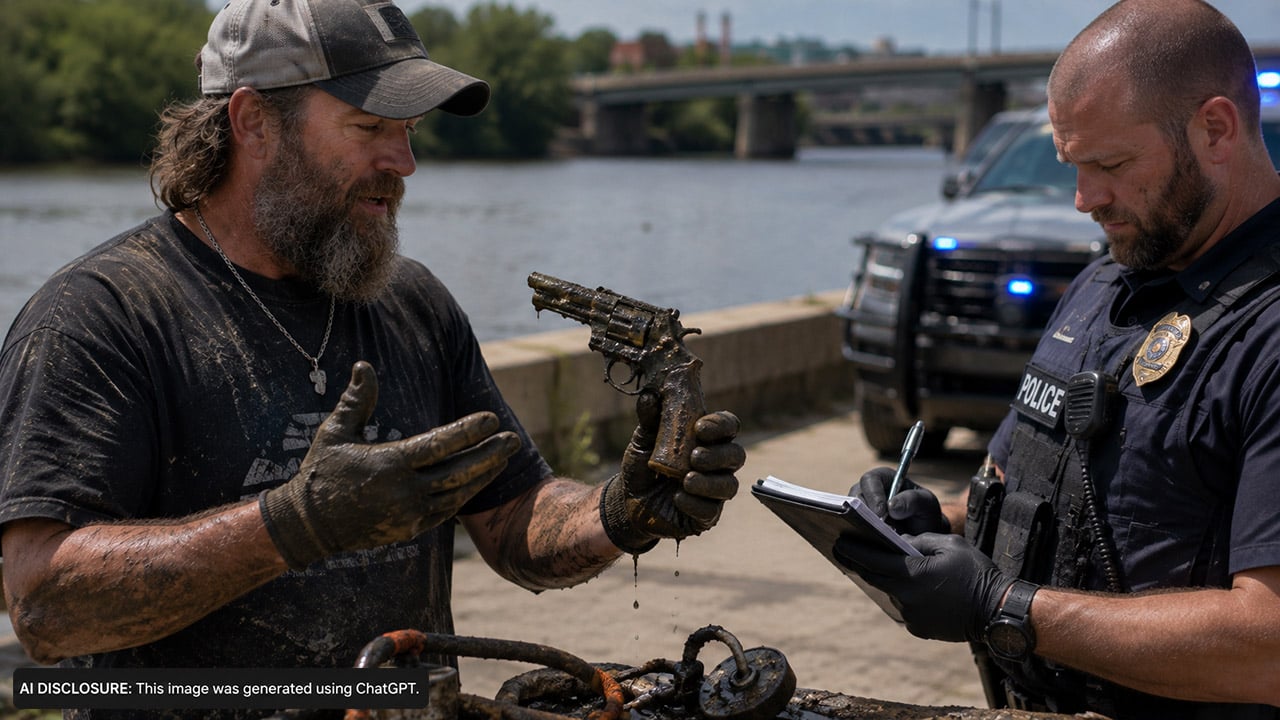
Photo credit: AI-generated image created using ChatGPT. Illustrative only
Magnet fishing is supposed to be simple: toss a big magnet, drag up scrap, and haul out whatever the river’s been hiding. But one Cincinnati magnet fisherman laid out a scenario that can turn a fun afternoon into a real problem in a hurry—especially if your past includes a felony and you’re trying to do the right thing. In the original post, he asked what happens if he pulls up a gun when he can’t legally possess one.
He said he has an F1 drug charge from years ago, and he’s now eight years clean. He also knows the common advice: report a found gun to police because it could be tied to a crime, and because a lot of firearms ditched in water weren’t thrown there for innocent reasons.
When a “cool find” turns into a legal land mine
If you’ve ever magnet-fished around bridges, docks, or old access points, you already know the pattern: things end up in the water when people want them gone fast. The poster made that point bluntly, saying it’s likely no one is tossing a “good legal gun” into a river.
That’s where his bind comes in. Turning a firearm in sounds like the responsible move. But the act of possessing it—even briefly—can be exactly what the law says a felon can’t do.
The practical problem: you can’t “un-find” a firearm
On the bank, this isn’t an internet thought experiment. It’s a heavy chunk of steel on the end of your rope. You’ve got a magnet stuck to it, water and mud everywhere, and maybe a couple curious onlookers who suddenly want a closer look.
The poster even mentioned hearing about people who call guns in and are sometimes allowed to keep them if “nothing comes back.” He wasn’t sure how that’s determined—and for someone with a felony record, that part matters less than the immediate moment of contact.
Why “it’s rusted” or “it’s missing parts” doesn’t feel like a safe answer
A lot of folks try to reason their way into a comfort zone with found guns. The poster brought up common assumptions: maybe it’s “not technically illegal” if it can’t fire because the firing pin is removed, and he figured the same might apply to a rusty gun.
In the real world, that’s shaky ground. A corroded firearm can still be considered a firearm. A gun with missing parts can still be considered a firearm. And for day-to-day people trying to stay out of trouble, “I thought it didn’t count” is not where you want to be standing when the stakes include a new charge.
The safety piece matters just as much as the legal one
Whether you’re a gun owner or not, a waterlogged firearm is an unknown. You don’t know if it’s loaded. You don’t know what condition it’s in. You don’t know what it’s been through.
Add in the magnet fishing reality—hooks, chain links, scrap metal, and other junk tangling up with it—and you’ve got a situation where careless handling can hurt somebody even if nobody ever intends to fire a shot. The smartest move is to treat it like a live, serious object and stop the “show-and-tell” impulse right there on the riverbank.
What the poster seemed to be looking for: a clean way to do the right thing
This wasn’t written like someone hunting for loopholes. It read like someone who knows his history, knows the rules around him, and doesn’t want to step back into trouble over something he didn’t ask to find. He even pointed out he’s in Cincinnati, noting the city “used to be violent,” and he believes finding a dumped gun is only a matter of time.
That’s a realistic expectation in a lot of places. Rivers and creeks hold onto evidence for decades. And when you’re dragging magnets around areas with traffic, past crime, and old dumping spots, you’re eventually going to snag something that changes your day.
The most grounded takeaway for magnet fishers with a record
The hard truth is that the “right thing” can still put you in a bad spot if you handle it wrong. If you’re prohibited from possessing firearms, the safest mindset is to plan for this before it happens—because the worst time to figure it out is when you’ve already got a gun clanked onto your magnet.
At a practical level, that means thinking through how you’ll avoid unnecessary handling, how you’ll keep other people from messing with it, and how you’ll report it without turning the bank into a circus. It also means understanding that a disabled-looking firearm may still be treated like a firearm, and that you don’t want to gamble your freedom on whether something is “rusted enough” to count.
Magnet fishing is a good way to clean up waterways and scratch that treasure-hunt itch. But if you’ve got a felony in your past, a gun find isn’t a trophy—it’s a hot potato. The smart play is to keep it safe, keep it boring, and make decisions that don’t create a second problem on top of the first.
Like The Avid Outdoorsman’s content? Subscribe to our newsletter so you never miss an article.
Here’s more from us: