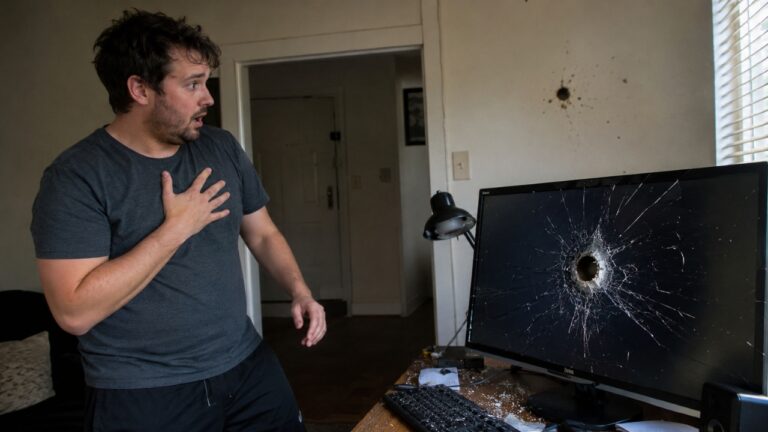
Photo credit: AI-generated image created using ChatGPT. Illustrative only
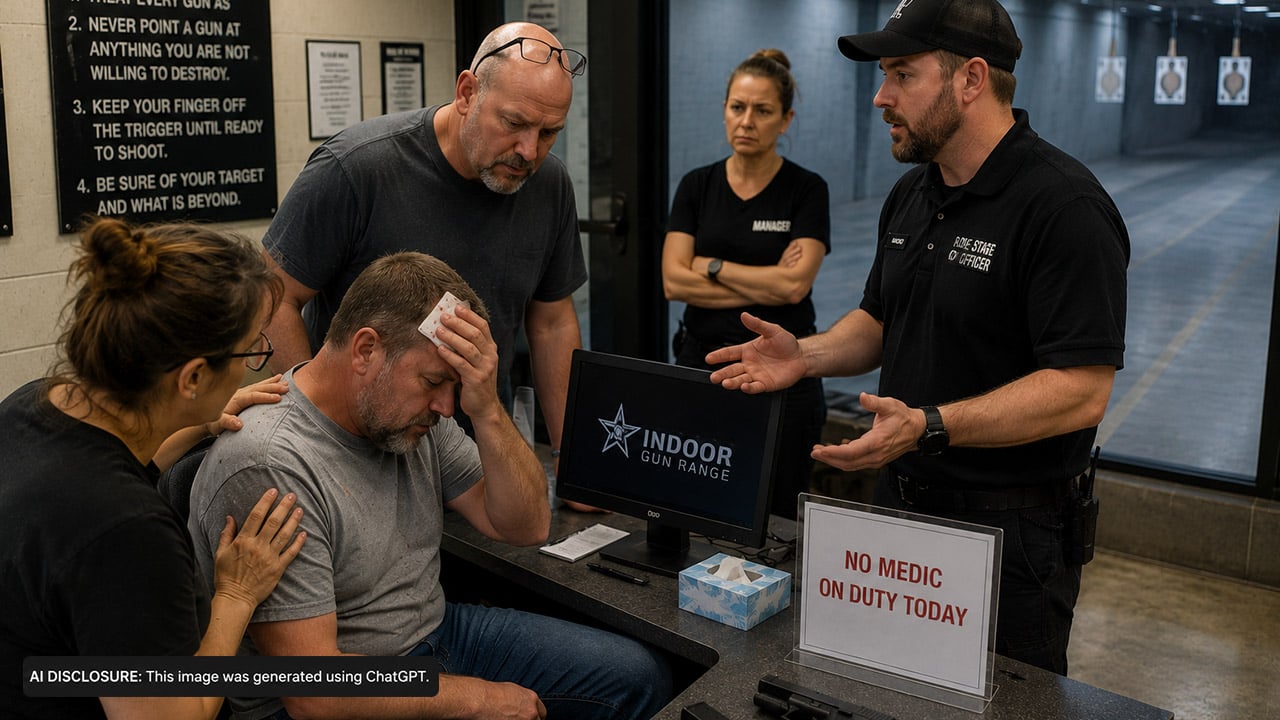
A routine range trip in Texas turned into an ER visit when a man loading magazines behind the firing line suddenly took an impact to the head and started bleeding. His girlfriend—who said she’s a medical professional—helped control the bleeding on site, but the wound still ended up needing seven staples.
The account was shared in the original post, where the couple described how range staff provided basic supplies like gauze, gloves, and hydrogen peroxide, but also commented that it was unfortunate no medic was working that day. That detail stuck with the couple, especially after medical staff suggested the injury didn’t look like it came from a simple spent casing.
What happened on the line
According to the report, the couple wasn’t actively shooting when it happened. They were standing back from the stalls loading magazines—something most of us do without a second thought—when “something” struck the boyfriend’s head and blood started running down.
The first assumption was a hot .40 S&W casing coming out of the shooter in the next lane. The writer noted the adjacent shooter’s brass seemed to be ejecting hard enough to hit them. Anyone who’s spent time at indoor ranges has felt the sting of flying brass, especially when stall dividers are short or shooters aren’t squared up to their lane.
Why the injury didn’t match the first assumption
At the emergency room, a nurse with military experience reportedly looked at the wound and felt it didn’t line up with a casing strike. After seeing the injury and hearing the story (and after the couple showed pictures to friends), the working theory became that it was more likely a bullet fragment or some kind of ricocheted piece of metal.
That matters because a casing to the scalp is usually a painful burn or a small cut—still unacceptable, but a different kind of hazard than fragments coming back toward the ready area. A laceration needing seven staples suggests force, a sharp edge, or both. And if fragments are coming back where people are loading mags, that’s a range-design and safety-control problem, not just “brass happens.”
The staff response and the “no medic on duty” moment
The range provided basic first-aid items, and the couple used them to control bleeding before heading out for proper treatment. But the staff comment—that this happened on a day when there wasn’t a medic working—left a bad taste. It also created a practical question: what is the range’s plan when a real injury happens?
Many indoor ranges don’t have an on-site medic, but they should have a clear emergency response process: a stocked trauma kit, staff trained to use it, and a plan for EMS access. A medic is a bonus. Training and readiness are the baseline. When staff “step back” because a customer says they’re in medicine, that’s understandable in the moment, but it can also signal the crew isn’t confident handling injuries.
What the couple did next—and what they worried about
After the ER visit, the boyfriend called the range and left his name and number, sharing additional details. The range didn’t say much beyond telling him to call back if needed. No mention was made of an incident report being taken on the spot, lane closures, or any immediate investigation into what actually hit him.
The couple’s concern wasn’t just the medical bill. They were worried that if there was negligence—whether it was lane setup, barrier issues, target/backstop problems, or poor supervision—somebody else could end up worse off later. That’s a pretty normal mindset for responsible shooters: you don’t want to be “that guy,” but you also don’t want the next person to take a fragment in the eye because nobody spoke up.
Where liability and waivers usually collide at gun ranges
The writer mentioned they signed a waiver at entry, but felt it read more like rules of the facility than a clear “we’re not responsible” document. Waivers are common at ranges, and in the real world they can discourage claims, but they don’t automatically erase a business’s responsibility to run a safe operation.
If an injury is caused by something the range could reasonably prevent—poor lane containment, damaged baffles, unsafe target placement rules, lack of supervision, or allowing certain ammo/targets that cause splashback—then a waiver may not be the end of the story. On the other hand, the details matter. Indoor ranges are complex environments: ventilation, backstop condition, steel placement (if allowed), angle of fire, and even how shooters use the lane all affect risk.
From a common-sense outdoorsman’s angle, the big point is this: a waiver doesn’t mean “anything goes.” It’s not a free pass for sloppy safety practices. It’s meant to cover inherent risk, not avoidable hazards.
Practical steps shooters can take after a range injury
The couple asked whether they should contact a lawyer and/or file a police report, and whether the range should pay medical bills. Those are fair questions, especially when you’re staring at a stapled scalp and an ER receipt. Even if someone doesn’t want a fight, documentation matters.
In situations like this, it’s smart to do a few basic things early: write down the date/time, the lane number, who was in adjacent lanes (if known), what firearm/caliber was being fired next door (the writer believed it was a .40), what staff said, and what first aid was provided. Photos of the injury are one piece, but photos of the stall setup and lane dividers can be just as important—especially if you suspect fragments or ricochet.
It also helps to request the range’s incident report procedure and ask whether they preserved any video footage. Many indoor ranges have cameras. Footage can disappear fast if it’s on a loop. None of that is about being dramatic; it’s about getting clarity on what happened so it doesn’t happen again.
As for medical bills, some ranges carry insurance for customer injuries. Whether they’ll pay voluntarily is another matter, but a documented incident with medical records gives you a factual foundation to ask the question in a serious way.
Finally, don’t let the “it was probably just brass” explanation close the book too quickly if the injury doesn’t fit. Spent casings can cut you, sure. But when medical staff with relevant experience say it looks like a fragment, that’s worth treating as a real safety signal, not an inconvenience.
Indoor ranges are where a lot of hunters and gun owners do their off-season work—sighting in pistols, tuning a carry setup, or just staying sharp. The takeaway here is straightforward: if something comes back off the line hard enough to split a scalp and earn seven staples, it deserves a careful look from the range and a paper trail from the shooter. Nobody wants the next impact to be an eye instead of a head.
Like The Avid Outdoorsman’s content? Be sure to follow us.
Here’s more from us: