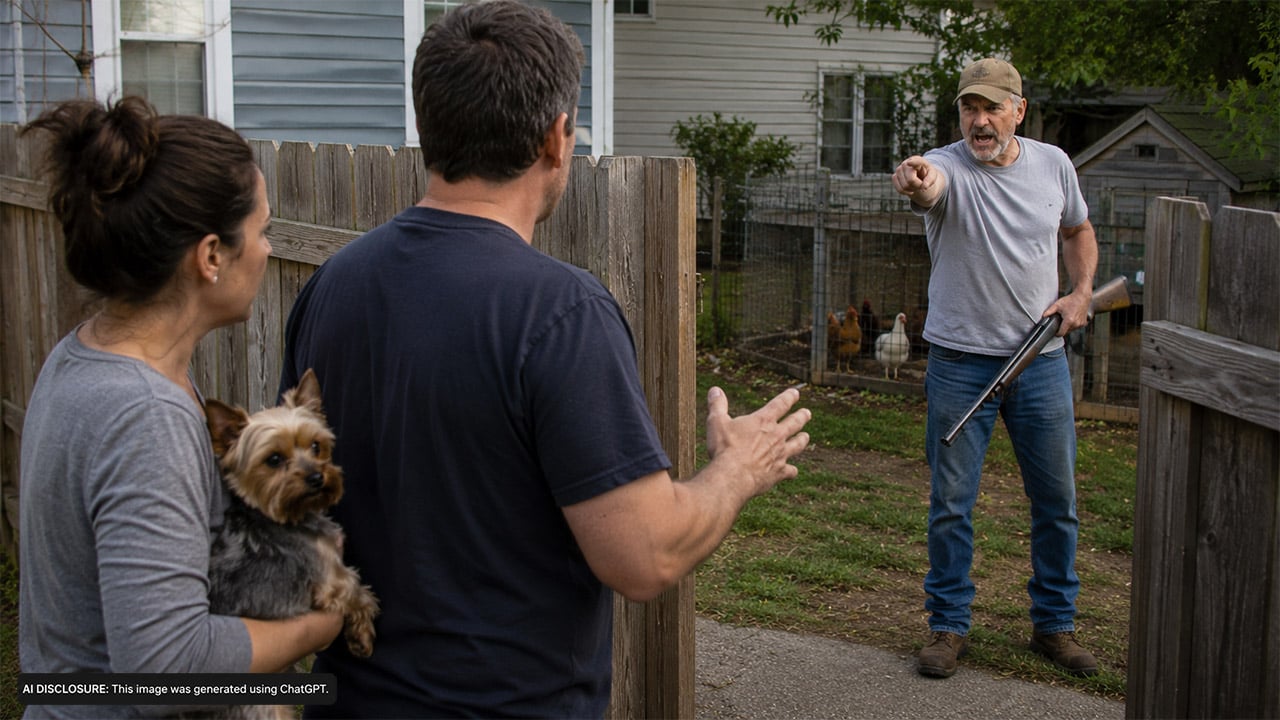
Photo credit: AI-generated image created using ChatGPT. Illustrative only
Out in the country, everybody understands the unwritten rules: keep your dogs at home, keep your livestock protected, and handle problems like an adult before somebody does something they can’t take back. But one homeowner says their neighbor skipped every step in the middle and went straight to a gun.
In the original post, the owner wrote that their two-year-old Yorkshire Terrier was shot by a nearby neighbor who claimed the little dog was “over by his house messing with his chickens.” The neighbor allegedly said he feared the Yorkie would kill a chicken. When the owner protested—saying the dog was more like family and had just made a local flyball competition team—the neighbor reportedly “growled” back and threatened to do the same thing to their other dog if it ever came onto his property.
A small dog, a chicken yard, and a decision that can’t be undone
Anyone who’s kept chickens knows predation is real. A loose dog can wipe out birds fast, and plenty of folks have lost flocks to neighborhood pets. But a Yorkie is also a toy breed, and there’s a big gap between “near my chickens” and “actively killing livestock.” That gap matters—morally, practically, and often legally.
The owner said they would have paid for chickens if any had been killed. That’s a normal rural solution: make the livestock owner whole, tighten up the dog situation, and keep peace with the folks you’re going to see at the mailbox for the next ten years.
The threat to shoot the other dog raised the stakes
The part that should put every landowner on edge wasn’t only the dog that got shot. It was the alleged warning: if the other dog is “ever” caught over there, the neighbor would do the same. That’s not a one-time, split-second decision in the middle of a real attack—that’s a standing promise of violence tied to a property line dispute.
In rural life, you can disagree about fencing, dogs, and wandering livestock and still stay civil. Once a neighbor starts talking like that, people stop thinking about chicken losses and start thinking about their kids in the yard, their own animals, and whether gunfire is going to become “normal” on that road.
Then came the edit: a pattern, not an accident
After the initial post, the owner added more information that makes this look a lot less like a single heated moment. They claimed this was the second of their dogs shot in about two and a half weeks. They also said the same neighbor shot another neighbor’s dog about a month earlier.
On top of that, they mentioned three dogs total and said two cats are missing as well. Missing animals don’t prove anything by themselves—country cats wander, and predators are hard on them—but stacked on top of multiple shootings, it paints a picture of a neighborhood problem that’s getting worse, not better.
Where chicken protection ends and reckless shooting begins
Most states have some form of law that lets a livestock owner protect their animals from a dog that’s actively harassing, chasing, or killing. But the details matter a lot: what counts as harassment, whether the dog was actually threatening the birds, whether non-lethal options were available, and whether shots were taken safely with a proper backstop.
Shooting on rural property isn’t automatically “safe” just because you’ve got acreage. Pellets and bullets travel, ricochet, and skip. When a neighbor starts shooting dogs and talking about shooting more, the conversation quickly becomes about public safety, not just animal control.
This is also where responsible gun ownership comes in. Firearms are tools, not temper outlets. If a situation is serious enough that you’re considering pulling a trigger, it needs to be serious enough that you can clearly articulate the immediate threat—and you’d better be sure of what’s beyond the target.
What people in similar situations usually focus on: proof, paperwork, and distance
When folks swap stories about dog-and-livestock conflicts, the advice tends to get practical fast. Step one is documentation: photos of property lines, where the dog was found, any fencing issues, and any injuries to livestock (if there are any). Step two is reporting—because once multiple animals have been shot, it’s no longer a handshake problem.
Just as important is controlling what you can control on your side of the fence. If you’ve got dogs that can roam, tighten that up immediately: check gates, repair fencing, add a run, and don’t rely on “they usually stay close.” In the country, “usually” is what gets you heartbroken.
And if you think the neighbor is looking for opportunities, distance matters. Keep your dogs supervised outside, especially near property lines, and don’t assume a warning means he’ll give you time to fix it next time.
The safest moves when a neighbor starts shooting animals
Based on the details shared, there are two separate tracks here: the animal situation and the human safety situation. For the animals, you want hard boundaries—literally. You don’t want any question about whether a dog was on his side, near his coop, or “over by his house.” The cleaner your side is, the clearer the case is if authorities get involved.
For the human side, avoid confrontation in the driveway. If you’re dealing with someone who “growled” threats and has already shot multiple animals, an argument at the fence line is a bad plan. Communication should be calm, brief, and ideally documented—text or email, not shouting matches.
And when gunfire and threats enter the picture, it’s reasonable to loop in local law enforcement or animal control and ask what documentation they need. In a lot of rural areas, the responding agency may vary—county deputies, animal control, or another local office—but the goal is the same: get the incidents on record and get clear guidance on what the law is where you live.
It’s also worth thinking about your own household’s routine. If your kids or grandkids play outside, if you walk your dogs near that boundary, or if you have a shared road or easement, treat it like a safety problem until it’s proven otherwise. The best outcome is one where nobody else—human or animal—gets hurt.
Good neighbors are worth their weight in venison. But when a person starts stacking up shot dogs and making open-ended threats, common sense says you don’t “wait and see.” You tighten up your own boundaries, document everything, and handle it through the proper channels before the next report isn’t about a pet at all.
Like The Avid Outdoorsman’s content? Be sure to follow us.
Here’s more from us: