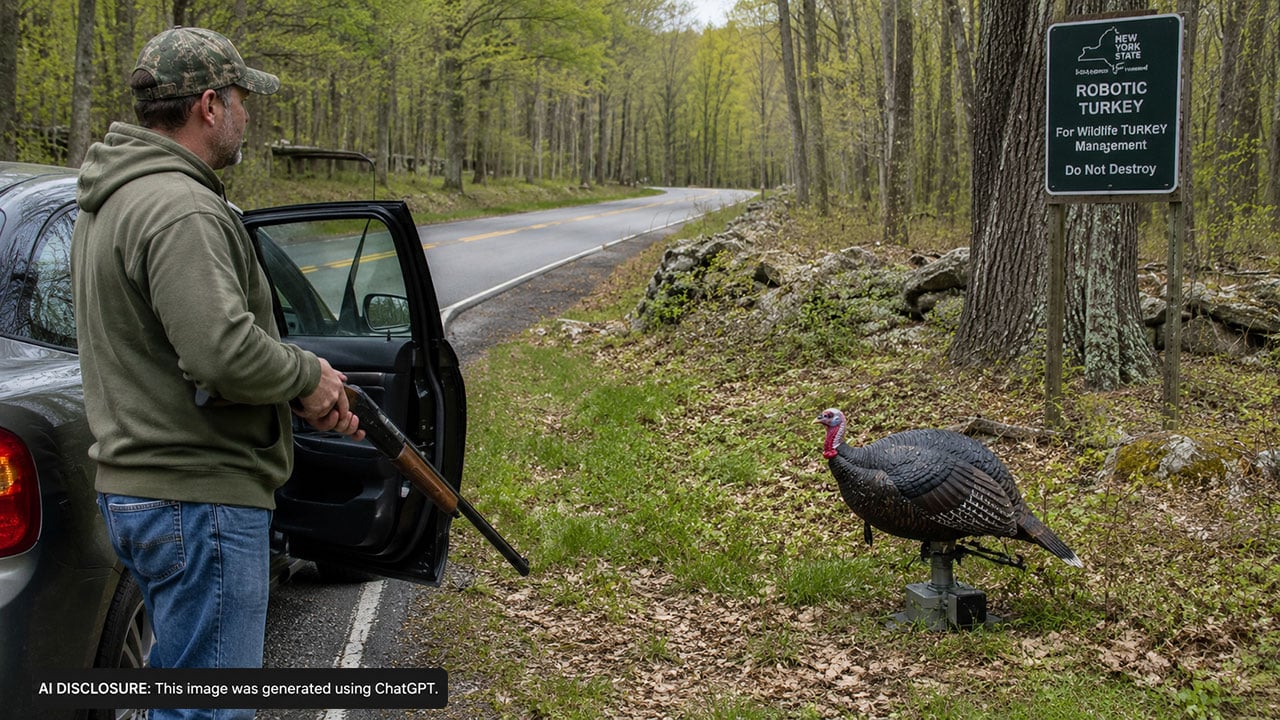
Photo credit: AI-generated image created using ChatGPT. Illustrative only
Spring turkey season has a way of making people do dumb things, especially when they’re road hunting and trying to turn a quick glimpse into a quick shot. In central New York this May, that bad decision collided head-on with a very modern enforcement tool: a robotic turkey decoy set out by Environmental Conservation Police Officers to catch poachers in the act.
Details of the case were shared in the original post, which summarized an incident pulled from a New York State DEC police report. And while the story has some almost-unbelievable elements, the underlying issues are the same old ones—shooting from the road, unsafe backstops, and folks ignoring basic rules that exist for good reasons.
A gobbler in a field and a quick U-turn
On May 10, about a week and a half into the 2026 spring turkey season, ECOs say Bobby J. McNitt, 43, of Altmar, was driving in Williamstown when he spotted what looked like a gobbler in a nearby field. Instead of parking legally and making a proper hunt out of it, officers allege McNitt pulled a U-turn and stopped in the middle of the road.
From there, it got worse fast. ECOs report he poked a shotgun out the car window and fired at the bird. That’s the kind of “one-and-done” road shot that puts everyone else at risk—people in nearby houses, other drivers, and anyone who happens to be out of sight in the direction of that muzzle.
The “turkey” wasn’t a turkey at all
The target wasn’t a live bird. It was a robotic decoy placed by New York State Department of Environmental Conservation police officers as part of an enforcement effort aimed at catching poachers.
That detail matters because it shows the DEC wasn’t responding after the fact—they were proactively trying to stop the behavior before an actual animal was illegally taken or before a reckless shot created a tragedy. A decoy in a field doesn’t bleed, and it doesn’t run onto posted land after being hit. It’s a controlled way to see who’s willing to break the rules.
When the bushes moved, the situation escalated
According to the report, immediately after the shot, two ECOs popped out of the bushes. McNitt then allegedly sped off, driving straight toward two other ECOs positioned up the road in their vehicles.
That’s the part that should make any hunter or landowner tighten up a little. When someone is willing to fire from a roadway, then flee, you’re no longer just talking about “a guy who messed up.” You’re talking about unpredictable decisions happening with a firearm in the mix, on a public road, with other people around.
The officers intercepted him. McNitt admitted to shooting at what he still believed was a real bird, according to the DEC account.
More problems than a bad turkey decision
Once ECOs had him stopped, they reportedly uncovered more than just an illegal shot. The report says McNitt was driving with a suspended license. It also states he is a convicted felon and is not legally allowed to have a firearm.
Those two details change the entire weight of the encounter. Plenty of outdoorsmen have seen somebody try to bend a regulation—shooting hours, tagging, baiting. But a prohibited person with a gun, paired with a roadside shot and a failure to stop, isn’t “fish and game stuff” anymore. It’s a serious public safety problem.
ECOs charged McNitt with possessing a loaded gun in a motor vehicle, discharging from a highway, failure to comply with an ECO, illegal take of a turkey, unlicensed operation of a motor vehicle, and criminal possession of a firearm. The case is pending in Williamstown Court.
Why DEC uses decoys—and what hunters can learn from it
Robotic and stationary decoys aren’t new in wildlife enforcement, but they’re becoming more common because they work. They also send a message that’s hard to ignore: if you’re thinking about road hunting, taking a flyer out the window, or trying to “grab one quick,” you might be shooting at fiberglass with a badge behind it.
For the law-abiding turkey hunter, there are a few practical lessons baked into this whole thing. First, if you can’t legally stop and hunt the right way, don’t hunt that bird. Second, never shoot from or across a public roadway—beyond the legality, it’s a terrible habit that can end in a wounded bird, a damaged home, or a hurt person. And third, if an officer lights you up or steps out to contact you, your best move is to comply and keep it calm. Even if you think you’re in the right, the roadside isn’t the place to argue it out.
It’s also a reminder that turkey hunting requires discipline. Spring birds will make your heart jump, and the temptation to rush is real. But the guys who consistently tag out year after year are usually the ones who slow down, set up right, and keep their heads in the game.
This DEC report shows it wasn’t an isolated enforcement month
The same DEC police report that included the turkey decoy incident also highlighted how broad ECO work really is. In 2025, the report says Environmental Conservation Police Officers responded to more than 35,575 complaints, which resulted in 15,673 tickets or arrests across a wide range of violations—from poaching to dumping.
The other excerpts in the report read like a snapshot of what game wardens and conservation officers deal with daily: officers taking part in a shoreline cleanup that hauled out about 500 pounds of trash in Pelham Bay Park; an investigation where a bird of prey was stuck in a suspended foothold trap and other violations were observed; and enforcement details targeting commercial garbage truck violations, including one cited for leaking fluid.
On the hunting side, the report also mentions a separate case in Vienna where an employee allegedly shot two adult Canada geese and seven juveniles with a 12-gauge, leading to multiple tickets for illegal take and other waterfowl-related violations. On the fishing side, the DEC noted multiple striped bass cases—including a group of anglers on Staten Island who received 20 tickets after officers found 14 fish kept outside the allowable slot size and other violations. Another case described an angler unlawfully netting and snagging northern pike in Conesus Creek.
Put together, it’s a reminder that enforcement isn’t just “checking licenses.” ECOs are dealing with firearms, roads, dumping, traps, and people making heat-of-the-moment decisions that can put everyone else at risk.
In the end, the turkey decoy did exactly what it was designed to do: it exposed a roadside shooter before a real bird—or a real person—paid the price. If you hunt spring gobblers the right way, this kind of setup shouldn’t worry you at all. But if somebody’s hunting from the driver’s seat, the DEC is making it clear they’re watching, and they’ve got tools that don’t blink.
Like The Avid Outdoorsman’s content? Subscribe to our newsletter so you never miss an article.
Here’s more from us: