Photo credit: AI-generated image created using ChatGPT. Illustrative only
When you’re a gun owner, you learn quick that one bad decision can follow you for a long time. But one North Carolina man says his biggest worry isn’t a range mistake or a busted hunting lease—it’s a threat coming from inside his own home.
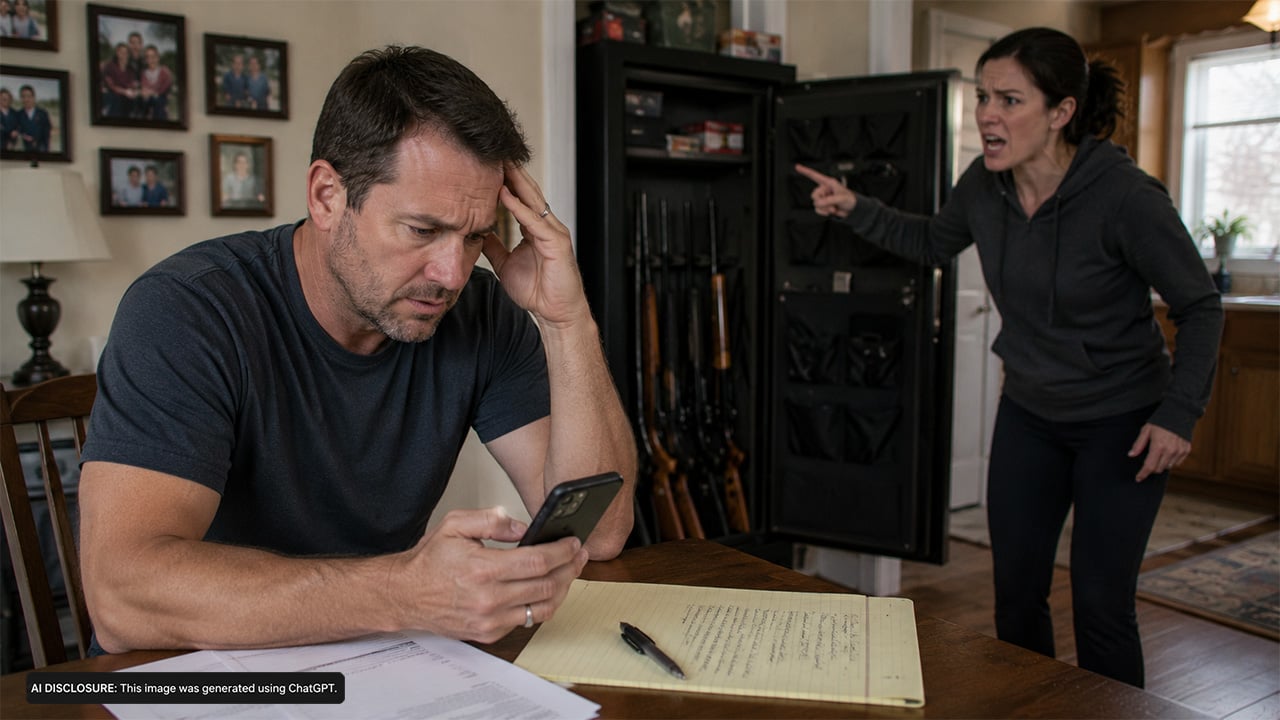
In the original post, he describes a marriage he says has been dominated for nearly four years by his wife’s cycles of anger, cruelty, and then sudden calm. Lately, he claims her threats have gotten more pointed: accuse him of domestic violence, not because it happened, but “for the express purpose of getting my firearms taken away” and making sure he can never own them again.
A home life that turned into a pressure cooker
The man says his wife is bipolar, and when she swings into anger, she goes for maximum damage. He describes her saying hateful things about his mother and son, and even mocking a close friend who died from a brain aneurysm years ago. He also claims she has threatened to report a car stolen while he’s at work to try to cost him his job.
He says he’s spent years swallowing his own anger and trying not to react, but he feels worn down by the routine—she pushes until she gets a reaction, then within a day or two everything is “rosey” again. The problem is that the words don’t disappear just because the mood changes, and he’s left carrying it.
Why the gun threat matters to more than just his hobby
Plenty of us know folks who blow off steam by buying a new box of ammo, tweaking a scope, or spending a quiet hour at the range. For this man, firearms aren’t just property—he calls them his only real hobby, and he believes his wife understands that taking them would hurt him more than anything else.
That’s what makes his fear feel immediate. He says he’s a legal gun owner, has purchase permits through the sheriff’s department, passes NICS checks, and hasn’t been arrested for anything besides a traffic infraction more than 15 years ago. In his mind, that clean history is exactly why a false allegation worries him: he feels like he has everything to lose and nothing to “explain away.”
Divorce, leverage, and the fear of a one-sided story
He openly admits he believes the moment he files for divorce, the accusation will come. That’s the part that will sound familiar to anyone who’s watched a rough split turn into a contest of leverage—bank accounts, access to the home, and yes, sometimes firearms.
He notes they both have grown kids from previous relationships and that there’s no income dependence, since they both worked and spousal support isn’t his main concern. What he’s focused on is the possibility that a claim—true or not—could trigger law enforcement involvement and put his guns at risk before he even gets a chance to respond in court.
The “preemptive strike” question: documentation, police contact, and recordings
His main question is practical: can he get ahead of it? He asks whether he should notify police about what she’s saying, and whether he should record her making the threats. He frames it as trying to protect himself from a situation he believes is being set up, not trying to win an argument.
Outdoorsmen tend to think in terms of preparation—spare tire, backup headlamp, extra map. But family law and domestic allegations don’t work like packing for a hunt. A “heads-up” call to police may not function like a protective shield, and recordings bring their own risks if you don’t know your state’s rules on consent. Even if something is legal to record, it can still escalate a volatile home situation fast.
He also seems to understand a hard truth: this isn’t just a gun issue. It’s a safety and stability issue inside the home, and it’s tied up with mental health, unpredictability, and the reality that a heated reaction—any reaction—could become part of someone else’s narrative later.
What other gun owners tend to focus on in situations like this
Even without seeing a full comment thread, you can predict where experienced folks usually land when a gun owner is worried about being targeted through the system: reduce exposure, get good advice early, and don’t assume “the truth will win” if things go sideways. In the real world, the first report and the first paperwork can shape what happens next.
Responsible gun owners also tend to talk about tightening up storage and access when the home situation becomes unstable. Not because you’re “hiding” anything, but because firearms add gravity to any domestic conflict, and you don’t want a bad night to become a permanent, life-changing event. The man posting sounds less worried about day-to-day handling and more worried about confiscation and lifetime prohibition—but the two concerns are connected by the same messy reality: once authorities get involved, control leaves your hands.
And there’s another angle outdoorsmen understand: when a person is willing to threaten your job, your reputation, and your rights, you’re not in a normal disagreement anymore. You’re in risk management mode.
The practical road he’s trying to find
At the end of his post, the man doesn’t talk like someone looking to “win” a breakup. He sounds like someone who wants out and wants his life back. He says he has never hit his wife or any other woman, and he’s exhausted by what he describes as nonstop provocation designed to finally get a reaction.
His situation is a reminder that gun ownership doesn’t happen in a vacuum. Your rights and your property can get tangled up in personal conflict, mental health struggles, and relationship breakdowns—things a deer rifle was never meant to be part of. If you’re in a similar spot, the most practical mindset isn’t “How do I outsmart this?” It’s “How do I lower the temperature, protect everyone’s safety, and get qualified help before one bad night turns into a permanent record?”
Like The Avid Outdoorsman’s content? Be sure to follow us.
Here’s more from us: