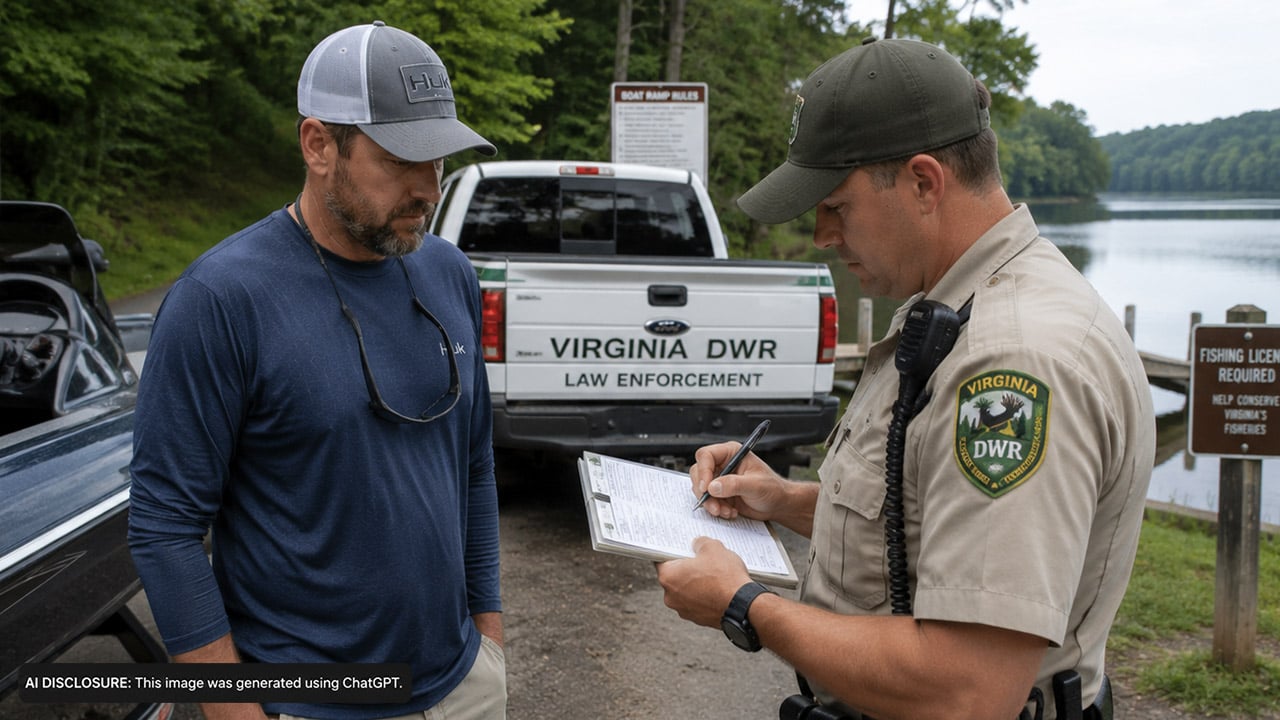
Photo credit: AI-generated image created using ChatGPT. Illustrative only
It’s one thing to get checked by a game warden when you’re standing on the bank with a rod in hand. It’s another when you think you’re still in the “getting ready” stage—rods out by the car, no fish on ice, planning to catch-and-release—and you still wind up holding a summons.
That’s the spot one Virginia angler described in the original post: he was cited for fishing on an expired license, then noticed the officer wrote down the wrong race on the ticket and made at least one other error on the form. The question was simple and practical: can a mistake like that get the whole thing tossed?
Expired license, rods staged, and a summons in hand
From the angler’s perspective, he wasn’t actively fishing when the contact happened. He said he “just had rods out by the car,” and added that he didn’t have a cooler or anything and was planning to catch-and-release.
But the citation was written for fishing with an expired license. In the real world, that’s a common scenario—folks assume they’re covered because they “always buy one,” or they forget the date, or last year’s license auto-renew didn’t happen. Game wardens and conservation officers don’t usually have much patience for “I meant to,” especially when the gear is already out and ready.
The paperwork mistake that got his attention
After the stop, the angler looked over the summons and noticed a clear error: the officer “screwed up my race on the ticket.” He also mentioned another error on the form, though he didn’t spell out what it was.
If you’ve spent time around courtrooms—traffic court, hunting citations, boating stuff—you’ve probably heard some version of the campfire myth: “If the officer misspells your name or gets a detail wrong, it’s automatically dismissed.” That idea hangs around because it sounds like a clean shortcut. Most of the time, it isn’t.
Why small errors usually don’t erase the charge
Common-sense reasoning applies here. Courts tend to care whether the ticket clearly identifies the person who was cited and what the alleged violation was—not whether every box is perfect. A clerical mistake like race being marked wrong may look sloppy, but it usually doesn’t change the core accusation: that the person named on the summons was fishing without a valid license.
In many jurisdictions, minor mistakes can be corrected, or they’re treated as harmless errors that don’t prejudice the defendant. The angler’s question was whether the error could get the case dismissed. Practically speaking, that’s a tough hill to climb unless the mistake creates genuine confusion about who was cited or what law was supposedly broken.
That “other error” he mentioned could matter more, depending on what it was. There’s a difference between a checkbox being off and a summons listing the wrong statute, the wrong date, or the wrong person. But with the details provided, the sure bet is this: the simple presence of a wrong race entry is rarely a golden ticket out.
“I wasn’t actually fishing” and what that argument runs into
The angler also said he wasn’t actually fishing at the moment—just rods out by the car—and that he was planning catch-and-release. A lot of outdoorsmen can relate to that gray area. You might be baiting hooks, rigging rods, walking to the water, or waiting on a buddy. It doesn’t feel like “fishing” yet.
The problem is that regulations and officer discretion don’t always match what “feels like” fishing. In plenty of places, if you’ve got your fishing gear set up in a way that shows intent and capability—rods rigged, near the water, ready to go—you can get treated like you’re fishing. The catch-and-release detail also doesn’t solve the license issue; the license requirement is typically about the act and the privilege, not whether you planned to keep fish.
Also, the absence of a cooler doesn’t move the needle much. Lots of anglers release fish all day long. Plenty don’t bring a cooler even if they might keep one. Wardens see it all, and they’re not going to treat “no cooler” as proof you weren’t fishing.
The warden’s advice: buy the license and you might save money
One of the more practical details in the post is what the game warden allegedly told him: buy a license now, and the judge “might take the cost of it off the fine.” The angler said he planned to buy one and wanted to know if that’s common.
That advice lines up with how these situations often go. Judges tend to like seeing a quick fix when the violation is administrative—expired paperwork, forgotten license, that kind of thing—especially if there’s no other aggravating behavior described. Buying the license doesn’t erase the violation, but it can show good faith, and sometimes courts will reduce fines or treat it more like a wake-up call than a hammer.
Whether it’s “common” depends on the court and the judge. Some judges are strict: expired is expired. Others will cut a break if you show up with a valid license and a decent attitude. Either way, buying the license is one of the only moves that can help without spinning up a bigger mess.
What people tend to focus on in cases like this
When outdoorsmen swap stories about tickets, the conversation usually splits into two tracks: the technicalities and the practicalities. The technicality crowd wants to know what errors are on the citation and whether the officer “messed up” enough to lose the case. The practical crowd wants to know what reduces pain—lower fines, fewer points (when applicable), and a cleaner record.
Based on what the angler shared, the practical path is usually the same: make sure you’re legal going forward, show up to court if required (or handle it however the summons instructs), and bring any proof that helps—like a newly purchased license. If the angler truly wasn’t fishing under whatever Virginia’s definitions are, that becomes a facts-and-law issue to raise, but it’s not the same as “the officer marked the wrong race, so it’s over.”
There’s also a bigger, quieter lesson a lot of folks learn the hard way: game wardens and conservation officers are often more squared away than people expect. They spend their days in regulatory gray areas—possession vs. use, intent vs. action—and they’re used to hearing “I wasn’t actually doing it.” That doesn’t mean they’re always right, but it does mean the easy arguments don’t always land.
If there’s one clean takeaway for anglers reading this, it’s simple: check your dates, keep your license current, and don’t rely on paperwork errors to save you. If you do get cited, fixing the underlying issue—like buying the license—often does more good than hoping a wrong box on the summons makes it disappear.
Like The Avid Outdoorsman’s content? Be sure to follow us.
Here’s more from us: