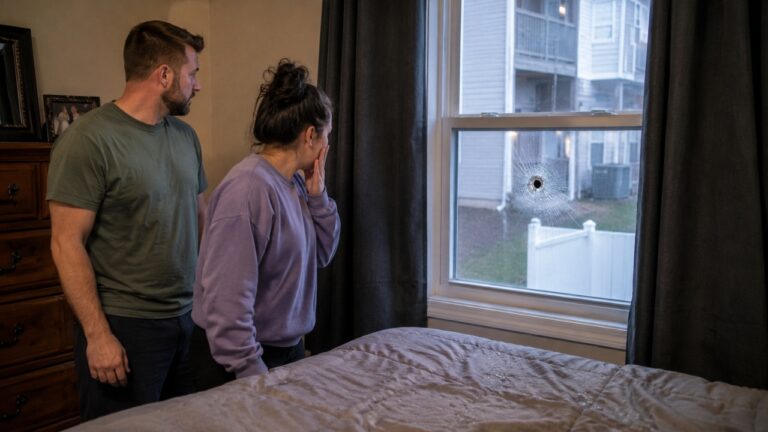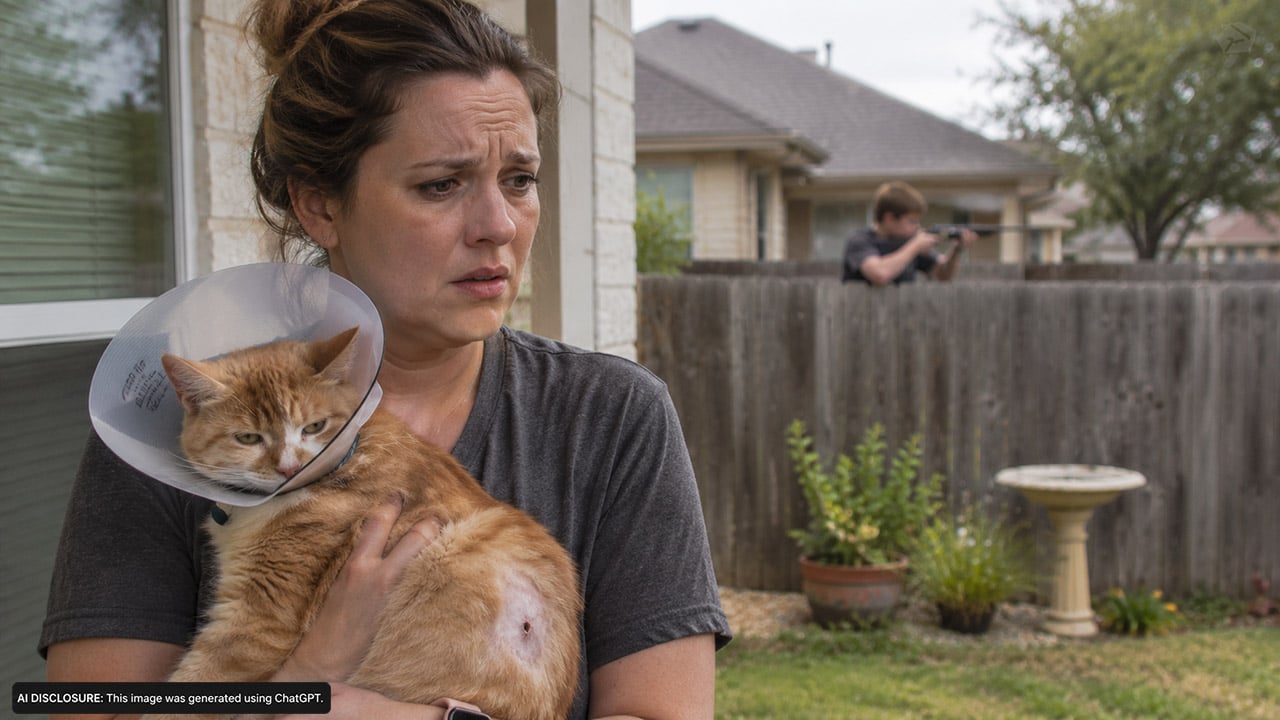
Photo credit: AI-generated image created using ChatGPT. Illustrative only
An Austin pet owner let her cat out like she’d done plenty of times before. The animal came back limping, and by the next morning the front leg had swollen to twice its size. That’s when “outside cat” stopped being a casual phrase and turned into an emergency-vet situation.
At the clinic, the cat was put under and X-rays revealed a BB lodged in her arm. The surgery ran over $300, and the vet saved the BB. In the source post, the owner said she was certain the shot came from the neighbor’s adult son—because the cat doesn’t leave the backyard, there’s a major road behind the property, and the only neighbor on that side is that family.
A backyard that should’ve been safe
This wasn’t a cat roaming the neighborhood and getting into trouble three streets over. The owner described a layout that funnels suspicion in one direction: a busy road behind the yard, a park on the other side of the house, and just one adjacent neighbor. In her mind, that narrowed the possible shooter down to one place.
She also said she was home when it happened—the same window of time she let the cat out and then back in. It’s the kind of detail that matters, because it’s not just about proving the animal was hurt; it’s about tying the injury to a person and a moment.
The vet bill provided proof, but not peace of mind
The $300-plus surgery and the recovered BB changed the situation from “my cat came home hurt” to “someone fired a projectile at my pet.” A lot of folks who don’t handle guns or airguns might think BB guns are harmless. They’re not. A BB in a limb can cause infection, damage tissue, and in a worse hit—head, neck, or chest—kill an animal.
The owner’s frustration wasn’t just about money, either. She was “shaking in anger,” and what really came through was the worry that it could happen again. She has other cats that go outside, and now she’s thinking about every time she opens that door.
Why the neighbor’s son became the focus
In the post, the owner described the neighbor as nice, but said the son—early college age—has always creeped her out. She also mentioned the son had a same-age friend staying over, and suspected they may have done it together, possibly with the friend bringing the BB gun.
There’s another part that will sound familiar to anybody who’s lived near reckless people: the past starts to look different. The owner said two cats disappeared one after the other a few years ago, and now she’s wondering if this was the same kind of behavior, just never caught.
Documenting the incident before emotions take over
If you’ve spent time around property disputes, stray rounds, or neighbor problems, you know the temptation is to storm over and “handle it.” The owner hadn’t confronted anyone yet, and that restraint may be the best decision she made in the first 24 hours. When you’re dealing with an accusation this serious, you want your facts tight and your paperwork in order.
Based on what she laid out, she already had a few important pieces: veterinary documentation that a BB was removed, the BB itself saved by the vet, and a clear timeline of when the cat went out and came back. That’s the kind of foundation that lets a complaint stay focused on evidence instead of turning into a shouting match across a fence line.
Just as important is thinking ahead. If the cat truly never leaves the backyard, then it’s reasonable to consider how a BB could enter that space—angles, fence lines, and where someone would have to stand to take that shot. That’s not about escalating; it’s about understanding what you’re dealing with and reducing the odds it happens again.
The bigger concern: unsafe shooting near homes
Outdoorsmen tend to be pretty level-headed about shooting sports, even when emotions run high. But there’s a hard line that most responsible gun owners won’t cross: firing at pets, and firing in a way that sends projectiles into someone else’s yard. Even with an airgun, you’re still launching a piece of metal with enough speed to injure or kill.
The owner’s fear wasn’t just for the cat that got hit. It was for the other cats—and, frankly, for herself. If someone’s willing to take shots into a neighbor’s yard, that’s a safety issue for anyone stepping outside, especially kids. That’s why these situations can’t be brushed off as “boys being boys” or “it’s just a BB gun.”
In a lot of places, discharging any projectile weapon inside city limits, or in a residential area, can run afoul of local ordinances. And cruelty to animals is treated seriously in many states. The post didn’t list what happened next, but the owner clearly wanted “the full extent of the law,” and the incident she described is exactly why those laws exist.
Practical next steps people tend to focus on in cases like this
Even without seeing the back-and-forth discussion, you can predict what experienced landowners and hunters usually zero in on when a neighbor problem turns into a proof problem: document everything, avoid a direct confrontation that could spiral, and get a clean record started with the right authorities.
On the practical side, a couple common-sense moves help protect animals and also protect the owner: keep cats inside or supervised for a while, especially during the times of day the neighbors are most active; and consider a camera pointed at the yard where the cats spend time. Not to play spy games—just to establish what’s happening if it happens again. When a future incident is captured clearly, things get resolved a lot faster.
And if the vet saved the BB, that’s worth keeping secured along with the invoice and any medical notes. In the real world, the simplest cases to address are the ones that are well organized: dates, times, photos of the injury and swelling, vet findings, and receipts.
This Austin owner wasn’t just dealing with an injured pet and a surprise bill—she was dealing with the uneasy feeling that someone nearby was willing to do something reckless and cruel for fun. When that’s the situation, the best path usually isn’t a fence-line argument. It’s calm, thorough documentation, tightening up pet safety in the short term, and using the evidence she already has to make sure the incident is taken seriously.
Like The Avid Outdoorsman’s content? Be sure to follow us.
Here’s more from us: