Photo credit: AI-generated image created using ChatGPT. Illustrative only
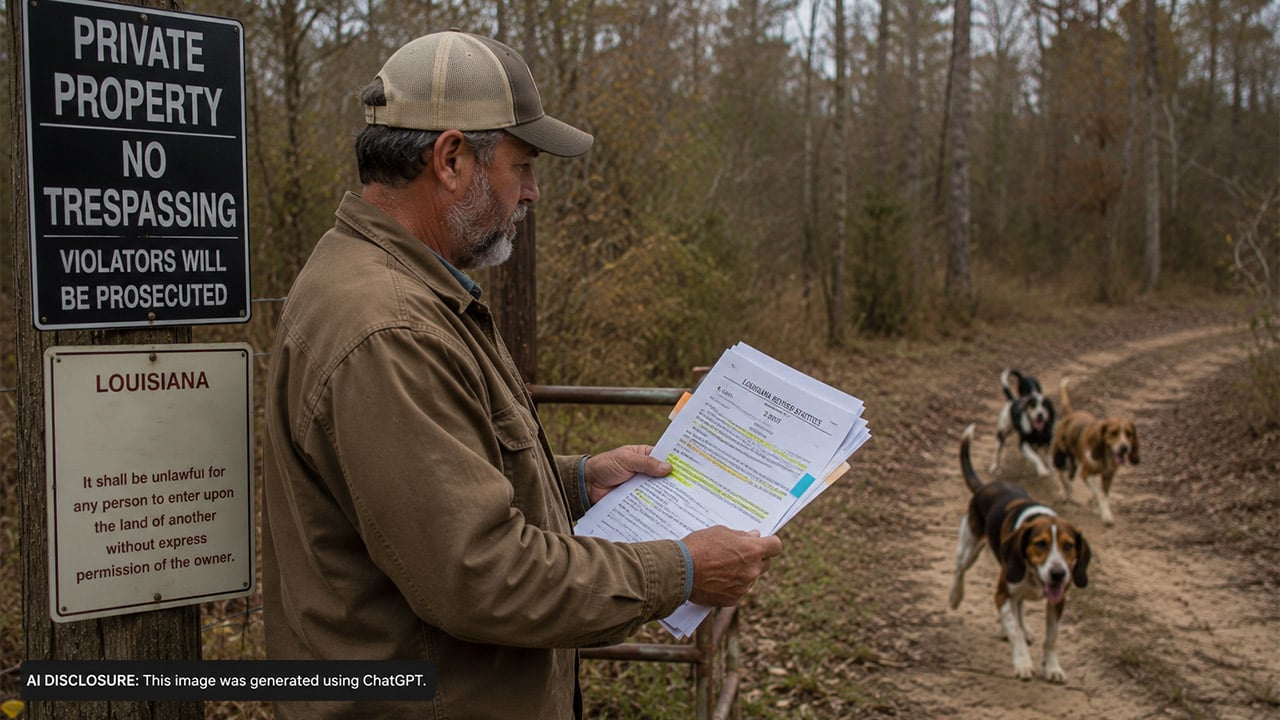
If you’ve got woods behind the house in Louisiana, you already know how this goes. One morning you’re feeding animals or checking a fence line, and here comes a pack of hounds cutting across your place like they own it—no truck in sight, no handler calling, just big orange collars flashing through the brush.
That’s the situation a Louisiana landowner laid out in the original post: loose hunting dogs crossing his property every year, with no permission to hunt granted, and a growing worry that this season will be different because he’s added small livestock and has dogs that aren’t friendly with strange dogs showing up uninvited.
Loose hounds are common in some parts of Louisiana
The landowner wasn’t talking about a pet that slipped a leash for five minutes. He described a local practice where hunters “set dogs loose into the woods” and those dogs will run across parks and private property, sometimes with no real recall ability. In other words, once they’re dumped, they’re gone until they circle back or somebody finds them.
He said he gets “lost hounds every single year,” and the dogs “never have gps tags or identification,” just those big orange collars. That matters, because the moment a dog shows up without contact info, the landowner isn’t dealing with a polite neighbor-to-neighbor conversation anymore. He’s dealing with an animal on his place that may or may not be under anyone’s control.
The real issue wasn’t hunting—it was livestock and safety
Plenty of landowners can shrug off a dog passing through if it’s not causing trouble. The tone changes when you’ve got small livestock on the ground—animals that can be chased, stressed, injured, or killed by a running dog that’s in prey-drive mode.
Then add the other piece: the landowner also has dogs of his own that “are not dog friendly.” That’s a recipe for a fight at the worst possible spot, like a pen gate or a feed area, where people tend to be close and the animals can’t easily get away. Even if nobody intends harm, a dog fight can happen fast, and once teeth are involved you’re talking vet bills, dead stock, and hard feelings that don’t go away.
Louisiana law sounded like it pulls in two directions
The landowner’s main question was simple and practical: can a property owner shoot or capture dogs running at large on his property when no permission to hunt has been given—especially if he doesn’t want wildlife disturbed or livestock chased?
Where it gets messy is his read of the statutes and “conflicting information.” He believed Louisiana law seems to do two things at once: give property owners a right to dispatch dogs that are bothering animals on their property, while also warning people off “touching hunting dogs.” That’s the kind of contradiction that leaves a landowner feeling like any decision—doing nothing, catching a dog, or protecting livestock—could bring trouble.
And that’s not just a legal headache. Out in the country, those decisions happen in real time, often when you’re alone, and usually when a problem is already underway.
When a dog has no ID, every option gets harder
The landowner said the hounds that show up don’t have GPS tags or identification. That’s not a small detail. A name tag and a phone number turn an incident into a quick call and a quick pickup. No identification turns it into guesswork and waiting.
It also changes the landowner’s risk. If you confine a dog, you’re now responsible for an unknown animal that could bite, tear up a kennel, or spread disease. If you let it go, it may come right back—or go straight to the livestock. If you confront the issue in the moment, you’re doing it without knowing whether the dog is aggressive, whether there’s a pack behind it, or whether the handler is going to show up hot and mad later.
That’s why his word choice—“I just want to be prepared if I have to intervene”—rings true for anybody who’s ever dealt with roaming dogs. Prepared doesn’t mean looking for a fight. It means not getting caught flat-footed when something goes sideways.
People tend to split into two camps on situations like this
Even without a full thread of responses included, you can pretty well predict how the public debate goes when hunting dogs and property rights collide. One side sees dogs as valuable hunting tools that sometimes range wider than intended, and they want protections so landowners don’t harm them. The other side sees an uncontrolled animal trespassing on private ground, stressing wildlife, and potentially threatening livestock—and they want clear authority to stop the damage.
The landowner’s post sits right in the middle of that collision. He wasn’t asking how to pick a fight with a hunter. He was asking what he can legally do when dogs show up on his property without permission, without identification, and without the kind of control you’d expect from a responsible handler.
That’s where the “contradicting” feeling comes from. If the law is written to protect hunting dogs broadly, but also acknowledges that landowners must be able to protect their animals, you can end up with language that reads one way in one section and another way somewhere else.
Practical steps landowners think about before it gets ugly
When loose dogs are a yearly problem, most folks don’t want legal theory—they want a plan. You want fewer surprises and more documentation, because if you ever do have to make a hard call, you’d better believe somebody is going to ask what happened and why.
In real life, “being prepared” usually looks like tightening up fences and gates, keeping livestock secured when you can, and having a way to record what’s happening on the property. Trail cameras at access points and along common dog routes can help establish patterns: time of day, number of dogs, and whether vehicles are nearby. It also helps separate a one-off stray from a repeated practice of dumping hounds where they don’t belong.
And even though nobody likes involving outside help, issues like this often end up as a conversation with local authorities or wildlife enforcement—especially when it’s not a single lost dog but an annual wave of them. That kind of contact can be useful if only to clarify what your local area expects a landowner to do when dogs are running loose and causing problems.
The hard truth is this: a landowner with livestock can’t afford to pretend roaming hounds are harmless. But a landowner also can’t afford to act on bad information, especially in a state where the rules can look like they’re stepping on each other. The safest move is to get clear on what’s allowed before the first pack comes through—because once dogs are in the pasture, you’re not making decisions in a calm moment anymore.
Like The Avid Outdoorsman’s content? Be sure to follow us.
Here’s more from us: