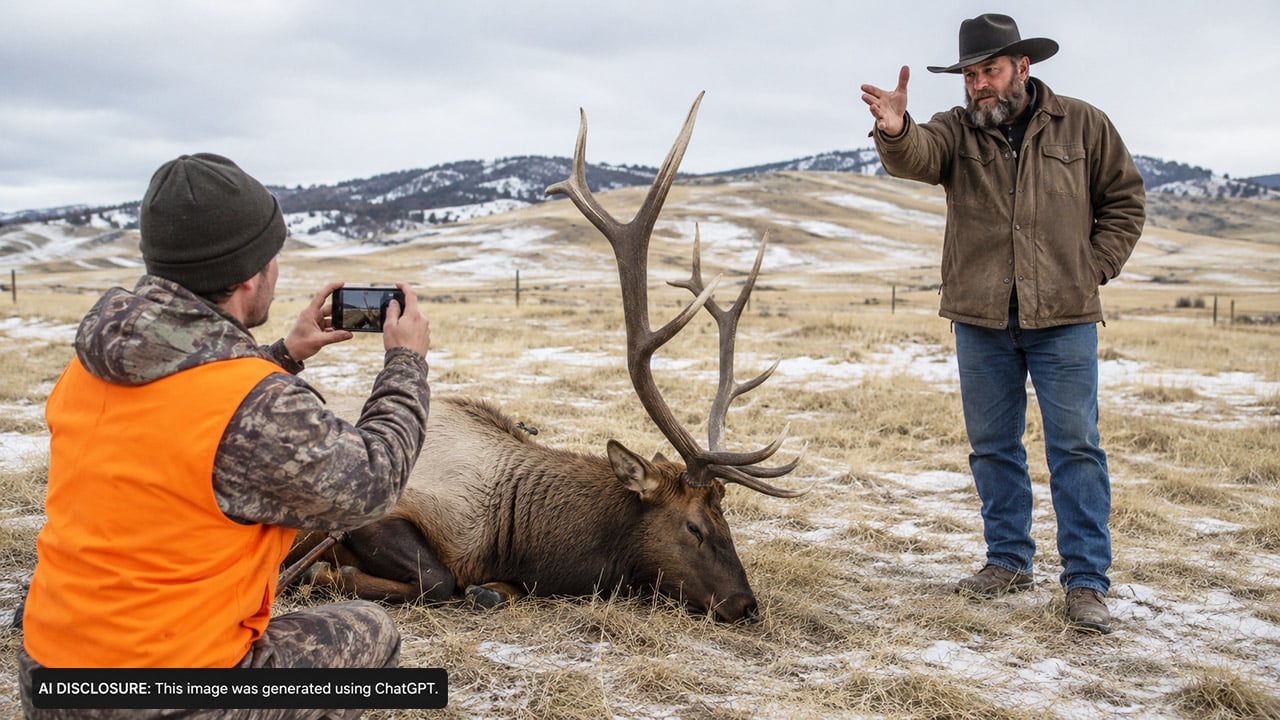
Photo credit: AI-generated image created using ChatGPT. Illustrative only
Out West, property lines can be the kind of thing you think you’ve got handled—until a bull steps out, the light’s going fast, and your brain starts rounding corners. In one Wyoming elk hunt that was filmed from start to finish, the same footage that caught a landowner trying to walk off with a hunter’s elk antlers also ended up being used against the hunters after it showed an accidental trespass and a bull killed on private ground.
The full account is laid out in the original post, including how the boundary mistake happened, how it was discovered, and what the legal fallout looked like in court.
A helicopter hunt, a blocked-up chunk of public land, and a camera rolling
The hunt was built around a method most folks will never use: chartering a helicopter to access a section of public land surrounded by private ranches. The goal was to document what happens when hunters use a “creative access tool” to reach public ground that, for practical purposes, is treated like private by the people who control the surrounding country.
That setup matters because it explains why everything was being filmed and why the footage got picked apart later. The party believed they were hunting state and BLM ground, and they leaned on digital mapping—onX Hunt—along with rangefinding and visual landmarks to stay right.
The rancher tried to take an elk rack, but the video captured something else too
The incident most people noticed first was the confrontation after the hunt, when a local landowner—described as the person who controls access to the landlocked public parcel—attempted to steal one of the hunters’ elk antlers. In the video, the landowner said he did it to deter the group (and others) from hunting the area again. That particular elk, the story notes, was harvested legally on public land.
But the same video contained another moment that would become the real hook for law enforcement: one hunter shooting a different bull that was not on the public parcel he believed it was on. Because the encounter was documented, it wasn’t just a “he said, she said” about where the elk stood. The footage had landmarks, terrain, and angles that could be checked.
The shot happened fast, and the line wasn’t marked on the ground
On the day of the kill, the group moved to a sparsely timbered knob to watch elk file out of heavy timber. The layout was tricky: they were positioned on state land with connected BLM land ahead, but a 160-acre private inholding sat along the base of the timber to the east.
There were no fences or clear markers on the slope—just grass, stunted junipers, rocks, and steep country. The hunters knew they had to “tippy-toe” around the private quarter-section, and the shooter even narrated that concern on camera as they watched elk drift near and through that private piece.
When the moment came, the shooter moved to get a better angle as the elk headed toward water. After a few minutes of crawling and hunched movement, he reached a dead tree to use as a rest. Two bulls started trotting uphill, and then a bigger bull stood not far away, facing him and looking ready to bolt.
That’s where the first admitted mistake happened: instead of ranging and checking the onX boundary again, he took the shot. The bull was hit as intended, then ran uphill, and the hunter fired two more times—later saying those were unnecessary because it was a heart shot.
How the landowner turned the footage into a trespass case
The hunter initially believed the bull was on state school-trust land, but it turned out the elk was standing inside private land—estimated at roughly 25 to 50 yards over the line—when the shot broke. The bull then ran farther onto private before dying and rolling downhill toward the public border, where the carcass was processed.
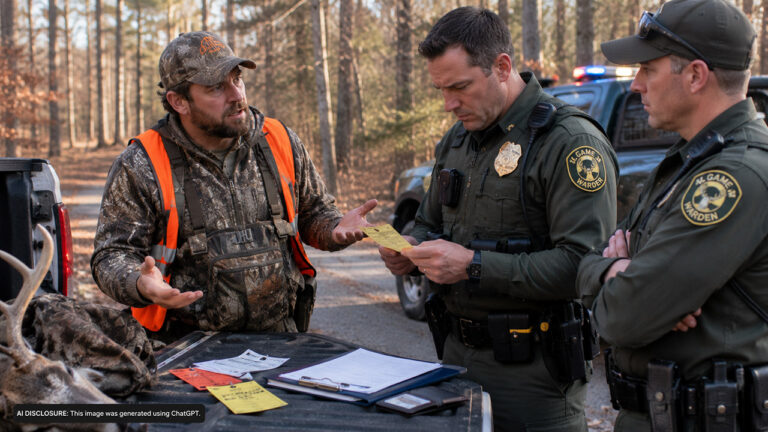
The landowner studied the published video closely, recognized features of his property, and suspected trespass. He reported that suspicion to a warden with the Wyoming Game and Fish Department, which led to an investigation. Months later, the story explains, the warden used video landmarks, aerial imagery, and boundary information to line things up.
One detail worth paying attention to if you hunt with mapping apps: the investigation also noted a small discrepancy between the digital boundary displayed on onX and the surveyed boundary tied to a BLM monument marker found on the hillside—about five yards. That doesn’t excuse a trespass, but it’s a real-world reminder that a phone screen isn’t a survey and steep terrain can warp your sense of distance fast.
Real consequences: court, fines, and surrendering the bull
The hunter answered the charges in Johnson County Circuit Court in Buffalo. He pleaded no contest, paid the required fines, and surrendered the bull he shot.
There was also personal fallout that’ll hit home for anyone who’s spent time teaching new hunters. He said he would resign from a 25-year run as a Montana Hunter Education instructor, explaining that he couldn’t in good conscience keep teaching the importance of permission and property rules with that violation on his record.
He also described the bigger sting: he has spent decades advocating for public-land hunting and conservation, and now he was publicly admitting he broke a rule that most hunters consider basic and non-negotiable.
The hard lesson for hunters and landowners: verify before you press the trigger
It’s easy to read this and turn it into a public-vs-private shouting match, especially because the hunt itself was meant to highlight how some landowners effectively lock up public ground and profit from exclusive access. The story even notes the landowner involved sells outfitted elk hunts on that ground.
But the shooter’s takeaway was simpler and harsher: he acted on an assumption and didn’t correct it in the few seconds that mattered. No quick check of the app. No range-and-confirm. And then a second assumption when the bull rolled downhill that everything must have stayed legal.
If there’s a practical point to carry into your next season, it’s this: when you’re hunting near an inholding with no fence line, your “I’m pretty sure” isn’t good enough. Stop, verify, and if you can’t verify, don’t shoot. That protects the landowner’s rights, keeps you out of court, and keeps all of us from handing ammunition to the folks who already think hunters can’t be trusted with access.
Like The Avid Outdoorsman’s content? Subscribe to our newsletter so you never miss an article.
Here’s more from us: