Photo credit: AI-generated image created using ChatGPT. Illustrative only
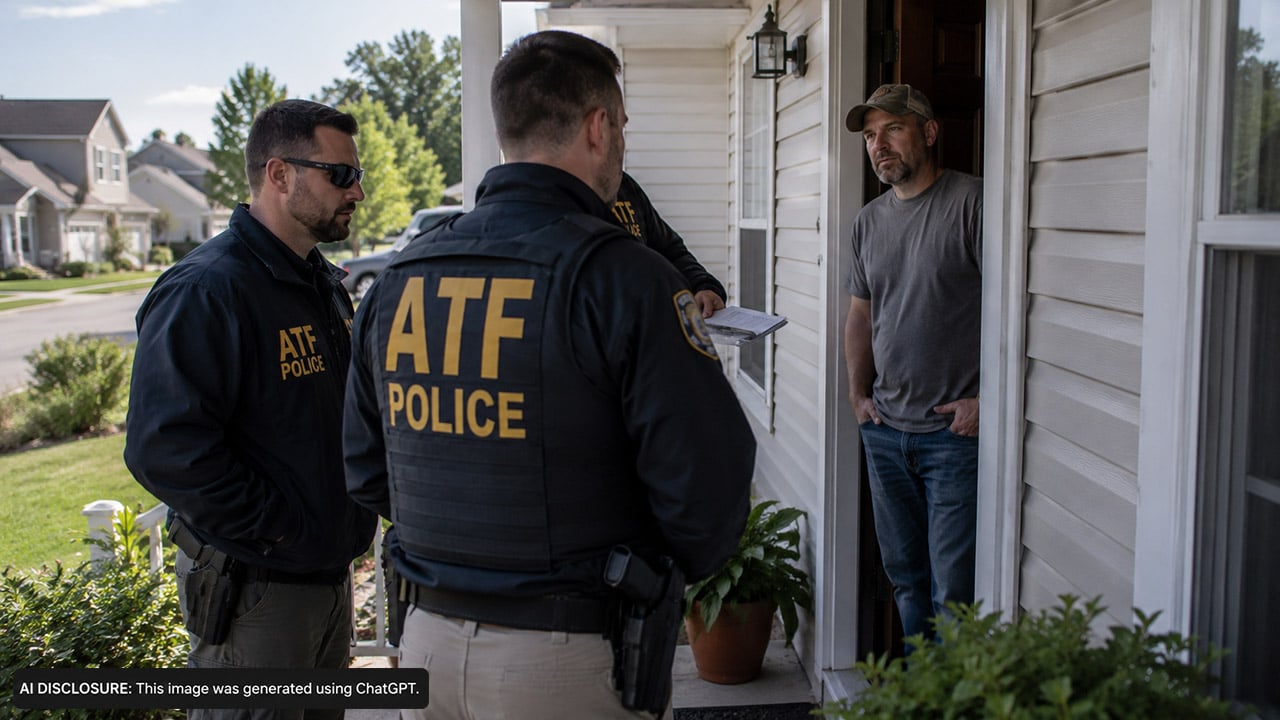
One morning a gun owner opened his door to two federal agents asking about something he’d bought online months earlier: a solvent trap. The visit wasn’t about a traffic stop or a range incident. It was a knock-and-talk that quickly turned into a pointed warning about federal prosecution and being “on our radar.”
In the original post, the man laid out a situation a lot of outdoorsmen worry about: buying parts that live in a gray area, doing at least some of the paperwork the right way, and then finding out the government may still treat the whole pile like contraband.
Two purchases, two very different paper trails
According to the man’s account, he purchased two solvent traps at different times the year before the visit. One of them, he says, was properly registered with the ATF, including the tax and stamp. After the stamp came back, he converted that particular solvent trap into a silencer—something he believed was legal because he filed the paperwork and received approval.
The second solvent trap, he said, was not modified and had no ATF filing tied to it. In his mind, it was just an unmodified solvent trap—no drilling, no baffles, no conversion. That distinction matters in real life because the line between “cleaning accessory” and “suppressor parts” is where folks end up in serious trouble.
A knock at the door and a request he didn’t want to entertain
The agents identified themselves and showed credentials. The man says there were two agents, but only one did most of the talking. The agent asked about a solvent trap the man had ordered and whether he still had it.
The homeowner’s response was simple: “I’m not going to answer any questions.” He then asked the question any rural landowner or gun owner should have in their back pocket when the stakes are high: “Do you have a warrant?” The agent said he did not.
That’s where the tone shifted from casual inquiry to pressure. The agent allegedly said they were there to “recover” the solvent trap(s) because “they are being used as suppressors,” and offered paperwork the man could sign stating he no longer had it. The man refused to sign anything.
Pressure, warnings, and the “we know what you’re using it for” line
With no warrant, the agent reportedly tried another angle: a warning. The man says the agent told him he didn’t have to sign, but if he was caught with it they would “prosecute you federally,” adding, “You’re going to be on our radar now.” The man stayed silent.
Then came the part that will sound familiar to anyone who’s watched how these conversations go when the government thinks it already has the story written. The agent allegedly said, “We know what you’re using it for. I mean, you bought a jig with it for your AR15.” The man replied, “I don’t know what you’re talking about.”
The agent also told him, “This isn’t the first time we’ve done this.” The homeowner’s position didn’t change: if the agents wanted more, they’d need to come back with a warrant.
Where outdoorsmen get jammed up: the purchase history problem
A lot of hunters and shooters don’t think about how a shopping cart can look from the other side of the desk. You buy a solvent trap. You buy something else that could be used in a build. You buy an AR-15 jig or tools that, on their own, are perfectly common. Put together, that purchase history can be interpreted as intent.
That doesn’t mean you’re guilty of anything. It does mean the “I’ll just explain it” approach can backfire fast when the person asking questions is building a federal case, not trying to clear up confusion. In the man’s telling, the agent wasn’t there to debate definitions—he was there to get property surrendered voluntarily or lock in statements.
It’s also a reminder that “I did the paperwork on one” doesn’t automatically protect you from scrutiny over another item that’s similar. From the outside looking in, two similar purchases can invite the question: which one is the registered one, and what exactly happened with the other?
What the man considered doing next—and why each option is risky
After the agents left, the homeowner started calling attorneys and asked what to do next. He floated three options: do nothing and wait to see if the agents came back with a warrant; destroy the items and dispose of them; or turn in the unregistered solvent trap (or both) to the ATF.
Even without giving legal advice, you can see the minefield. Doing nothing might feel safest, but it also means living with the uncertainty of another visit. Turning anything in might sound cooperative, but it can also create a record and invite more questions about what was owned, when, and in what condition. And destroying evidence—if an item is actually unlawful or being investigated—can stack new problems on top of the old ones. That’s the kind of decision that needs a real attorney on the phone, not buddy advice.
There’s also the practical side outdoorsmen tend to understand: when a knock-and-talk gets tense, it’s rarely the last chapter. The fact the agent mentioned prosecution and being “on our radar” suggests they weren’t just doing a friendly compliance check.
The most practical lesson: don’t talk your way into a bigger mess
If there’s a plain takeaway from the man’s account, it’s that he did one important thing right in the moment: he didn’t start chatting. He didn’t volunteer a timeline. He didn’t confirm what was in the house, what was modified, or what paperwork existed. He asked about a warrant, refused to sign, and ended the conversation.
That kind of restraint is hard when someone with a badge is on your porch implying they already know what you’ve done. But outdoorsmen have seen this in other contexts—game wardens asking “mind if I take a look?”, a neighbor fishing for a confession about a property-line issue, a deputy trying to “clear things up.” Friendly talk can turn into a written statement in a hurry.
The other lesson is to keep your own house in order. If you’re going to play anywhere near NFA territory, keep documentation squared away and accessible, store regulated items securely, and understand that “unmodified” is a claim you may someday need to defend with facts, not feelings.
The man’s story ends where a lot of these begin: waiting on attorneys to call back and trying to figure out what the government thinks it knows. For folks who hunt, shoot, and tinker with gear, it’s a reminder that some purchases bring more attention than you’d ever expect—and the wrong conversation on the front porch can turn an ordinary day into a federal headache.
Like The Avid Outdoorsman’s content? Be sure to follow us.
Here’s more from us: