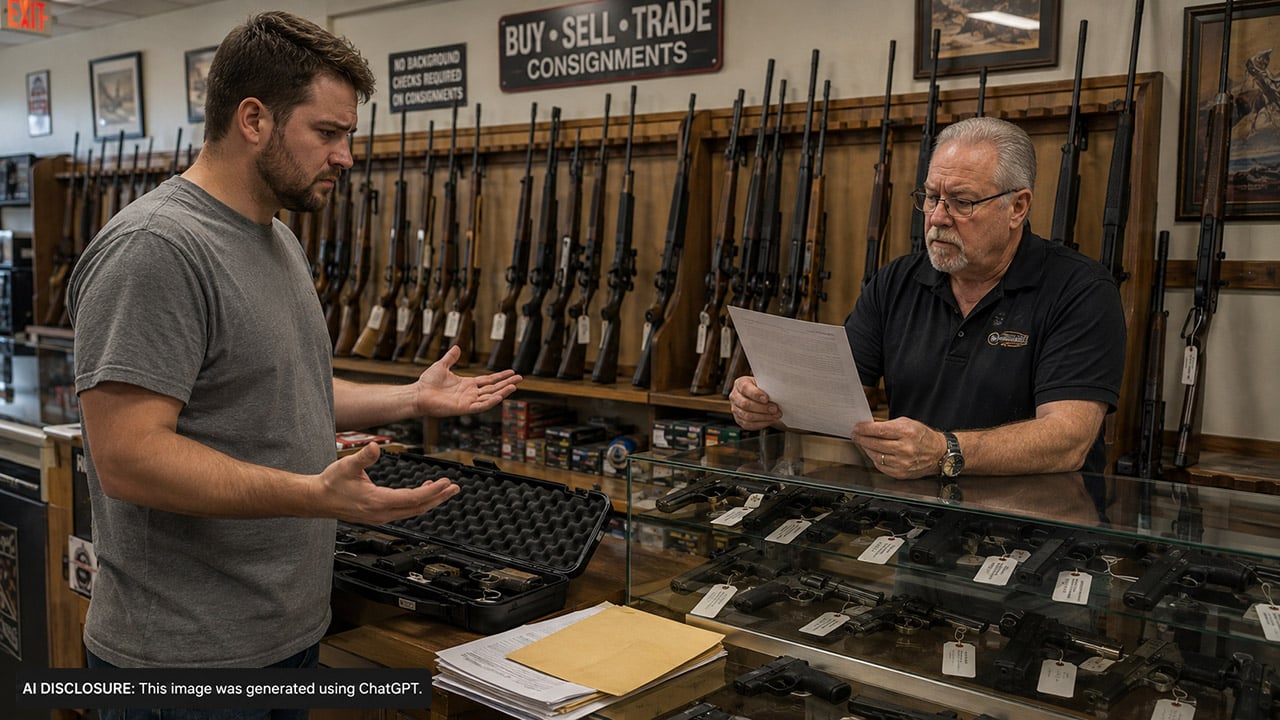
Photo credit: AI-generated image created using ChatGPT. Illustrative only
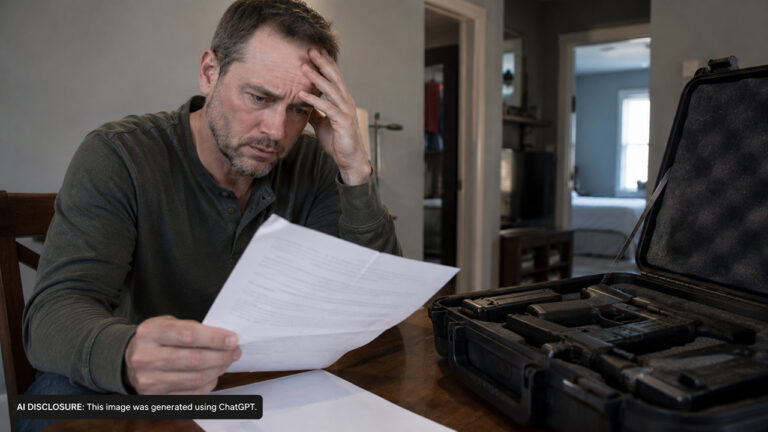
When a man passes and leaves behind a lifetime of rifles, shotguns, and handguns, the “who gets what” question can turn into a real-world problem fast—especially when the collection is big enough to fill a safe room. That’s the spot one out-of-state son found himself in after his father died in Alabama with no will, leaving behind 80-plus firearms and a mess of logistics and paperwork.
In the original post, the son explained that he lives in Wisconsin, his dad died in early May, and he was told the estate would have to go through probate. The immediate plan was simple: his stepmother offered to hold the guns temporarily while he figured out how to move them without spending a fortune. Then the collection ended up at a consignment shop, and the shop wasn’t willing to proceed without legal proof of who actually has the right to sell them.
A big collection meets a hard rule: “Show us you can sell these”
Consignment shops aren’t in the business of taking chances with firearms. If they sell guns for someone who didn’t have the legal authority to hand them over, they can wind up pulled into a dispute, forced to return property, or dealing with law enforcement questions they don’t want.
That’s why the shop’s demand matters here: they want documentation stating the firearms are legally the son’s, and that the stepmother didn’t just drop them off “in good faith” as if she owned them. From the shop’s perspective, it’s not personal—it’s survival. Guns are tightly regulated compared to most estate property, and the paper trail has to be clean.
The “no will” part is what turns this into probate-country
In a lot of families, folks assume “it all just goes to the kids.” But when someone dies without a will, that’s not how it works. The property generally becomes part of an estate that has to be handled under state law, and somebody needs legal authority to manage it.
With 80-plus firearms involved, the difference between “I’m the son” and “I’m the legally appointed personal representative” is everything. Until an executor/administrator is appointed and the estate process starts sorting ownership, a shop is smart to treat any attempted sale like a potential ownership dispute—because that’s exactly what it can become.
The stepmother’s decision to consign them changed the whole situation
The son said they’d only briefly discussed selling some “more common ones” to help cover funeral and travel costs. That’s a pretty normal conversation after a death—estates often need cash, and plenty of collections have duplicates or lower-value pieces that can go first.
But the stepmother took that as permission to bring all of them to a consignment shop to “offload them.” That move didn’t just speed things up; it handed control of the guns to a third party that now wants legal proof before they’ll do anything. It also raises an uncomfortable question for the family: did she have the authority to move and consign estate property at all?
The divorce detail is the kind of wrinkle that makes shops freeze
Here’s the part that really tightens the knot: the son said his stepmother and father fully divorced in March of this year, just a couple months before his dad died. He also believes she may not have disclosed that divorce to the consignment shop.
That matters because “wife” and “ex-wife” can be two very different things in estate and property questions. If the shop believed she was the surviving spouse, they might have assumed she had a stronger claim to handle the estate property or at least a clearer connection to it. Once divorce enters the picture, the shop has every reason to pump the brakes and demand documentation before any firearm gets sold or transferred.
And from a practical gun-owner standpoint, it’s easy to see why: an 80-gun estate can include everything from hunting rifles to collectibles to items that raise extra compliance questions. A shop that gets caught in the middle can end up holding inventory it can’t legally sell until the estate issues are resolved.
What “proof” usually looks like when guns are tied up in an estate
The son asked what document would be best to prove the guns are his and not hers. In situations like this, “proof” usually isn’t one magic receipt—it’s legal authority. A shop often wants paperwork showing who has been appointed to act for the estate, because that person can lawfully manage estate assets, including arranging transfers or sales.
Practically speaking, that tends to mean court-issued documents from the probate process naming an executor/administrator (often called letters of administration or similar terms, depending on the state). If the son isn’t the appointed person, then even being the next of kin may not satisfy a cautious shop. The shop is looking for the person who has the right to sign and make decisions without the deal getting unwound later.
It’s also not hard to imagine the shop wanting clarity on whether the stepmother had any remaining claim after the divorce, and whether the guns were solely the dad’s property or potentially disputed. Even if the answer is “they’re clearly his,” the shop will still want it in writing from the right authority.
The real-world consequences for gun owners: don’t let a collection drift without paperwork
This is the part that hits home for a lot of outdoorsmen. Folks build a collection over decades—duck guns, deer rifles, a revolver Grandpa carried, a couple safe-queens you always meant to pass down. Then life happens, and the family is left trying to sort it out across state lines while also grieving.
A few practical lessons jump out from this situation. First, moving guns to “temporary storage” with someone who isn’t clearly authorized can go sideways fast, even if everyone thinks they’re helping. Second, consignment shops and gun stores are going to protect themselves, and “trust me” won’t cut it when the estate is in limbo. Third, when there’s no will—and especially when there’s a recent divorce—expect everything to slow down until probate puts a name on the person who can legally act.
Most of all, this is a reminder that if you’ve got a serious collection, a basic estate plan isn’t just for rich people. It’s for anyone who doesn’t want their kids scrambling to prove ownership while a shop holds the keys to the gun rack and asks for legal documentation before a single firearm moves.
Like The Avid Outdoorsman’s content? Subscribe to our newsletter so you never miss an article.
Here’s more from us: