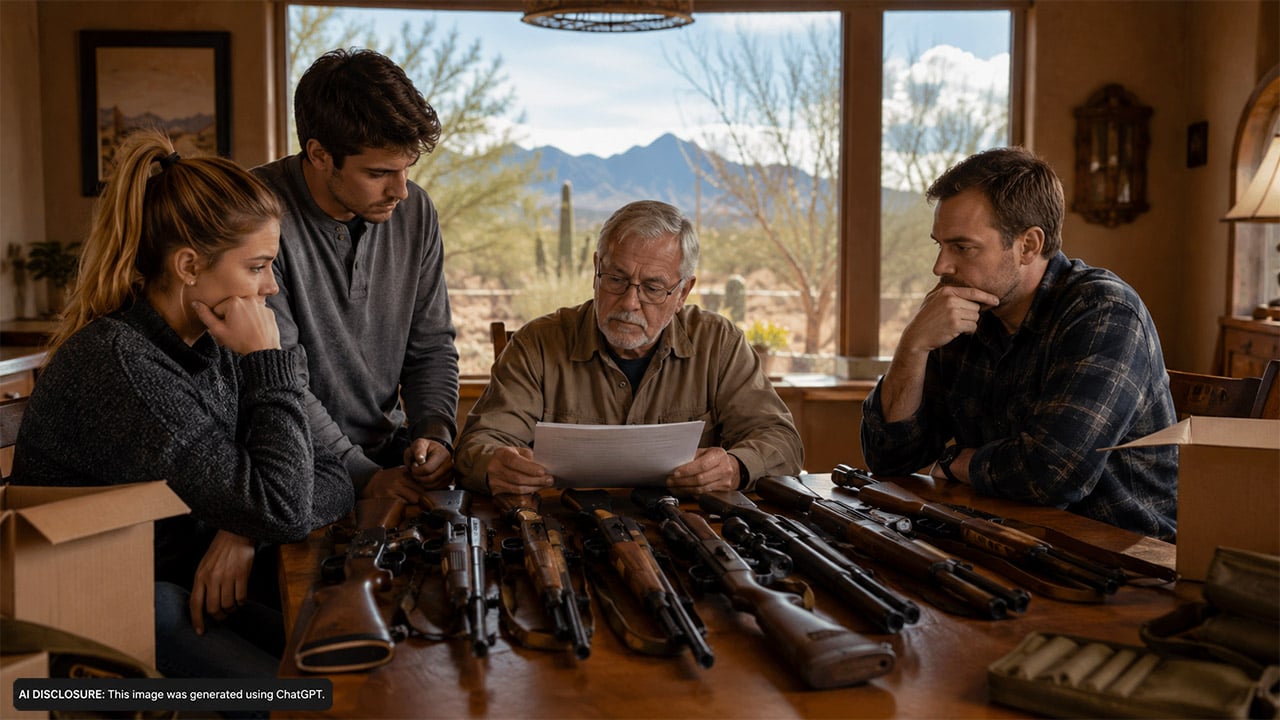
Photo credit: AI-generated image created using ChatGPT. Illustrative only
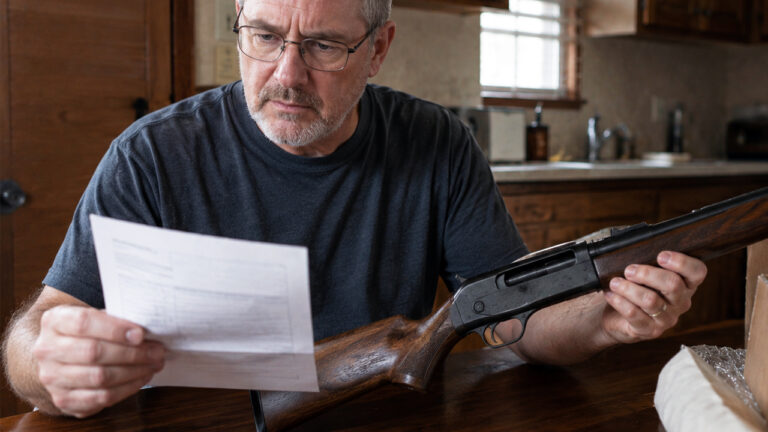
A grandfather in Arizona did what a lot of old-school hunters hope to do—pass down the rifles that meant something to him. He left his gun collection to his grandchildren, and nobody in the family wants to sell. They want to keep the memories, keep the traditions, and keep the guns in the family.
But once the dust settled, the practical questions hit hard: how do you legally and safely move a handful of rifles (and “the odd handgun”) from Arizona to Southern California, central Alabama, and Seattle? That’s the knot the family is trying to untangle in the original post, and it’s a situation a lot of gun-owning families eventually face.
A sentimental inheritance meets the real world
The grandson explained that the grandchildren connected with their grandfather through guns and shooting, and the will reflects that. The plan is a “round robin” distribution where everyone takes turns picking what they want, and each person will likely end up with about half a dozen rifles. The collection leans heavy on hunting classics—he described his late grandfather as a “big 30-.06 enthusiast.”
The guns are currently with the grandmother in Arizona, where the grandparents lived. For the cousins in Southern California, it’s a drive-and-pick-up situation on paper. For the grandson in Alabama and his brother in Seattle, it turns into travel logistics, shipping questions, and a whole lot of legal fine print.
The confusion around “registration” and the ATF
One of the first worries mentioned was that none of the guns were “registered with the ATF.” He’d prefer not to register them, but said he’d do it if it made everything smoother. That’s a common misconception, especially among folks who grew up around someone who was cautious or skeptical about government paperwork.
In most of the country, typical rifles and handguns aren’t “registered with the ATF” the way cars are registered with a DMV. That doesn’t mean there aren’t rules—there are plenty—but the rules usually revolve around who can possess them, how transfers happen, and what your state requires. The hard part is that those requirements change fast when you cross state lines, and they change again when one of those states is California or Washington.
Interstate transfers: where families get jammed up
When firearms move between residents of different states, it’s not the same as handing your cousin a duck call at deer camp. Federal law has specific rules about interstate transfers, and families handling an estate often assume the “it’s inherited” label makes everything automatic. In reality, the “how” matters—especially if the recipient lives out of state.
This family’s situation has three different destinations, and each one carries its own baggage. A bolt-action .30-06 headed to Alabama is usually less complicated than almost anything headed to Southern California. And Seattle adds its own layer, especially for handguns and magazine-related issues if any of those guns wear modern accessories.
Even if the rifles themselves are straightforward hunting guns, the moment you’re talking about “the odd handgun,” you’ve got another category with tighter rules in several places. A handgun that’s perfectly ordinary in one state can be a paperwork headache in another, and in some areas the requirements aren’t just about the gun—it’s about the exact model, features, and how the transfer is documented.
The travel-and-shipping problem nobody thinks about at the funeral
The practical side matters just as much as the legal side. If the cousins from Southern California are driving to Arizona, they still have to think about how they’re transporting firearms back across state lines, where they’ll be stopping, and how the guns are stored during travel. “Easy drive” can turn complicated if you detour through a place that treats handgun transport differently than you’re used to.
For the grandson in Alabama and the brother in Seattle, the big question is whether to fly, ship, or use a dealer to handle transfers. Flying with firearms can be done legally with the right procedures, but it isn’t something you want to freestyle on a tight connection with a borrowed hard case. Shipping firearms has its own rules too, and the “odd handgun” is where folks get burned because carrier policies and state rules can stack up fast.
Then there’s the volume. “Half a dozen rifles each” isn’t one heirloom rifle in a soft case. It’s multiple long guns that need to be secured, documented, and protected from theft and damage. If you’ve ever moved a gun safe or transported a stack of rifle cases, you know the logistics alone can wear you down before you even get to the paperwork.
Keeping Grandpa’s rifles — without creating a mess for Grandma
It’s easy for the younger generation to focus on getting their share home, but the grandmother in Arizona is the one sitting in the middle of it. She’s the one with the collection on site, and she’s the one who could be left holding the bag if a transfer goes sideways or if guns are left unsecured during the family shuffle.
A clean process usually starts with slowing down and getting organized before anybody starts grabbing rifle cases. That means making a basic inventory, keeping the guns secured, and being honest about what’s going where. It also means thinking about timing. A round-robin pick is a fun way to honor the old man, but it can create a lot of handling and a lot of moments where guns are out and moving around—exactly when mistakes happen.
And since the post mentions handguns mixed in, it’s worth separating “long gun plans” from “handgun plans.” Families often treat them all the same because they were all in Grandpa’s closet. The law doesn’t always agree.
The most practical path forward
In situations like this, the simplest, safest route is usually the one that treats the inheritance like what it is: a formal transfer of firearms across multiple state lines. That often means leaning on reputable firearms dealers in the recipient’s home states (and sometimes in the state where the guns currently sit) so the transfer is handled in a way that’s clearly documented and compliant.
That approach also helps with something the grandson mentioned directly: saving extra work and avoiding the feeling that you’re creating a paperwork trail you don’t want. It’s not about paranoia, and it’s not about “the ATF coming knocking.” It’s about not accidentally committing a serious mistake because you tried to DIY something that’s regulated differently in three different places.
If there’s one outdoorsman’s lesson here, it’s the same lesson as hauling meat in warm weather: don’t take shortcuts when the stakes are high. A little patience and the right help can keep a family inheritance from turning into a long-term headache—and it keeps the focus where it belongs, on a grandfather who clearly loved his .30-06s and the grandkids he wanted to have them.
Like The Avid Outdoorsman’s content? Be sure to follow us.
Here’s more from us: