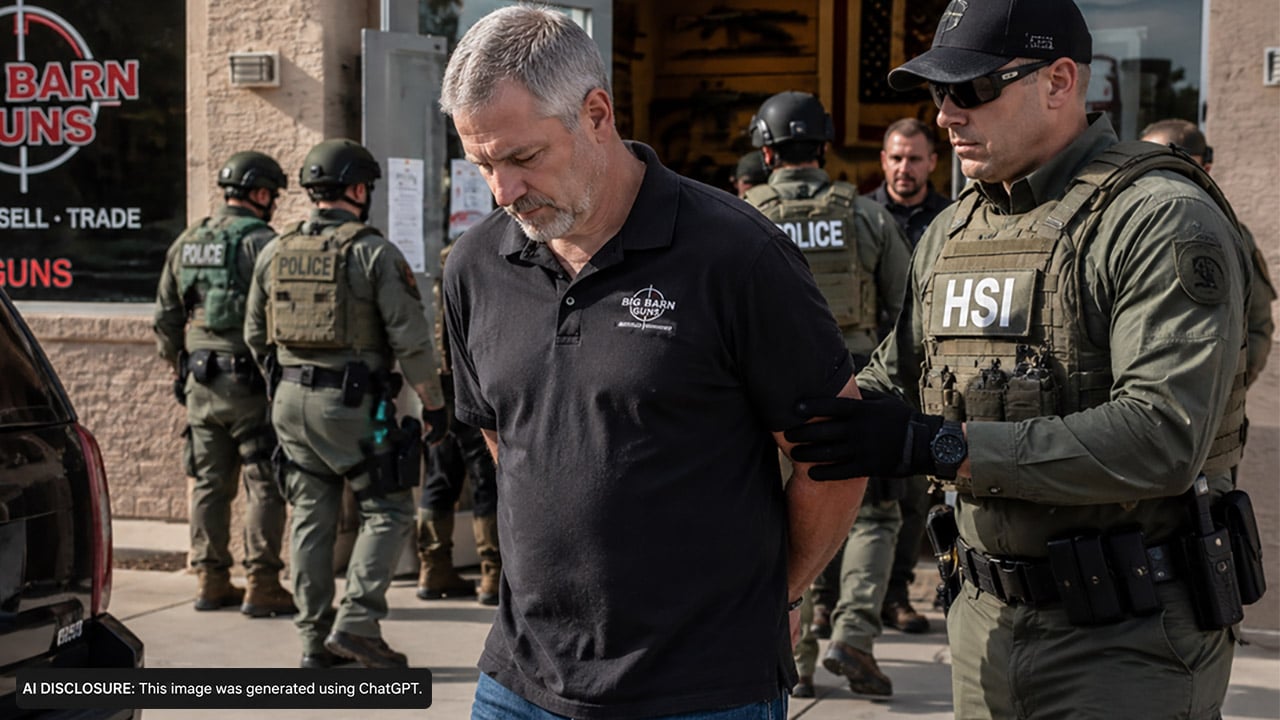
Photo credit: AI-generated image created using ChatGPT. Illustrative only
If you’ve spent any time in a small-town gun shop, you know how much the whole system runs on trust. A customer walks in, fills out paperwork, and the dealer’s name is on the line every time a firearm goes across the counter. That’s why this federal case out of Arizona hits like a gut punch for a lot of law-abiding gun owners.
Federal prosecutors say a Hereford, Arizona man who owned Grips By Larry—a former federal firearms licensee—went from being indicted on straw-purchase and trafficking-related allegations to facing much heavier accusations tied to cartel terrorism. The details are laid out in the source post from the U.S. Attorney’s Office for the District of Arizona.
A familiar firearms case took a hard turn
The man at the center of it is Laurence Gray, 65, of Hereford. Prosecutors say he owned Grips By Larry and had been a federally licensed firearms dealer in Arizona. Gray was already under indictment from 2025 for what most gun folks recognize as the usual set of serious federal allegations: firearms trafficking offenses, aiding and abetting straw purchases, and aiding and abetting material false statements during the purchase of a firearm.
But on March 17, 2026, a federal grand jury in Phoenix returned a superseding indictment that adds a whole different layer. The new charges include Attempting to Provide Material Support to a Foreign Terrorist Organization and Conspiracy to Provide Support to a Designated Foreign Terrorist Organization. Gray was arraigned in federal court on that superseding indictment.
The cartels named in the indictment were labeled terrorist organizations
What makes this case stand out isn’t just that it’s tied to cartel violence—it’s how the law is now being applied. The indictment names Cartel de Jalisco Nueva Generacion (CJNG) and Cartel de Sinaloa (CDS), and notes they were designated by the U.S. Secretary of State as foreign terrorist organizations on Feb. 20, 2025, under Section 219 of the Immigration and Nationality Act.
That designation matters because it changes the legal terrain. Once an organization is formally designated as a foreign terrorist organization, “material support” statutes come into play, and those are the kinds of charges that can stack time fast. For folks who live and hunt near the border or just pay attention to cartel activity, it’s also a blunt acknowledgement of what those groups are capable of.
What prosecutors say Gray tried to do
According to the indictment, Gray “knowingly attempted to provide firearms to CJNG in May of 2025.” Prosecutors also allege he “knowingly conspired to provide firearms to both CJNG and CDS” during that same year.
The government’s release doesn’t get into the nuts and bolts—how the alleged contacts were made, what firearms were involved, or how close anything came to actually crossing the border. But the core accusation is clear: this wasn’t just allegedly skirting paperwork rules or looking the other way on a questionable sale. Prosecutors are saying the intent was tied directly to organizations the U.S. had already labeled as terrorist groups.
The earlier indictment included straw purchase and false statement allegations
Before the terrorism-related counts were added, Gray’s 2025 case already included multiple firearms-related charges. The release says Gray was indicted alongside a second individual, Barrett Weinberger, 73, of Tucson. The original charges included trafficking in firearms, aiding and abetting the straw purchasing of firearms, and aiding and abetting material false statements during the purchase of a firearm.
For everyday gun owners, this is the part that hits home because it’s the scheme that keeps showing up in trafficking cases: someone who can pass the background check buys the gun for someone who can’t, or buys it for a prohibited destination. That’s why the “actual buyer” question on the federal form is such a big deal, and why reputable shops get prickly the moment a customer starts acting like they’re shopping for somebody else.
It’s also why this kind of conduct—if proven—doesn’t just put the buyer at risk. It can wreck the dealer, the community’s trust in local gun businesses, and it gives ammo to people who want to paint every gun owner as reckless.
The penalties are heavy, even before you add the cartel counts
The release lays out what’s on the line if there are convictions. Each of the two terrorism-related charges—Conspiracy to Provide Support to a Designated Terrorist Organization and Attempting to Provide Material Support to a Foreign Terrorist Organization—carries a maximum of 20 years in prison, a fine of up to $250,000, or both.
On the firearms side, a trafficking conviction carries a maximum of 15 years and up to a $250,000 fine. Aiding and abetting the straw purchase of firearms also carries a maximum of 15 years and the same potential fine. Aiding and abetting a material false statement during the purchase of a firearm carries a maximum of 10 years, again with up to a $250,000 fine.
That’s the practical point a lot of people miss: even “paperwork crimes” around straw purchases aren’t treated like a slap on the wrist in federal court. And when prosecutors add an allegation that the intended recipient was a designated foreign terrorist organization, the ceiling goes higher and the case gets a lot more attention.
What this means for regular gun owners and small gun shops
If you’re a law-abiding buyer, this case is a reminder that the clean, boring parts of gun ownership matter. Buy for yourself. Don’t “help” somebody else buy a gun. Don’t fill out paperwork for a buddy, a cousin, or “a guy from work” because they’re short on cash or “don’t have time to come in.” Those shortcuts are how people end up in felony territory.
If you’re an FFL—or you’re friends with one—this is also a harsh example of how one bad run can turn a local shop into a headline. The release notes Gray is a former federal firearms licensee, and it doesn’t say when he stopped holding that license. But the broader lesson stands: the dealer is the choke point in the legal market, which means the dealer is also the first place investigators look when guns start moving illegally.
The investigation in this case was conducted by the Bureau of Alcohol, Tobacco, Firearms and Explosives (ATF), and it’s being prosecuted by the U.S. Attorney’s Office in Arizona. The release also places it under “Operation Take Back America,” described as a DOJ initiative aimed at cartel and transnational criminal organization enforcement, along with violent crime and illegal immigration efforts.
One more important note: an indictment is an accusation, not a conviction. The government emphasized that defendants are presumed innocent until proven guilty beyond a reasonable doubt.
But whether you’re a hunter who just wants to buy a new rifle without hassle, or a shop owner trying to keep the doors open, cases like this are why doing it by the book isn’t optional. When firearms get routed toward cartel violence, everybody pays for it—usually the honest folks first.
Like The Avid Outdoorsman’s content? Subscribe to our newsletter so you never miss an article.
Here’s more from us: