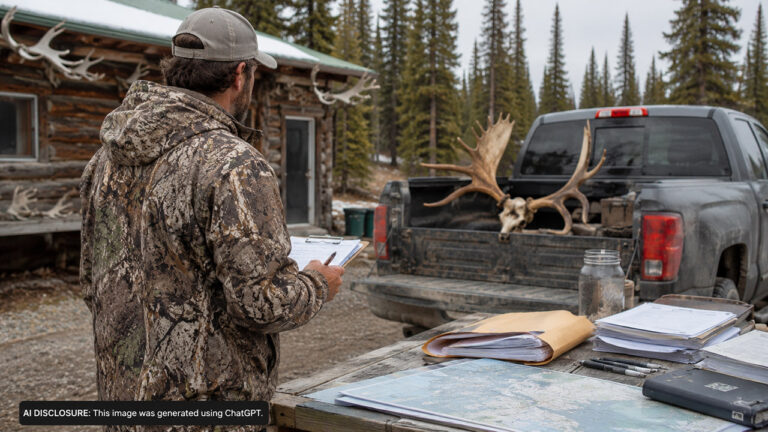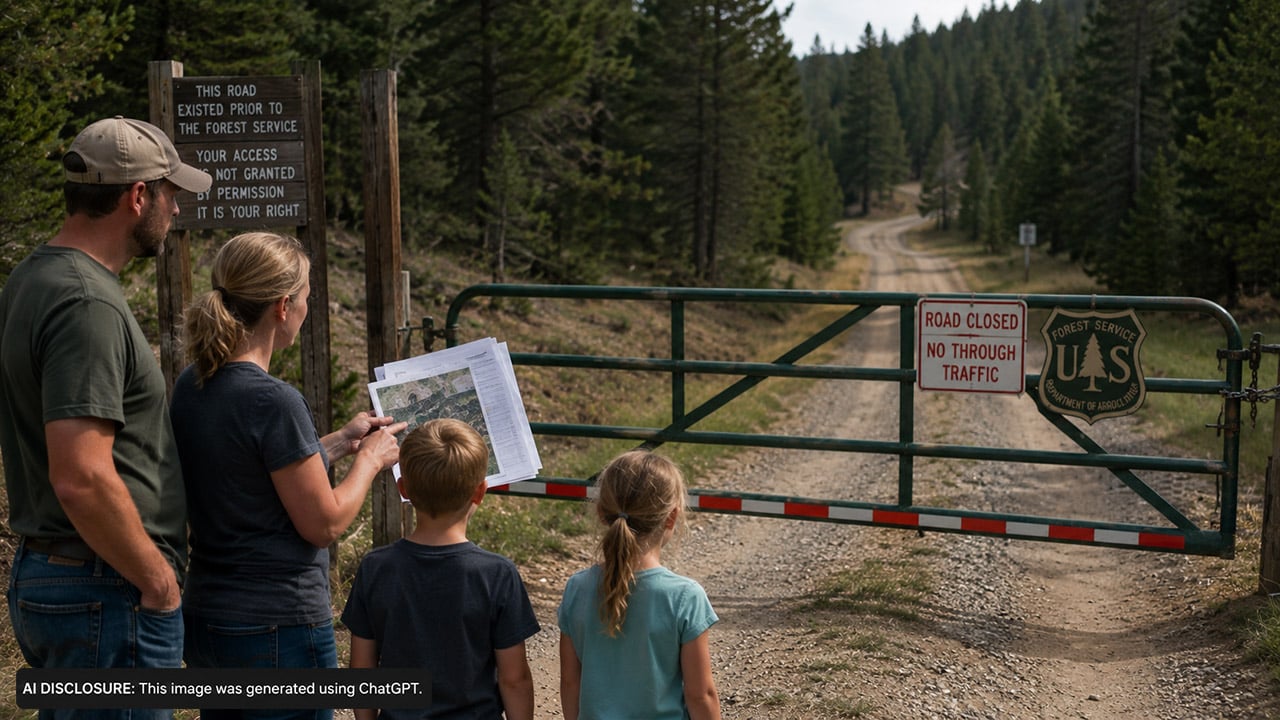
Photo credit: AI-generated image created using ChatGPT. Illustrative only
Buying a piece of ground in Montana is supposed to mean freedom—room to breathe, room to hunt, and a place your family can get to when the weather breaks. But one Montana family says their access hinges on a locked Forest Service gate that turns their place into a seasonal property, not by choice, but by policy.
In the original post, the writer explains how their parents purchased land knowing a gate at the start of the road gets locked each year. What they didn’t expect was getting denied a key outright—and then watching county-level decisions pile up without anyone actually forcing the issue.
A seasonal gate turned into a real access problem
The family says the Forest Service locks a gate at the beginning of the road every year. They expected a typical Montana setup—roads closed for winter, sometimes tightened up around rifle season, then reopened when the snow lets go.
But this one, they say, closes October 15 and doesn’t reopen until June 15. That’s not a “winter closure” in the practical sense most folks mean. In their view, it limits full use of their property to about four months a year, which affects everything from hunting season plans to maintenance, wood cutting, and basic peace of mind.
They tried to do it the friendly way first
Before anyone started throwing around old road law, the family says they simply asked for a key. The realtor had told them landowners typically get access, and they knew of nearby property owners who’d obtained keys without much trouble.
That comparison fell apart once they learned those friends were in a different ranger district. According to the post, the ranger over the friends’ district was willing to work with landowners, but the ranger district that controlled this gate denied the request. The family says they made multiple attempts to work with the Forest Service and got nowhere.
Dad dug into the history and built a case around an old road right
With the key request going nowhere, the writer says their father started researching and landed on what he referred to as RS2477—an old legal concept tied to historic roads and rights-of-way. He reportedly spent months collecting information and concluded the road existed well before the late 1800s and had been treated as a public highway under various federal and Montana laws.
Just as important, the family says they found no evidence the road had ever been abandoned by the county. In their view, that meant the county—not the Forest Service—held the legal rights to the road, and therefore the gate shouldn’t be there in the first place.
The county commission voted to reaffirm the road—but the gate stayed
According to the post, the father took his research to the county commissioners. On January 9, 2018, the commissioners voted to reaffirm the road as a “non-maintained” county road and remove the gate. The decision was published in a local paper, and the county attorney was directed to send a letter to the Forest Service requesting removal of the gate.
Then things got muddy. The writer says the Forest Service saw the news and responded to the commission in writing that it would not recognize the county’s claim and would continue managing the road, including keeping the gate locked seasonally.
But the bigger issue, at least from the family’s perspective, is that the county attorney allegedly never sent the first letter he was instructed to send. Later, in October 2018, the commission voted on another notice reaffirming the road and that letter did get sent to the Forest Service.
Still, the Forest Service reportedly answered back in the same way: it had managed the road for 30-plus years and intended to keep doing so.
The county attorney became the bottleneck
The family’s frustration isn’t just pointed at a federal agency. It’s pointed at their own county’s lack of follow-through. In May 2019, the writer says their father contacted the county attorney again and asked him to move forward on removing the gate based on the commission’s direction and the legal authorities the father believed applied.
Instead, the county attorney allegedly encouraged the family to keep working with the Forest Service for access—something they say they’d already tried repeatedly. The writer also claims the county attorney’s position changed after two things happened: the county had an unfavorable outcome in an unrelated road access suit, and a local sportsman’s club (which the attorney belonged to) opposed opening the road.
On top of that, the post describes an odd wrinkle: in November 2018, the commission’s CEO—who had opposed reaffirming the road but was not a voting member—said he’d attended a meeting with the Forest Service about the road and characterized it only as “very friendly” and “went well.” The writer says other commissioners weren’t aware of the meeting and no further details were shared publicly.
Why this hits outdoorsmen harder than most people realize
If you’ve spent time in the West, you know access is everything. Not theoretical access—real access when you need it. When a gate is locked from mid-October through mid-June, you’re missing late-season hunts, you’re missing the shoulder seasons, and you’re missing the time of year when a lot of landowners do work without cooking themselves in July heat.
There’s also a safety and stewardship angle that doesn’t get enough attention. If you can’t reliably reach your own place, you can’t keep an eye on it. You can’t check damage after storms. You can’t deal with downed trees. You can’t respond quickly to vandalism, trespass, or problems that tend to show up when no one’s around.
And from a hunting perspective, this is the kind of thing that can change how a family uses their property entirely. You don’t just “work around it” when your access shuts down right as general season ramps up.
The options they ran into weren’t simple
The writer says their father looked into suing to force the gate removed, but believed the Forest Service wouldn’t recognize such a claim coming from a private citizen—only from a county or the state. They also say he reached out to the Montana Attorney General’s office seeking review of the county attorney’s refusal to act, only to be told that office does not take complaints from private citizens.
That’s the corner the family describes: the county voted and reaffirmed the road, the federal agency refused to acknowledge it, and the local official tasked with legal enforcement wouldn’t press the matter. Meanwhile, the gate continued to control access.
This is the kind of dispute that makes rural folks feel like they’re living under rules that change depending on who’s willing to show up and enforce them. And when the argument is over a road that’s been on the landscape longer than any of the agencies involved, it gets personal in a hurry.
For landowners, hunters, and anyone who values public roads staying public, this is also a reminder to dig into access before you sign—seasonal closures, easements, maintenance status, and who actually holds authority. Because once a gate becomes “normal,” getting it moved can turn into a long fight where paperwork matters as much as boots on the ground.
Like The Avid Outdoorsman’s content? Subscribe to our newsletter so you never miss an article.
Here’s more from us: