Photo credit: AI-generated image created using ChatGPT. Illustrative only
There’s a special kind of helpless feeling that comes from opening your front door at night and realizing the person on the other side isn’t a neighbor, a delivery driver, or a cop. It’s somebody geared up, asking about a name you don’t recognize, and clearly looking for trouble.
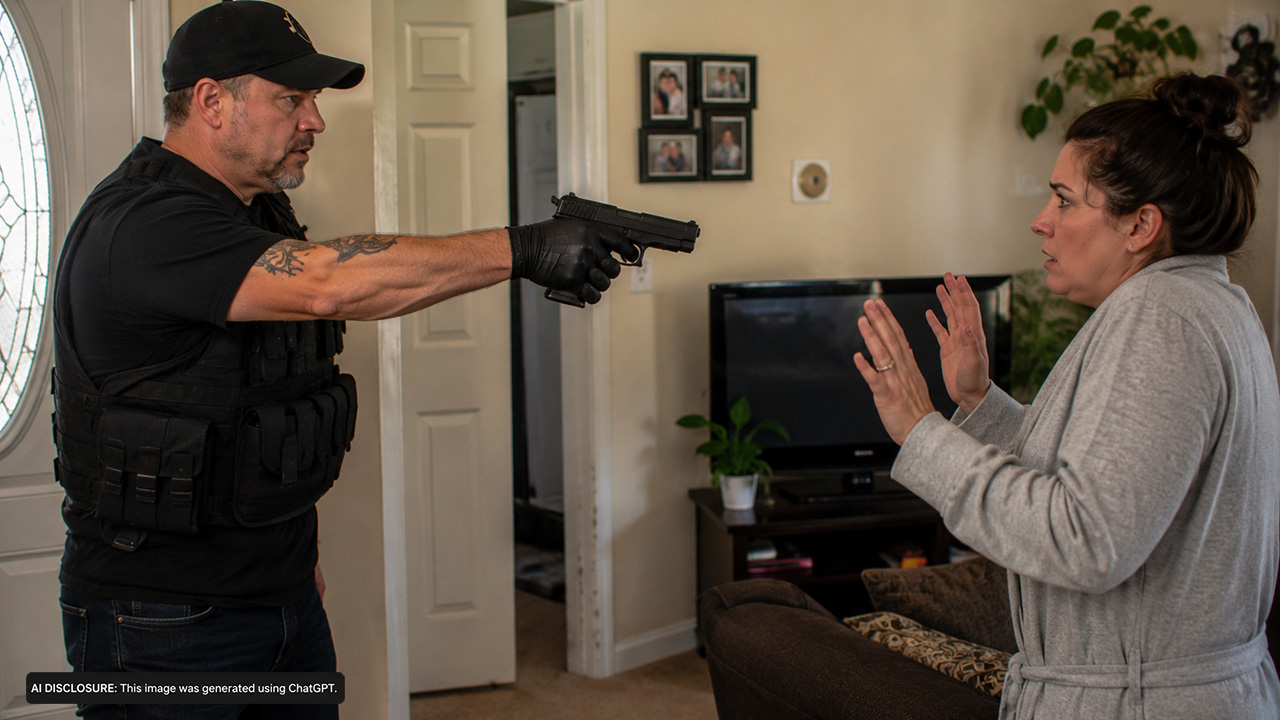
That’s the situation described in the original post, where a Washington state apartment tenant says a man wearing a camo “tactical” vest showed up at his door and wound up forcing his way inside with a taser drawn while asking if someone named “Amara” was there.
The knock at the door didn’t feel right from the start
According to the tenant, the visitor didn’t stand square in front of the peephole like most people would. He was off to the side. That’s the kind of small detail that makes your instincts light up, whether you live in town or ten miles down a gravel road.
When the door opened, the visitor asked, “Is Amara there?” The tenant said he didn’t know anyone by that name. The questions kept coming, and only then did the tenant notice the taser.
Refusing to answer led to a forced entry
The tenant says he told the man he didn’t have to answer questions and tried to shut the door. Before it closed, the visitor “blasted into” the apartment with the taser out and began searching the place.
In plain terms, that’s the moment things go from uncomfortable to dangerous. A taser may not be a firearm, but it’s still a weapon, and having a stranger push into your home with one changes the whole risk picture. The tenant called 911 while the search was happening.
The “bounty hunter” explanation came after the fact
Only after the entry and search did the tenant say he realized the man was a bounty hunter. The tenant also says the intruder never properly identified himself, and he didn’t appear to have “proper gear on.”
To make it worse, the tenant had only been in the apartment about a month and a half. The woman who had apparently skipped bail no longer lived there. The only reason the bounty hunter came to that door, the tenant says, is because it was the address the woman had listed or previously lived at.
Police response left the resident frustrated
When law enforcement arrived, the tenant says he was told no crimes were committed. He also says he wasn’t able to file a complaint beyond what was automatically generated.
That response is the part that will hit home for a lot of outdoorsmen and gun owners. Most of us have been taught our whole lives that your home is your line in the sand. Yet here was a new tenant saying a stranger forced entry, searched his place, and the official answer felt like, “That’s just how it is.”
Why this scenario matters to homeowners, renters, and gun owners
You don’t have to be living on a ranch to understand how sideways this can go. A stranger at the door, a weapon in hand, a sudden entry—those are the same ingredients that lead to tragic misunderstandings in home-defense situations.
The tenant did one thing that likely helped: he called 911 immediately. He also tried to end the conversation and close the door once he saw the taser. Beyond that, the post reads like someone trying to make sense of a world where a private individual can treat an address on paper like a permission slip to intimidate a new occupant.
From a practical standpoint, it’s also a reminder to treat odd doorstep encounters seriously. If someone won’t stand where you can clearly see them, won’t identify themselves up front, and starts asking about people you don’t know, that’s a “door stays shut” situation. In many homes, it’s also a “lights on, phone in hand, and let dispatch sort out who’s who” situation.
The biggest sticking point: rights of a new tenant versus a paper trail
The tenant’s frustration boils down to a simple question: why should a new renter lose peace and safety because a previous occupant listed that address on bail paperwork? He notes that he “didn’t sign that stupid paper” and didn’t agree to give up rights just because someone else once lived there.
That’s a fair gut-level reaction, and it’s the same reaction you’d have if a stranger hopped your gate because “the last guy said it was fine.” Paper trails matter in the legal system, but doors and locks matter in real life.
Even in places where bounty hunters have more leeway than most folks expect, the on-the-ground problem remains: the person answering the door might be an uninvolved tenant, a family with kids, or somebody who’s going to interpret a forced entry as a deadly threat. That’s not politics. That’s reality.
The post also makes a point about identification. If someone is going to show up acting with authority, residents want to see clear identification and a professional approach. When a person appears “tactical” but not official, it’s hard to tell whether you’re dealing with a legitimate agent, a scam, or a straight-up criminal using a vest as a costume.
The tenant’s final takeaway was blunt: he viewed these kinds of actors as vigilantes, and he didn’t understand why they’re allowed to operate this way—especially when the target wasn’t even there.
Whatever side you land on with the broader idea of bail enforcement, the situation described here is the kind nobody wants repeated. A wrong address, a weapon displayed, and a home entry against the resident’s will is a recipe for someone getting hurt—resident, officer, or the person doing the searching. If you’re a renter or homeowner, it’s another reason to trust your instincts at the door, keep your phone close, and get law enforcement involved fast when something feels off.
Like The Avid Outdoorsman’s content? Subscribe to our newsletter so you never miss an article.
Here’s more from us: