Photo credit: Triggered!/YouTube
Big-bore and heavy-for-caliber cartridges have a way of making you feel confident up close. They hit with authority, they break bone well, and they leave a clear blood trail when everything goes right. The tradeoff is distance. Once you start stretching the yardage, the same traits that make these rounds hit hard—big frontal area, heavy bullets, modest velocity—also make them drop fast and drift more than you’d like.
That doesn’t mean they’re “bad.” It means you treat them like the tools they are. You keep your shots inside the window where your trajectory and wind calls stay realistic, and you don’t let energy numbers distract you from what the bullet is doing in flight. These are calibers that thump game, but make long-range work harder than most hunters expect.
.45-70 Government

Inside its comfort zone, .45-70 hits like a hammer. You get heavy bullets, wide meplats in many loads, and a level of penetration that has anchored a lot of big animals at woods ranges. It’s a legitimate close-to-midrange hunting round.
Start reaching, though, and you feel the trajectory get steep fast. Even with modern pointed bullets and hotter loads in strong rifles, it’s still carrying a lot of drop compared to faster, sleeker rifle cartridges. Wind can move it more than you want, too, because you’re spending more time in the air. If you keep it where you can hold with confidence and verify your zero, .45-70 shines. Past that, it becomes a range-and-dial lifestyle.
.444 Marlin

The .444 is a classic lever-gun thumper that does its best work where you can still read the animal well with the naked eye. It drives a big bullet with plenty of punch for deer, bear, and hogs, and it tends to hit with more authority than the paper ballistics might suggest.
The downside shows up when the shot gets long. Most common bullet options aren’t built for long-range aerodynamics, and velocity isn’t high enough to flatten things out. You end up with a trajectory that drops quickly and demands real range confirmation. Wind becomes a bigger factor than people expect, especially on open hillsides. Run it as a timber, brush, and field-edge cartridge and you’ll love it. Treat it like a distance round and it’ll humble you.
.450 Bushmaster

The .450 Bushmaster is built around the idea of hitting hard from a handy rifle, and it does that well. It’s a great deer and hog round inside moderate distances, and it carries enough frontal area and bullet weight to make hits feel decisive.
Where it struggles is staying flat past the ranges most people want to call “long.” The bullets are big, and many loads are more about reliable expansion than sleek flight. Drop stacks up quickly, and wind drift becomes a real issue once you start reaching across open ground. You can stretch it with careful data and good optics, but it’s still a cartridge that wants you to hunt within its lane. Keep it in that lane and it’s very effective.
.458 SOCOM

The .458 SOCOM was designed to bring big-bore performance to the AR platform, and it does deliver a lot of thump in a compact package. With heavy bullets and large diameter, it can hit hard on hogs and similar game at close ranges, especially when you’re moving fast and shooting from imperfect positions.
Distance is where it becomes challenging. Many loads are relatively slow, and the bullets are not built to cheat physics. You get a pronounced arc, and the margin for range error shrinks quickly. Wind can also push those big slugs around more than you’d guess, because time of flight grows fast. If your hunting happens in thick cover, feeders, or short shooting lanes, it makes sense. If your hunting happens across long draws, it’s not the ideal tool.
.50 Beowulf

The .50 Beowulf is a hard-hitting specialty round that can be a lot of fun—and very effective—inside short-to-moderate distances. You’re sending a large, heavy projectile that can deliver deep penetration and big wound channels on tough hogs or close-range game.
The price is trajectory. It drops quickly, and it demands discipline with range estimation. Past moderate distances, you’re dealing with significant holdover and increased wind drift, and that’s before you factor in how much load-to-load variation can matter. It’s also easy to get lulled into thinking “big bullet equals long reach,” which isn’t how it works. Treat it as a close-range sledgehammer and it performs like one. Ask it to behave like a flat-shooting rifle round and it won’t.
12-gauge rifled slugs

A 12-gauge slug can hit unbelievably hard at practical ranges. In slug country, it’s taken countless deer cleanly, and with modern sabots in the right barrel, you can get impressive accuracy and terminal performance where a lot of rifles aren’t legal.
Long distance is still the limiter. Even the better modern slug setups run into steep drop and wind sensitivity as range increases. The projectile is large, and velocity is modest compared to rifle cartridges, so time of flight works against you. You can stretch slug guns farther than the old smoothbore days, but you’re still operating inside a fairly tight envelope if you want predictable hits. A slug is a close-range wrecking ball. You keep it where your drop chart stays realistic.
20-gauge rifled slugs

The 20-gauge slug has earned a following because it’s easier to shoot well than a heavy-kicking 12, and it still carries plenty of punch for deer. With a good rifled barrel and the right sabot load, it can be accurate and effective inside the ranges where slug guns are meant to live.
Like the 12, it runs out of aerodynamic advantage as distance grows. Drop and wind drift show up fast, and the bullet still spends a lot of time in the air compared to rifle rounds. The lighter recoil can tempt you to stretch farther, but the trajectory doesn’t magically become flat because the gun is comfortable. When you keep a 20-gauge slug gun inside its realistic window, it performs very well. Past that, it becomes a game of precise ranging and perfect conditions.
.44 Magnum

Out of a revolver, .44 Magnum is a close-range powerhouse. Out of a carbine, it becomes even more effective, with better velocity and easier shot placement. Either way, it can hit hard on deer and hogs when you keep distances realistic.
Stretching it is where you start paying for the bullet shape and speed. Even with good loads, you’re dealing with a rainbow trajectory compared to rifle cartridges. Drop increases quickly, and wind starts to matter more than most people think because the bullet isn’t moving fast enough to ignore it. For timber, thick brush, and short fields, .44 Magnum is a strong choice. For long shots across open country, it’s the wrong tool.
.357 Magnum

.357 Magnum is a great example of a round that can surprise you up close, especially from a lever gun. With the right loads and good shot placement, it can take deer cleanly and it’s easy to shoot well. The mild recoil also helps you stay steady when the moment gets hectic.
Distance is the limiter. Out of a handgun, you run into drop and velocity loss quickly. Out of a carbine, you gain reach, but it’s still not built for long-range work. Many bullets are designed for handgun speeds and expand differently as distance increases. You also have to respect wind drift because time of flight grows fast. Treat .357 as a close-to-moderate range deer and hog round and it can be very effective. Past that, it turns into guesswork.
.35 Remington
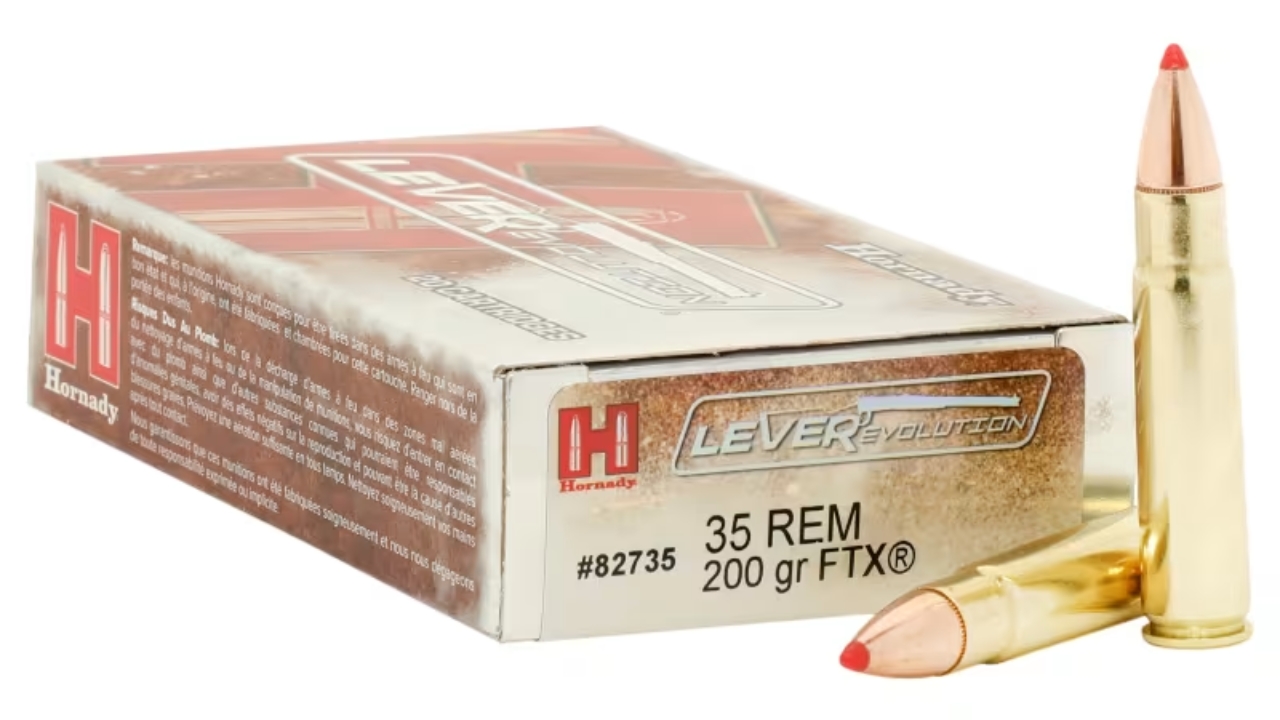
The .35 Remington hits harder than its numbers suggest at woods ranges. It’s a classic for deer and black bear, and it tends to put animals down with authority when you’re hunting thick cover and taking practical shots.
Where it struggles is reaching out. The common bullet weights and shapes are not built to stay flat at distance, and the cartridge doesn’t carry the velocity needed to keep drop under control. Once you get past moderate ranges, you need more holdover and the wind starts to matter more. It’s also not a caliber that offers a huge variety of high-BC hunting bullets, which limits how much you can “upgrade” it for distance. Use it where it was meant to be used and it shines. Ask it to be a long-range deer round and it becomes a handicap.
.38-55 Winchester

The .38-55 has a well-earned reputation as a close-range hunting round that hits with a heavy, authoritative push. In a lever gun, it’s pleasant to shoot, and it has taken a lot of deer cleanly when hunters keep shots within a realistic window.
Long distance is not that window. Velocity is modest, and the bullet designs most commonly used aren’t built for flat trajectory. Drop stacks up quickly, and wind can move the bullet more than you’d like once you’re shooting across open areas. The cartridge also tends to live in rifles with iron sights or traditional optics setups, which naturally steer you toward closer shots. That’s not a weakness—it’s part of the charm. Hunt it like a classic woods cartridge, and it delivers.
.45 Colt

Out of a revolver, .45 Colt can hit hard with the right loads, and out of a lever gun it becomes even more effective at close ranges. It’s a great short-range hunting option when you want a big bullet and you’re hunting in places where shots happen fast and close.
It’s not built for long distance. The standard bullet profiles are not aerodynamic, and velocity isn’t high enough to keep drop manageable as yardage climbs. You can get excellent performance in the woods, on hogs, and on deer at reasonable ranges, but the trajectory turns steep once you start reaching. Wind drift also becomes a factor faster than most people expect. Treat .45 Colt like a short-range hammer and it makes sense. Treat it like a distance round and you’ll be holding over a lot.
.454 Casull

.454 Casull hits hard, and it keeps that authority better than many people expect at moderate ranges. In a revolver it’s serious medicine, and in a carbine it can be extremely effective on tough game when shots are kept within the cartridge’s practical limits.
Those limits show up quickly once you start stretching distance. Even with the added velocity from a longer barrel, you’re still launching large-diameter bullets that aren’t shaped for long-range flight. Drop becomes a real problem, and wind drift grows because time of flight increases quickly. Recoil and blast also make it harder to shoot precisely at distance, which matters more than raw energy. If you keep it where you can place shots confidently, .454 Casull is very capable. Past that, it’s asking too much from the platform and the ballistics.
.480 Ruger

The .480 Ruger is built for heavy bullets and deep penetration at close ranges. It’s the kind of cartridge that makes sense when you’re hunting in thick cover, dealing with tough animals, or prioritizing straight-line performance over flat trajectory.
Distance is not its strength. Velocity is modest, and the bullets are big, so you get steep drop and more wind influence as range increases. That matters because the farther you push it, the more perfect your range estimate needs to be, and the harder it is to keep hits precise. This is a caliber that rewards you for staying inside realistic handgun ranges, or close-range carbine work if you’re set up that way. It hits hard where it’s meant to be used. It’s not built to stretch.
.500 S&W Magnum

.500 S&W Magnum is one of the hardest-hitting handgun cartridges you can carry, and it delivers a level of impact that few rounds can match at close range. In the right hands and with the right load, it can be effective on large game at practical distances.
Long range is still a problem. The bullet is large, and even though some loads are fast for a handgun, the trajectory becomes steep as distance increases. Wind drift shows up, and recoil makes precision harder the farther out you go. In a carbine, you gain velocity and control, but the cartridge still doesn’t turn into a flat shooter. It remains a close-to-moderate range powerhouse that demands discipline. If you treat it like a short-range tool that hits very hard, it makes sense. If you treat it like a long-range solution, it disappoints.
Like The Avid Outdoorsman’s content? Subscribe to our newsletter so you never miss an article.
Here’s more from us: