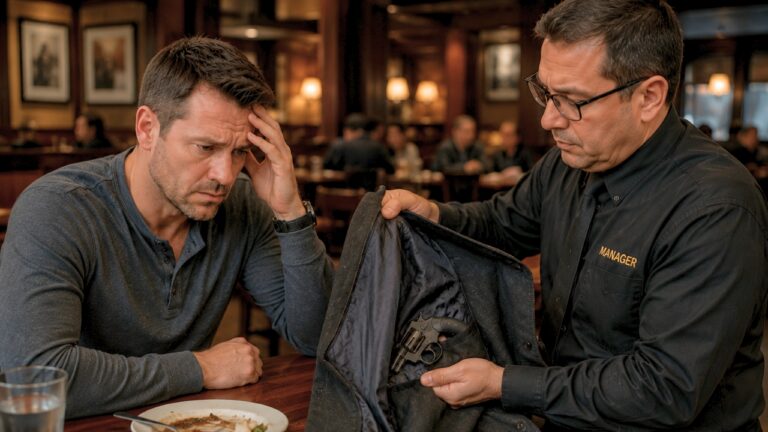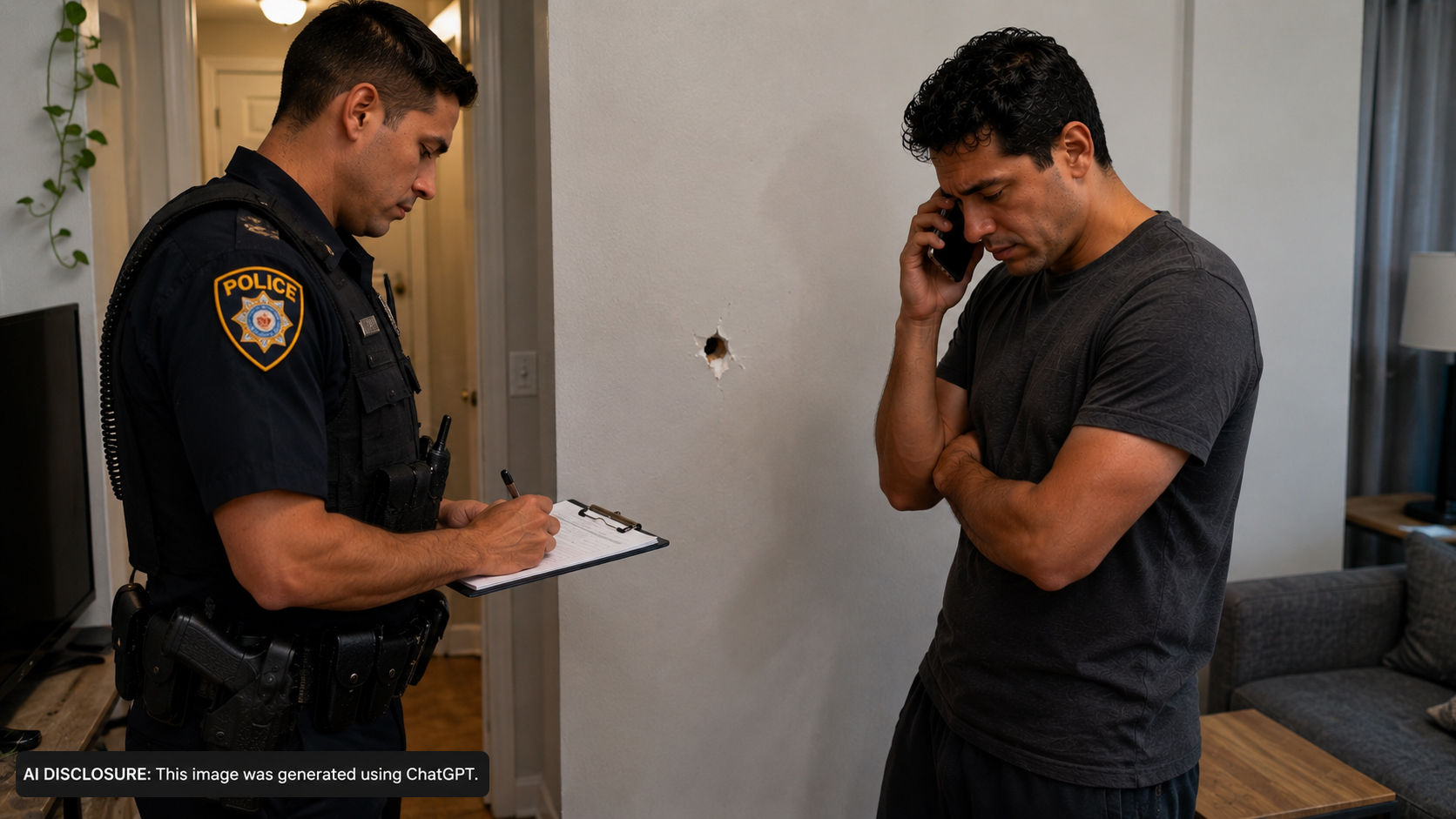
Photo credit: AI-generated image created using ChatGPT. Illustrative only
Just after midnight in a big California apartment complex, a renter and his significant other woke up to a single loud crack. No yelling. No follow-up noise. Just that heavy, unmistakable sound that makes your stomach drop when you realize it wasn’t a car door.
Minutes later their dog started barking at the bedroom window, and they spotted someone outside shining a light into windows. With no air conditioning and their blinds open, the couple didn’t feel like waiting to find out what was going on. The renter got dressed, stepped out, and confronted the person.
A “check for damage” turned into a worst-case explanation
The person outside didn’t try to run or make excuses. They told the renter a rifle had been accidentally discharged inside their apartment and they were walking around to see if anyone was hurt or if any property was damaged.
That’s when it got real. The neighbor showed the renter a hole where the bullet exited a window—one that faced directly toward the renter’s bedroom window about 15 feet away across a footpath. The renter wrote that, thankfully, nobody appeared to be injured.
The bullet’s path made the situation hard to shrug off
The renter looped in another neighbor—someone living directly above the unit where the shot went off. That upstairs neighbor went down to confront the people inside, and the tone shifted fast. The renter described the upstairs neighbor as furious, while the people in the apartment were apologetic and appeared sober.
They also told the renter it wasn’t even one of the regular residents who fired the rifle. A third person was visiting, allegedly picked up a rifle to “check it out,” and fired it. Inside the apartment, the renter said they could see the bullet holes tracking from the living room, through a bathroom, through a bedroom, and out the window.
Four loaded rifles on a wall changed the safety conversation
The renter said they were invited inside to see what happened. What stood out wasn’t just the negligent discharge—it was the storage. The renter wrote that there were four rifles mounted on the living room wall, all facing the same direction, and that direction lined up with the renter’s bedroom.
Even more concerning, the renter said the residents told them the rifles were kept loaded. In a complex with 200+ units and “close to a dozen children” in that immediate courtyard area, the renter wasn’t just thinking about his own window anymore. He was thinking about the next mistake—because mistakes have a way of repeating when the underlying habits don’t change.
Calling police felt obvious, but the follow-through didn’t
The renter did what most reasonable folks would do: he called the non-emergency line and let law enforcement handle it. An officer showed up, and the renter saw the officer go to the upstairs neighbors around 1:30 a.m. to check on them.
After that, the renter didn’t have much clarity. He planned to contact police later to get a copy of the report from the incident, but he wasn’t sure what “came of it.” In the version of events he shared, that report didn’t materialize quickly, leaving him stuck in the worst spot a responsible person can be: knowing something dangerous happened, and not knowing what the system is doing about it.
The full account is laid out in the original post, including the renter’s concerns about kids in the complex and the rifles being stored loaded on a wall mount.
What the renter actually wanted: safety, not a showdown
This wasn’t written like a revenge story. The renter came across grateful that nobody was hurt and pretty measured about the whole thing. But he also wasn’t willing to pretend this was normal.
He mentioned California Penal Code 246.3—negligent discharge—and wondered if the language fit what happened in an apartment. He’d also been told by friends and neighbors that the Second Amendment would prevent much from happening, and that confiscation was unlikely if the firearms were legally owned.
In plain outdoorsman terms: he wasn’t asking how to “win.” He was asking what lever exists to keep a neighbor’s bad gun-handling from putting a round through someone’s kid’s wall next time.
Common-sense lessons for gun owners living wall-to-wall
Any hunter or shooter who’s spent time around firearms knows accidents don’t come out of nowhere. They come out of bad routines—loaded guns sitting where hands will wander, muzzles pointed where nobody thinks about, and “it won’t happen to me” confidence.
Wall-mounted rifles can be fine when they’re treated like what they are: tools that require strict handling discipline. But combining “loaded” with “mounted in a living room” and “accessible to guests” is the kind of recipe that gets people killed. In an apartment complex, you don’t have a berm, you don’t have a safe backstop, and you don’t get to pretend drywall is protection.
If you own guns in tight quarters, the safe play is boring and consistent: store them so unauthorized hands can’t get to them, and make sure muzzle direction is never aimed into a neighbor’s unit—because in apartments, “downrange” might be someone’s bed.
For the renter, the practical path looked like documentation and pressure through the right channels: getting the police report, notifying property management, and keeping the focus on safety and policy compliance rather than getting pulled into a personal argument across a courtyard. When you’ve got kids playing outside and bedrooms lined up window-to-window, “we’re sorry” is a start, but it’s not a safety plan.
This is one of those incidents that should end with nothing more than a ruined window and a hard lesson learned. But that only happens when the people closest to the mistake change how they handle and store their firearms. In a place where walls are thin and families are close, the margin for error is exactly zero.
Like The Avid Outdoorsman’s content? Be sure to follow us.
Here’s more from us: