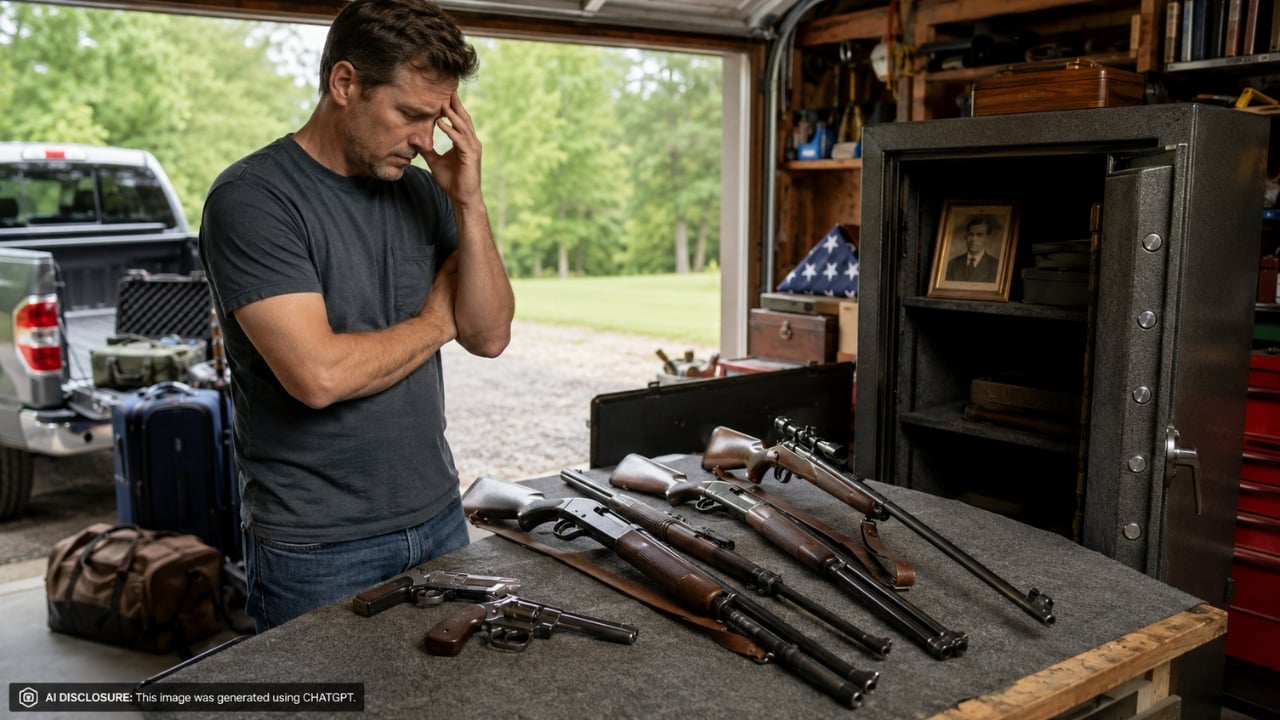
Photo credit: AI-generated image created using CHATGPT. Illustrative only.
Losing a parent is hard enough. Then you find out part of what they left behind—guns with family history—can’t just be tossed in a case and hauled home like a box of old fishing reels.
That’s exactly the corner one son found himself in after his father died in Arizona. In the discussion, he explained that his dad had several “family heirlooms” and the plan was for a cousin to get them to him in Texas, since his sisters and their spouses in California didn’t want to deal with registration headaches. The catch: when firearms cross state lines, federal law can turn a simple family errand into a legal mess fast.
When “just bring them home” isn’t an option
In the outdoors world, we’re used to solving problems with a pickup, a few ratchet straps, and some common sense. But moving guns from one state to another isn’t always that kind of problem—especially when you’re not the owner on paper and the guns are coming from an estate.
The son laid out what was involved: two shotguns (one pump and one bolt-action), a Ruger 10/22, a lever-action .30-30, a .22 semi-auto handgun, and an old break-action revolver he believed was in .32 and didn’t have a serial number. Those aren’t exotic firearms, but the interstate part changes the rules.
The collection: old store-brand shotguns to a classic 10/22
Two of the heirlooms were Sears and Roebuck-branded guns—exactly the kind of “grandpa gun cabinet” pieces many families have. Sears sold firearms under house names for years, and plenty of them are still solid, serviceable field guns if they’ve been cared for.
Add in a Ruger 10/22 and a lever-action .30-30, and you’re looking at a set of firearms that could have covered everything from squirrels to deer for generations. That’s why people fight to keep them in the family. It’s not about the money; it’s about the stories.
Federal law is what trips people up across state lines
Here’s the plain-English issue: federal law generally doesn’t allow a private person to transfer a firearm directly to a resident of another state. There are exceptions and nuances, but the safe, common route is that interstate transfers go through a Federal Firearms Licensee (FFL) in the recipient’s state.
That matters in this situation because the firearms are in Arizona and the intended recipient lives in Texas. Even if they’re inherited, and even if everyone involved is family acting in good faith, the interstate handoff can still be the part that puts someone on the wrong side of the rules if they do it casually.
Long guns versus handguns also changes the conversation. Handguns, in particular, are typically the category where “just ship it” or “just drive it” becomes a serious mistake if it doesn’t go through the proper channel.
The shipping question: “How difficult is it?” depends on doing it the clean way
The son’s main question was how hard it would be for his cousin to ship the guns to him in Texas. The practical answer, for most gun owners who’ve dealt with this, is that it’s not complicated when you accept one key point: involve an FFL on the receiving end (and sometimes on the sending end, depending on the carrier and the type of firearm).
Doing it clean usually means the cousin coordinates with a Texas gun shop/FFL that’s willing to receive the firearms, and then follows that shop’s preferred process. Some shops will accept firearms shipped from a private individual; others want them shipped from an FFL in the origin state. Either way, the “difficulty” often comes down to paperwork, carrier rules, and cost—not some impossible legal hurdle.
And cost matters here. Multiple firearms, mixed types, and an estate situation can mean transfer fees and shipping fees stack up fast. It’s still often cheaper than the alternative: risking a felony-level problem because someone tried to “keep it simple.”
The no-serial-number revolver is where you slow down and get careful
The detail that should make anyone pump the brakes is the old break-action revolver that “doesn’t even have a serial number.” Some older firearms were made before serial numbers were required, and certain antique firearms can be treated differently under federal law. But that doesn’t mean you want to guess.
There’s also a big difference between “manufactured without a serial number decades ago” and “serial number removed.” One can be lawful; the other is the kind of problem you do not want to inherit. The smart move is to have a reputable FFL or knowledgeable attorney (especially one familiar with firearms law) look at what it is and how it’s classified before it travels anywhere.
That same caution applies to the .22 semi-auto handgun. Handguns crossing state lines are the category most likely to require a strict, by-the-book transfer process. Treat it like a hunting trip where you double-check the license and the regs before you leave the driveway—because you can’t fix it after the fact.
Why the California angle changes family decisions—even when the destination is Texas
The son noted that his sisters and their partners live in California and didn’t want the hassle of registering the guns and dealing with that state’s rules. That’s not a knock on them; it’s a realistic response to a state with layered firearms regulations, reporting requirements, and feature-based restrictions.
Even though the firearms were headed to Texas, the family was still making decisions based on who was best positioned to handle the logistics. That’s a common estate reality: the “gun person” in the family ends up managing the firearm side of the inheritance, even if they weren’t expecting to.
It also highlights something outdoorsmen learn the hard way: state laws aren’t just different; they can be different enough to change who can reasonably take possession, what gets transferred first, and what gets sold instead of passed down.
At the end of the day, these heirlooms sound like the kind of guns that belong in a family safe, not in the back of a moving truck with fingers crossed. With interstate transfers, doing it the right way usually means slowing down, involving an FFL, documenting what’s being moved, and getting clarity on anything unusual—especially an old handgun with no serial number. The goal is simple: keep the memories, keep the guns legal, and keep the family out of trouble.
Like The Avid Outdoorsman’s content? Subscribe to our newsletter so you never miss an article.
Here’s more from us: